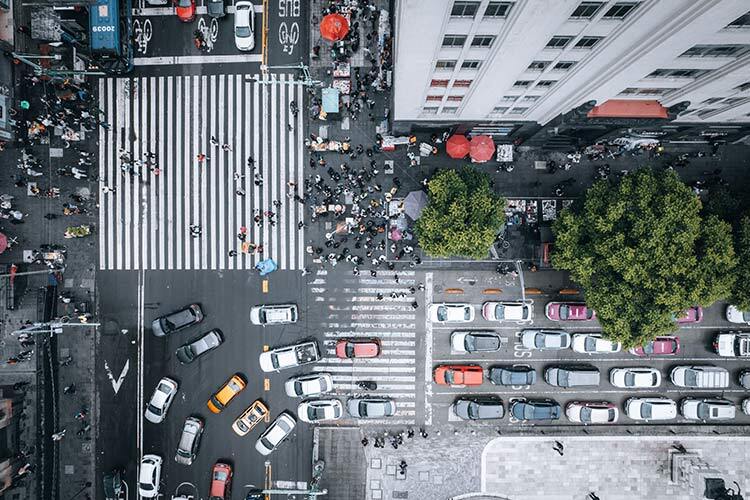


By 2050, the greatest urban growth will occur in low- and middle-income countries. These regions—the most vulnerable to climate change and global pandemics—still lack urban planning policies that protect the health of their populations.
This paradox was documented in a series of articles published in The Lancet Global Health in 2022. In them, researchers from various institutions analyzed 25 cities across 19 countries to identify which public policies foster healthier and more sustainable cities.

Researchers developed concrete metrics to measure how urban planning promotes healthy lifestyles. That effort was the start of the Global Observatory for Healthy and Sustainable Cities (GOHSC), which has just received the Nobel Sustainability Trust Award 2025. This recognition, created by members of the Nobel family, honors sustainable solutions with global impact.
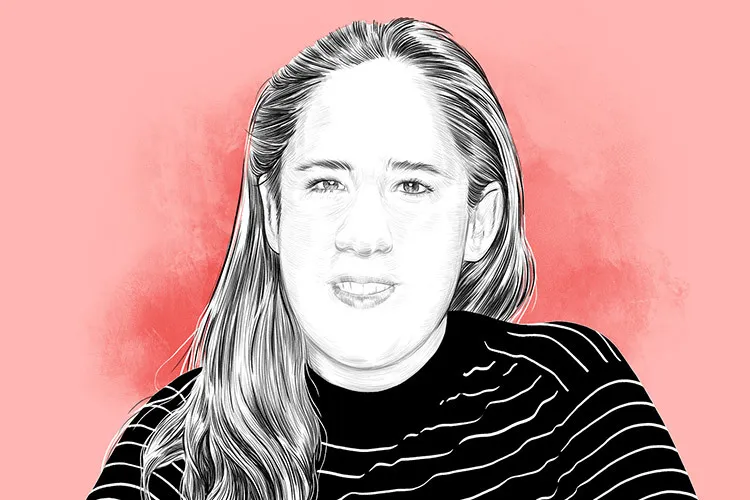
The award recognizes the effort of an international network of 319 researchers and professionals in 198 cities across 57 countries. Among them is Eugen Resendiz Bontrud, from the Center for the Future of Cities at Tec de Monterrey, a founding executive committee member and the observatory’s director of memberships. She is the only Latin American representative in the leadership group.
“I’m a very collaborative person,” says Resendiz. “I like seeing how this network, which has given me so much, can now also give a lot back to the center.”
From Science to Policy
Currently, the GOHSC leads the 1,000 Cities Challenge, an initiative that invites public officials and planning groups to evaluate their policies using a checklist of metrics.
This document allows for an in-depth analysis of policies on topics like transportation, air quality, employment distribution, and other factors that shape any urban environment. Each policy is evaluated at three levels:
- Whether it mentions characteristics of a healthy city.
- Whether it includes clear metrics.
- Whether those metrics are backed by scientific evidence.
Resendiz summarizes it with an example: a document may state that the city wants to increase the number of people who walk. But without concrete data—how much, in which neighborhoods, within what timeframe—there’s no way to gauge whether it can be achieved.
“If we don’t measure things, plans don’t get made,” she emphasizes, echoing the GOHSC’s motto.
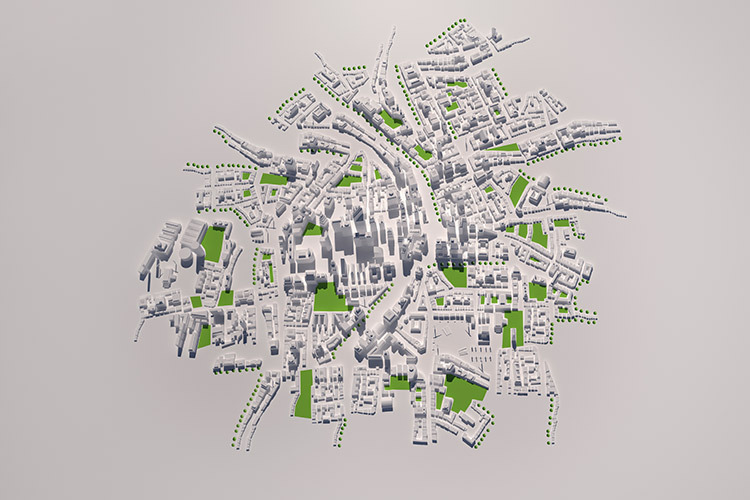
In addition to the checklist, the GOHSC shares indicators that measure physical features of the urban environment: walkability, distance to parks and green spaces, access to food stores or public transportation, and vulnerability to urban heat. All these factors have documented impacts on physical and mental health.
The use of standardized methodologies and open data such as OpenStreetMap allows for global city comparisons, something that was previously difficult due to differences in data collection.
Latin American Megacities: A Major Challenge
Latin America has six of the world’s 33 megacities, making it a crucial region for the GOHSC, but they are among the least studied in terms of urban health. The reason, Resendiz explains, is because the governments of these urban centers can be especially complicated: “Generally it’s more than one government, more than one city, more than one actor, and that represents a challenge when you do research,” she says.
With GOHSC tools, any territory can be analyzed: a complete metropolis, a municipality, or even a specific neighborhood. Results from participating cities are published on the observatory’s website to enable comparisons between regions.
Mexico illustrates a unique pattern in urban planning and policy adoption. “We’re at the forefront of many urban interventions, but they haven’t reached policy,” she comments.
In cities like Mexico City, innovative programs—such as bus rapid transit, Sunday bike lanes, or bike-sharing—are often implemented first and formalized later. This reverse order makes it difficult to replicate good practices in other spaces.
Open Data to Drive Decisions
In Mexico, ten cities are currently being analyzed, and several municipalities are already using the metrics for concrete actions, such as new parks and green spaces.
The GOHSC has also been integrated into the work of Tec’s Center for the Future of Cities. Some researchers are currently participating in groups dedicated to urban cycling indicators, heat vulnerability, and the development of a web platform that will make the observatory’s tools more accessible.
For Resendiz, open science and interdisciplinary collaboration are key to its impact.
“The award is a reflection of the reach the observatory has had, the interest it has generated over time, and the impacts we’re starting to see,” she notes.
As director of memberships, she not only coordinates the existing network; she also connects decision-makers with teams capable of conducting analyses in their region. This coordination facilitates academia, science, and civil society entering the spaces where urban policies are designed.
“As long as collaboration continues between academia, science, civil society organizations, and citizens, we can begin to build better cities.”
Did you find this story interesting? Would you like to publish it? Contact our content editor to learn more at marianaleonm@tec.mx