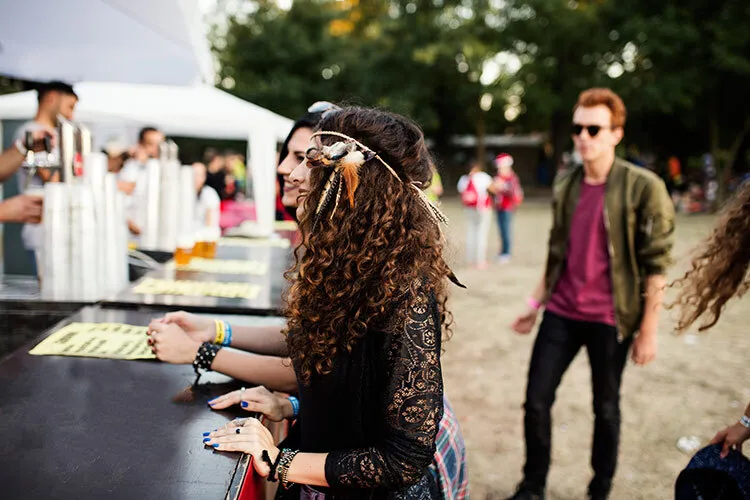


Hundreds of thousands of people attend major music festivals held in Mexico each year, such as Vive Latino (with around 150,000 attendees), Corona Capital (more than 230,000), and Tecate Pa’l Norte (about 300,000). Beyond the spectacle, these events involve a range of financial decisions for attendees, from tickets that can exceed $600 USD (10,000 pesos) to spending on food and drinks over several days.
To better understand how these decisions are made, researchers at Tecnológico de Monterrey have conducted studies on the financial behaviors of people who attend these events.
One such study is the Financial Culture Report: Financial and Consumption Habits in Entertainment at the Pa’l Norte Festival, carried out by Francisco Javier Orozco and Christian Reich, research professors at the FAIR Center for Financial Access, Inclusion, and Research within the School of Business.
“Understanding people’s financial and consumption habits opens the door to providing them with financial tools before, during, and after these events,” says Orozco, who leads the Monterrey Region of the FAIR Center.

Music Festivals in Mexico: How Much Do We Spend?
According to the researcher, previous studies conducted by the team, particularly the Financial Culture Report on Students at Tecnológico de Monterrey, show that leisure, music, and live events like these major festivals rank among the top categories of personal spending within lifestyle and consumption. Moreover, these events draw massive crowds for up to three days, feature internationally renowned artists, and generate economic spillovers that, according to expert estimates, can exceed $60 million USD (1 billion pesos).
With this in mind, the team carried out a study during the 2024 edition of the festival held in Monterrey, Nuevo León, aiming to understand how attendees plan, finance, and manage their money in a large-scale leisure and entertainment setting. To gather data on financial behavior, the team designed a survey that was administered to 167 festivalgoers during and after the event.
Orozco explains that, based on the information collected, the analysis focused primarily on two dimensions: financial habits, how much people spend, how they finance their attendance, and the extent to which they plan their budgets, and consumption habits, examining what they spend on within the festival, the main spending categories, the factors that influence their decisions, as well as the most commonly used payment methods.
According to the study’s findings, the profile of attendees falls within a young adult age range of 18 to 34, with more than 80% of the audience in this group. In addition, 54.5% of respondents identified as working professionals and 35.9% as students, indicating that these events attract both individuals already in the workforce and young people still in training.
Among the findings on financial habits, the study reveals that most attendees did not rely on credit to pay for their experience, instead covering costs with personal savings.
The analysis found that 67.7% of participants used previously saved money, while only 10.2% used credit cards, and a smaller proportion borrowed from family or friends.
“We wanted to understand these stigmas or labels that have been placed on younger generations, such as the idea that everything is financed with credit. But what we found is that the event is funded—primarily—through savings,” Orozco explains.
We Plan How Much to Spend
He adds that this finding suggests that, rather than being an impulsive expense, attending a festival involves prior financial planning. This aligns with another result from the study, which shows that 69.5% of attendees had previously gone to the festival, indicating that it may be a recurring experience that becomes part of an annual entertainment budget.
As part of planning for the experience, the study indicates that approximately 33.5% of attendees follow a budget for their spending; however, 32.9% make decisions on impulse. Other factors also come into play, such as group influence when people attend with friends or family.
“Going to the event with others has a positive impact on spending. There is a clear correlation: those who attend with someone tend to spend more,” Orozco notes.
“Within behavioral finance, there are cognitive biases, and at these events, three in particular shape spending: present bias, seeking immediate gratification without thinking about the future; the herd effect, ‘everyone else is doing it, so I will too’; and confirmation bias, meaning having information that validates or reinforces my decision to spend. If the people you attend the event with encourage you, you’re likely to go along with it.”
As for payment methods, the study found that 71.9% of attendees reported using cash for their purchases, 19.8% paid with debit cards, and 8.4% used credit. The results suggest that, despite advances in digital payment infrastructure at these events, cash remains the preferred method of payment.
This can also be linked to attendees’ budgeting strategies. For instance, 59.3% said they planned to spend less than $60 USD (1,000 pesos) per day, while 67% reported actual spending within that range. The remaining attendees fell into higher spending brackets, primarily between $60 (1,000 pesos) and $180 USD (3,000 pesos) per day.
The analysis of consumption habits shows that the main expense within the festival is beverages, with 83.8% of attendees reporting spending in this category. Food follows at 58.7%, and alcoholic beverages at 55.7%. Other reported expenses include transportation, at 32.9%, and the purchase of official event merchandise, at 16.8% of respondents.
“What’s interesting is that the number one expense is beverages, but not alcoholic ones. That says a lot about how consumption habits have been changing among younger generations,” the finance expert notes.
Orozco adds that the results of this study may align with patterns seen at other festivals and events, not only concerts or music-related spaces, but also a wide range of live entertainment formats within the creative industries. This includes aspects such as planning to attend, methods of financing, and consumption behaviors in these types of experiences.
They may also help financial institutions and event organizers better understand people’s spending habits, allowing them to develop financial tools that translate financial education into actual behaviors and promote sound practices among consumers.
He emphasizes that studies like this make it possible to design financial planning strategies with concrete actions to improve money management in these contexts. For example, planning, since the shorter the time window, the higher costs can climb; setting a clear budget that accounts for all expenses, not just the ticket; and using digital tools to improve both financial management and security. It also involves recognizing factors such as impulse and social influence when making decisions, in order to encourage balanced, mindful, and informed consumption.
“Attending these events is, I think, an emotional investment, but conceptually speaking, it is definitely an expense,” Orozco concludes.
Did you find this story interesting? Would you like to publish it? Contact our content editor for more information: marianaleonm@tec.mx