

To optimize a supply chain, artificial intelligence (AI) recommendations might allow a company’s transportation department to choose a cheaper route to reduce costs. However, if this route is less reliable, the inventory department would have to stockpile more products to prevent shortages. Each department is fulfilling its responsibilities, but the overall result remains inefficient.
Although technological advances and mathematical optimization allow for the automation of complex decisions, the biggest obstacles to implementing these changes are related to decisions, organizational processes, and data management, rather than algorithms.
Traditionally, companies tend to optimize their inventory, transportation, demand, and production systems separately. But while each may function correctly, the decisions they make don’t necessarily benefit the entire organization.
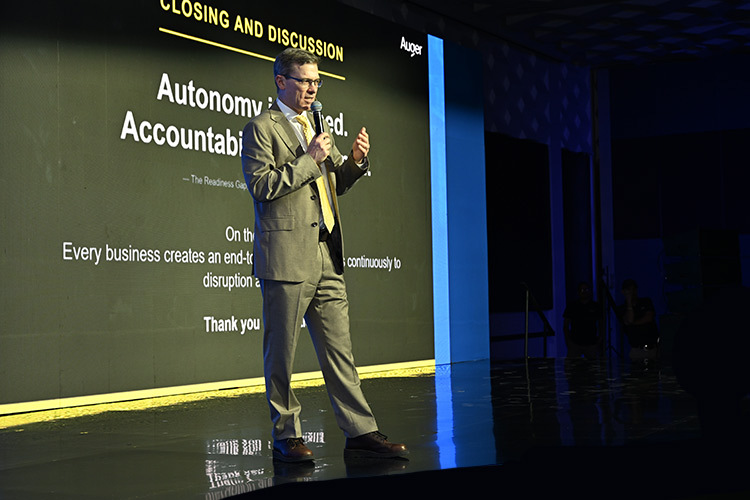
“Most of what stands between a good model and a working system right now si not the model itself,” said Russell Allgor, Chief Supply Chain Scientist at Augur and a member of the National Academy of Engineering (NAE), during the event organized by Tec de Monterrey and NAE.
During his lecture From Fragile to Resilient Automation, Allgor explained that the biggest challenges to automating a company’s operations are not necessarily in the technology, but in how people organize themselves to work.

The Four Obstacles to Automation
Based on research from the Global Supply Chain Institute, Allgor —who worked for more than 24 years developing decision-making systems at Amazon— identified four main challenges that prevent leveraging AI.
- The first is the decision rights. When a decision involves several departments, often no one has the authority to make or modify it.
- The second is decision context that lives outside the systems. Much of the knowledge needed to run a business remains in emails, spreadsheets, or in the experience of employees, beyond the reach of automated systems.
- The third is the search for perfect data. Companies can spend too much time trying to correct all their information, when what’s important is determining whether the available data is sufficient to make good decisions.
- The fourth is authority and writeback. A system may find the best solution, but if it lacks the authority to apply it, its usefulness is limited.
“Once the model is good enough, autonomy grows as the buisness chooses to delagete to it,” Allgor said.
From Better Algorithms to Better decisions
To demonstrate this, the expert presented the case of Fanatics, a sporting goods company where workers manually intervened in 59% of the orders.
Although they developed a more efficient algorithm, the real breakthrough came when the company defined responsibilities, incorporated the knowledge of its workers, and allowed the system to modify certain dates and quantities.
Currently, Fanatics optimizes around one million orders every night, and more than 90% of assignments are made without human intervention.
This example demonstrates that developing more sophisticated technologies does not guarantee better results. Organizations need to establish clear responsibilities, share information, and define which decisions they can delegate to machines in order to truly benefit from them.
This does not mean eliminating human participation, but rather shifting it towards decisions that require greater judgment and supervision.
Thus, the future of automation depends not only on creating smarter systems, but on building organizations that are capable of working with them.
“Autonomy is earned and accountability is assigned,” Allgor said.
Did you find this story interesting? Would you like to publish it? Contact our content editor to learn more: marianaleonm@tec.mx