

Every day, thousands of drivers spend hours stuck in city traffic. For freight transportation companies, traffic congestion translates into millions of dollars in losses due to higher fuel consumption, wasted time, and delivery delays.
In the United States, for example, traffic congestion cost the freight transportation industry more than $100 billion in 2022, according to Leandro Coelho, a researcher specializing in transportation and supply chains at FSA Université Laval in Canada.
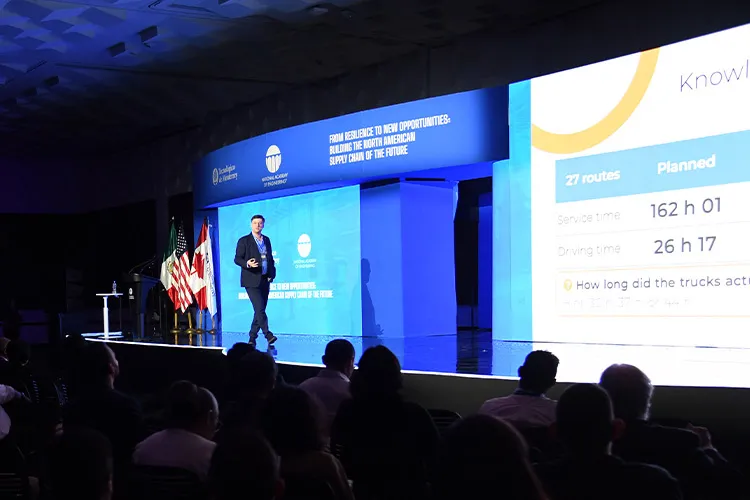
“It’s not just about costs. Companies are losing efficiency. They are losing time. They have to keep higher inventories because things do not arrive as soon as they should,” he said during a National Academy of Engineering (NAE) event at Tecnológico de Monterrey.
During his keynote presentation, From Models to Measurable Impact: Engineering Sustainable and Resilient Freight Systems, Coelho highlighted success stories in which research and collaboration between universities and businesses helped reduce losses through mathematical modeling and optimization tools.
Reducing Transportation Times Without Changing Routes
During his presentation, Coelho demonstrated that companies can reduce freight transportation times by making better use of the data they already collect, without having to change their routes, build new roads, or make major infrastructure investments.
In one case involving a company that distributes household products in Quebec, Canada, the research team analyzed data from the company’s planning systems and compared it with GPS records from its trucks.
On a day involving 27 delivery routes, the company’s software estimated that its vehicles would spend a combined 26 hours on the road. However, GPS data revealed that the actual driving time exceeded 44 hours. The researchers found that the discrepancy stemmed from the system’s failure to account for traffic fluctuations throughout the day.
What’s more, most trucks left the distribution center in the morning, around 7:30 a.m., when traffic congestion was particularly heavy. Armed with this information, the researchers examined how adjusting departure times could shorten travel times without changing routes or compromising delivery commitments to customers.
“What we observed is that it was optimal to perform those routes about two hours later than what they were usually doing. By doing that, the total driving time of the trucks would decrease by 10 hours just by changing the departure time, not optimizing anything else about the routes,” Coelho explained.
The researcher emphasized that this adjustment could reduce driving time by approximately 22%. According to the company’s estimates, the reduction would also translate into fuel savings of roughly 15,000 liters (nearly 4,000 gallons) per year.
Sharing Transportation to Cut Costs and Emissions
The expert also demonstrated how collaboration between companies from different industries operating within the same industrial park can improve logistics operations, lowering transportation costs while also reducing their environmental impact.
In this case, the researchers worked with companies located in the same industrial park in Canada. Each business managed its own logistics and relied on its own transportation provider, operating independently of the others.
This arrangement created several problems, including unnecessary truck traffic throughout the industrial park on multiple days, higher transportation costs from shipping small loads that failed to make full use of vehicle capacity, and increased emissions.
The research team analyzed transportation data and presented a collaborative proposal to company representatives. The idea was to coordinate shipments by consolidating goods at a shared collection point and scheduling pickups on the same days.
“We sat together, we got some data, we put these people around the table, and we asked: Look, you don’t compete, but perhaps you can cooperate,” he explained. “We ran a pilot, and things really worked. These companies started to collaborate, saving money and helping the environment at the same time.”es started working together, saving money and helping the environment at the same time.”
Coelho highlighted that the project enabled companies to cut transportation costs by approximately 50% and reduce greenhouse gas emissions within the industrial park by as much as 80%. “Sometimes cost and the environment are not opposite objectives, but they go hand in hand,” he said.
From Research to Real-World Transportation Solutions
The researcher also highlighted a project that combined simulation tools and mathematical models with real-world implementation, optimizing traffic signal operations to reduce the number of times freight trucks had to stop.
The researchers used traffic data to develop an intelligent system that automatically adjusted traffic light timing.
“We changed the traffic lights of a city so that they were autonomously controlled, changing the timing of the lights, and we were saving more than 30% of the stops of delayed buses and heavy vehicles,” he explained. “This system is operational to this day. There are thousands of trucks benefiting from it. All of the buses in the city are benefiting from it.”
As his presentation drew to a close, Coelho emphasized that projects like these demonstrate the importance of collaboration between universities and businesses in identifying challenges and developing solutions for supply chains.
“We have the know-how, and we know how to apply that in practice. With a little bit of goodwill from both sides, we can have a real impact,” he said.
Did this story interest you? Would you like to publish it? Contact our content editor to learn more: marianaleonm@tec.mx