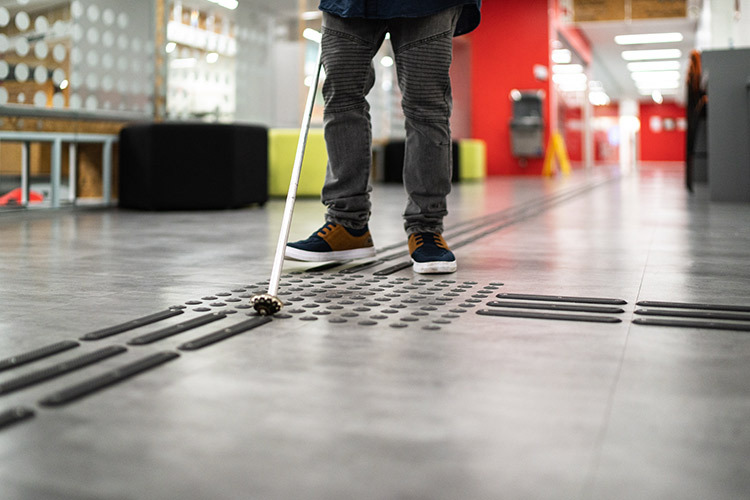


Worldwide, less than 10% of people with disabilities gain access to higher education, and an even smaller proportion are able to complete their studies. In Mexico, in fields such as health sciences, the representation of students with visual impairments is almost nonexistent.
“Here in Mexico we have no idea how much a person with a visual disability can do because the system holds them back from a young age,” says Cristina Gehibie Reynaga, research professor at the School of Humanities and Education (EHE) at Tec de Monterrey.
Faced with this scenario, Reynaga, in collaboration with research professors from different disciplines and schools at Tec, as well as with students of different grades, has developed a project that proposes a profound transformation of the college classroom through universal design of learning, with the aim of making scientific education truly accessible and inclusive.
The project seeks to facilitate the entry and retention of students with visual disabilities in medical science careers, combining didactic and pedagogical strategies with the development of accessible physical materials, designed to teach complex scientific concepts in a multisensory way.
In disciplines where learning depends heavily on images, diagrams, and visual models, this proposal rethinks the way in which knowledge is constructed.
The materials developed are interactive and multisensory: through touch, textures, reliefs, shapes, and height, the objects communicate key information.
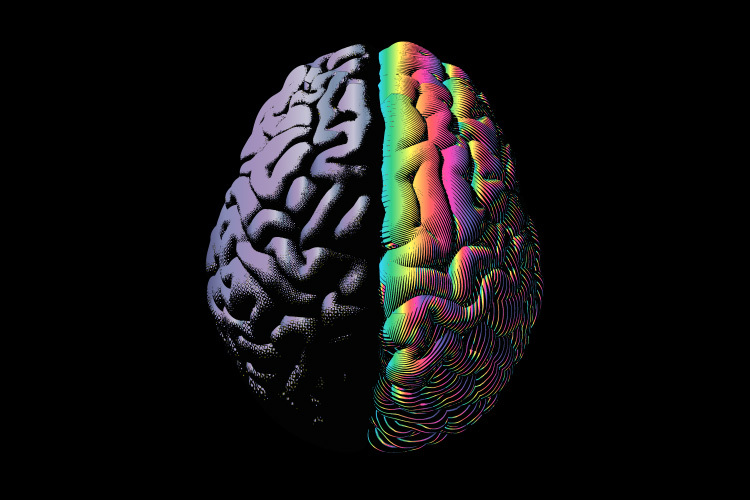
“On one occasion, my students proposed creating educational material about the internal organs of the human body, so that children could touch what the heart and brain are like,” she says.
Furthermore, when integrated with electronic devices, these resources can offer auditory feedback, expanding the possibilities for understanding. Thus, concepts cease to be exclusively visual and become accessible experiences for more students.
Teaching Science and Medicine in a Truly Inclusive Way
In addition to access to information, the project has the objective of preventing students from feeling intimidated by subjects traditionally perceived as difficult or inaccessible.
In this sense, inclusion not only eliminates physical barriers, but also emotional and cognitive ones that influence academic progress.
“Right now we have materials permanently available on the Mexico City Campus, in collaboration with colleagues from the School of Medicine,” says Reynaga.
One of the most relevant elements of the project is its interdisciplinary nature. The initiative brings together professors and students from education, design, engineering, and health sciences, reflecting a global trend in research: collaboration between disciplines to solve complex problems.
Today, the project has evolved into a community service initiative, where new students join each semester and create inclusive materials continuously. The prototypes are tested and improved, incorporating feedback from the visually impaired students who use them.
“I get goosebumps because I still remember the happy faces of the first visually impaired children I worked with when they were doing an experiment,” Reynaga recalls.
For the researcher, who has specialized for twenty years in science education in vulnerable populations, including students with visual disabilities, it is also key to train teachers who seek to be inclusive in their classrooms.
When faced with the reality of what it is like to learn with a visual impairment, teachers develop empathy, critical thinking, and innovation skills.
Universal Design for Learning
At a social level, the project helps to break down deeply rooted stigmas, such as the idea that people with visual disabilities cannot study careers related to medical sciences.
By demonstrating that learning is possible when the environment is inclusive, the initiative expands educational and professional opportunities for a historically excluded population.
Beyond its immediate results, the project aims for a structural change: to generate greater awareness about the need to create inclusive classrooms.
To the extent that institutions have more accessible educational resources, the learning experience improves for all students.
“That’s the concept of universal design for learning; you design for populations that have more difficulty accessing information, but what you create is useful for everyone,” Reynaga emphasizes.
Did you find this story interesting? Would you like to publish it? Contact our content editor to learn more: marianaleonm@tec.mx