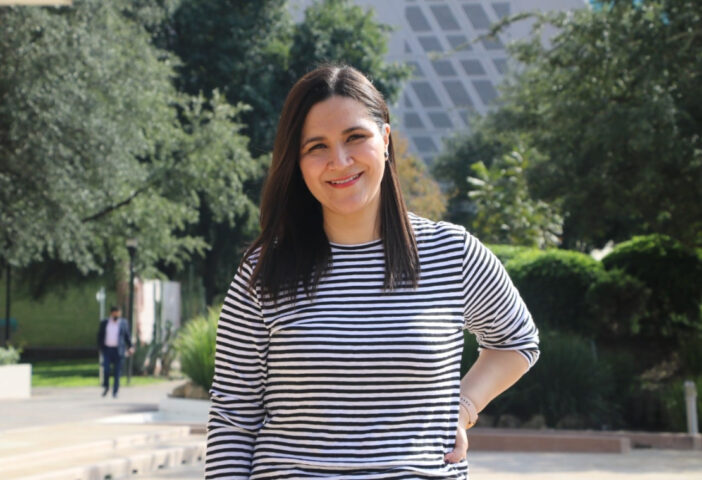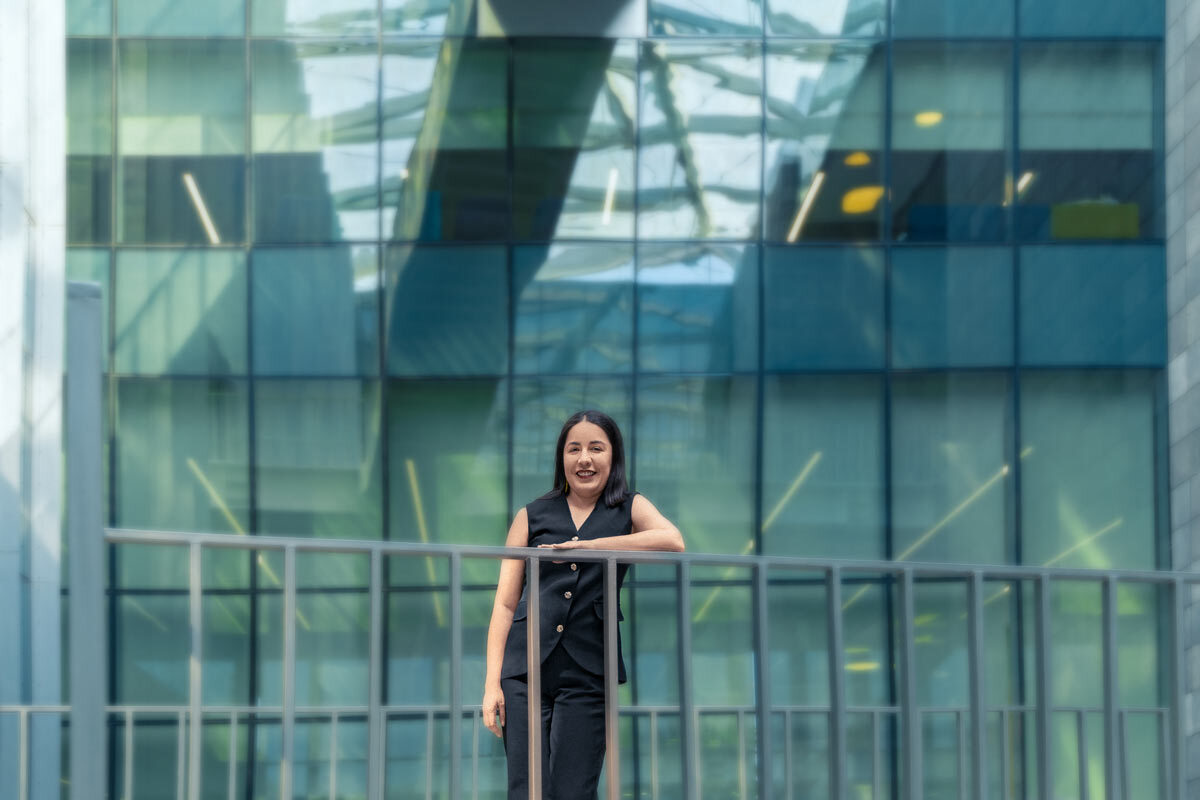


Using materials smaller than a virus to improve women’s health through innovative therapies was the focus of Ana María Pinilla‘s research for years. Now, she seeks to train the next generation of female scientists and engineers, using the scientific method as her guide.
For her career as a researcher specializing in nanomedicine, the researcher has received the Mujer Tec Award 2026 in the science category.
“For me, it’s confirmation that all of this has been worth it,” says Pinilla, a Student Mentor and Leader of the Research and Innovation Ecosystem (EIIME) within the Department of Mentorship Model Management at Tec de Monterrey.
Pinilla is originally from Colombia and arrived in Mexico in 2018 to pursue a doctorate in materials science at the Center for Research in Advanced Materials (Cimav) in Monterrey.
There, she developed a project to create nanosystems for gene therapy against breast cancer. “These systems are selective and allow for therapies that are much more targeted than chemotherapy or radiotherapy,” the expert explains.
Nanomedicine is the application of nanotechnology to develop treatments, diagnostics, therapies, and preventative tools that improve people’s health.
The scale at which it operates allows intervention in biological processes at the molecular and cellular level. One of its most promising applications is the targeted delivery of drugs and therapies.
“I was interested in nanomedicine because other therapies are extremely invasive,” says Pinilla.
Nanomedicine to Treat Breast and Cervical Cancer
One of Pinilla’s main research interests was designing materials that could interact safely with biological systems, such as the human body.
In one of their studies, Pinilla and her team developed a sustainable method for synthesizing gold nanoparticles using mesquite gum to regulate and stabilize the reactions.
The result was particles with a size between three and 30 nanometers with low cellular toxicity, a key characteristic for them to be applied to medicine.
Metallic nanoparticles like these have sparked great interest in biomedical research due to their potential; however, many production methods generate particles that can be harmful to cells.
The use of natural biopolymers, such as mesquite gum, offers a safer and more sustainable alternative for stabilizing these nanomaterials.
“During my master’s degree, I worked on how to synthesize nanoparticles for cervical cancer therapies,” Pinilla recalls. “I wanted to become an expert in that field.”
The researcher earned her bachelor’s and a master’s degree in chemistry from the Industrial University of Santander, Colombia. Once in Mexico, she continued her line of research, now focused on breast cancer.
In 2023, her life took an unexpected turn that led her to dedicate herself to mentoring, where she combines her scientific knowledge with her passion for guiding other women to become scientists.
Guide New Female Scientists and Engineers Without Imposter Syndrome
Beyond the laboratory, Pinilla has focused on training women in STEM fields. As a mentor, her work involves guiding students through the process of developing scientific thinking, from formulating questions or hypotheses to interpreting experimental results.
“I consider my transition quite disruptive,” says the researcher. “Scientists tend to focus a lot on solving problems, but in my case, I currently focus more on a humanistic approach.”
For her, the scientific path is wonderful, so she feels that her mission is to teach more women how interesting it is to be a scientist.
“It’s not an easy path, but there’s something for everyone, whether you’re drawn to nature, the human body, materials, aviation… there are many approaches,” Pinilla invites.
In the Research and Innovation Ecosystem, mentoring is structured around four axes: reflection, research, dissemination, and innovation.
In their vision, everything begins with reflection, with those attending a mentoring session deciphering their purpose in life and the problem they want to solve.
Her aim is to inspire future generations not to be afraid to pursue research. In this sense, her work contributes to two dimensions of science: the generation of knowledge and the formation of a scientific community.
“As women, we often experience imposter syndrome,” says Pinilla. “When we’ve established ourselves for a while, we start thinking, ‘I don’t know if this is luck or if I deserve it.’”
Through her mentoring and research in educational innovation, she hopes that future generations will no longer doubt their abilities and will know that they can achieve anything they want, especially if that means becoming a scientist.
Did you find this story interesting? Would you like to publish it? Contact our content editor for more information: marianaleonm@tec.mx