

Vaccines are important components of healthcare systems because they train our immune system to recognize and fight pathogens. However, a gap exists between scientific innovation and equitable access, meaning they don’t always reach those who need them most.
Developing an effective vaccine is a huge challenge, but what comes next is also difficult: producing it on a large scale, getting it approved, and then distributing it.
Millions of people do not have access to them due to manufacturing costs, geopolitical decisions, limited health infrastructure in low-income countries, and global inequalities.
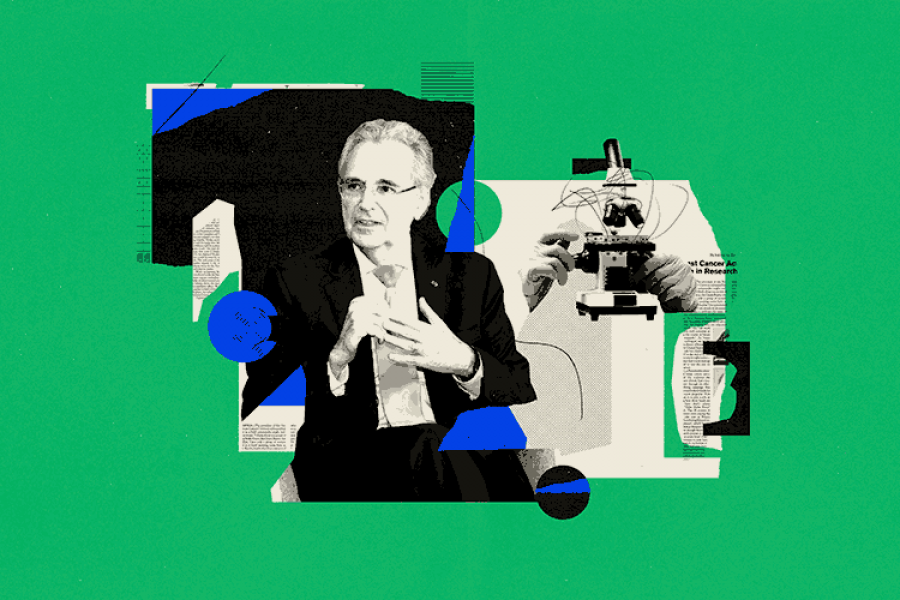
A group of scientists, led by Maria Elena Bottazzi, co-director of the Texas Children’s Hospital Center for Vaccine Development, has the mission of creating vaccines for everyone.
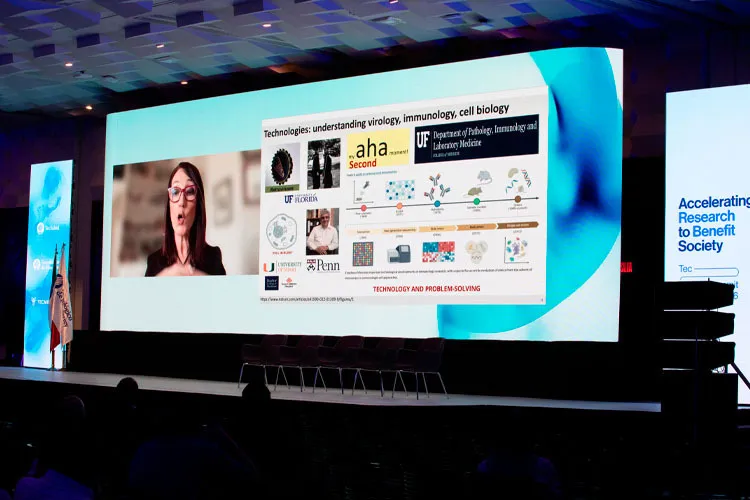
In her keynote lecture, Vaccines for All: Research and Development in the Service of Humanity, which took place during the Tec Science Summit 2026, the researcher issued an unusual invitation for a vaccine conference: to think about the “aha” moments.
Those moments—when one idea connects with another and changes the way we understand a problem—, she explained, are the true engine of scientific innovation.
According to her, finding the intersection between science and business is an effective way to make biomedical innovations truly serve communities.
“When I was a student, we weren’t taught anything about that intersection,” Bottazzi said. “All my classes were purely scientific.”
How to Combine Science and Business?
Her first “aha” moment happened while she was studying microbiology and clinical chemistry at the National Autonomous University of Honduras, when She was trying to develop less invasive diagnostic methods to detect cysticercosis.
There she understood the relationship between microbiology and technology, which led her to leave Honduras for the United States to pursue her master’s, doctorate, and postdoctoral studies, increasingly specializing in vaccine development.
“I also did a master’s degree in business because I had a huge curiosity about how I could really advance these technologies with my scientific brain,” Bottazzi recalled.
As time went on, it became clear to her that she wanted to dedicate her life to developing vaccines that are accessible to everyone, with a particular emphasis on neglected tropical diseases.
This is a group of diseases, such as Chagas, leprosy and dengue, that affect more than a billion people living in poor communities, without access to clean water or sanitation, causing disability, stigmatization and perpetuating cycles of poverty.
“In 2000, I realized I wanted to return to my roots, to that Hispanic, Honduran cultural intelligence,” the expert said. “With an aspiration to develop technologies that could solve global problems.”
From the Lab to the Real World
One of the central messages of the conference was that vaccine development should be considered from beginning to end, which is called an end-to-end strategy.
This means designing the research by considering from the outset questions that rarely appear in experiments: Who will produce the vaccine? Will it be affordable? Are public health systems going to be able to adopt it? Can it actually reach vulnerable populations?
According to the researcher, the historical failure of many biomedical technologies is not due to scientific failures, but to the fact that these social and economic factors are ignored.
Her work at the Center for Vaccine Development has attempted to break that paradigm through open science, international collaborations, and non-exclusive licensing models that facilitate production in low and middle-income countries.
Translating the health burden of neglected tropical diseases into their economic impact has been key to convincing governments and manufacturers to invest in and distribute solutions.
“Large, developed countries also have many pockets of poverty, we see it here in the United States,” Bottazzi emphasized.
For her, one of the keys to her success has been understanding how regulation works and how to talk to governments and the public and private sectors to motivate them to market and distribute biomedical products with an equitable approach.
Covid-19 and Combination Vaccines
One of the examples she gave during her lecture was the development of Covid-19 vaccines based on decades of previous research on other coronaviruses, such as SARS and MERS.
When the pandemic began, her team already had international networks, technology transfer agreements, and regulatory expertise. This allowed them to develop and transfer vaccines to manufacturers in developing countries in less than two years, demonstrating that a collaborative and open model can compete with traditional schemes dominated by large pharmaceutical companies.
“We did it knowing that we wanted to do non-exclusive licensing, not have patents, give open access, and that’s how we achieved it, not just with one, but with two of these vaccine producers,” he said.
Another of her projects was the development of a vaccine for hookworm, a disease caused by a parasite that causes severe anemia in millions of people living in tropical and subtropical areas of Africa, Asia and Latin America.
The team devised an innovative strategy: blocking the parasite’s ability to digest blood within the human gut. Early clinical trials showed safety and induction of an immune response, and controlled studies suggested complete protection in an experimental group.
The next step was to assess whether the vaccine would have a greater impact when combined with one against malaria, since both diseases occur in the same regions and cause anemia.
“Agencies, like WHO, have said that perhaps what is needed is not more vaccines, but combinations,” Bottazzi explained.
Science With a Human Purpose
For Bottazzi, the future of biomedical development depends on three transformations: training scientists with regulatory knowledge, integrating social and economic perspectives into research, and building interdisciplinary teams capable of collaborating beyond academic boundaries.
The goal should always be to develop vaccines that are low-cost, high-quality, and universally accessible.
“Our north star must be global access, they cannot be just for a small group,” she exclaimed.
According to her, science advances when it connects disciplines, cultures, and people with a common goal: that vaccines—and scientific knowledge in general—are not privileges, but global public goods.
“Think about those ‘aha’ moments, because in the end that’s what fuels our curiosity, sustains our courage and our passion,” she concluded.
Did you find this story interesting? Would you like to publish it? Contact our content editor to learn more: marianaleonm@tec.mx