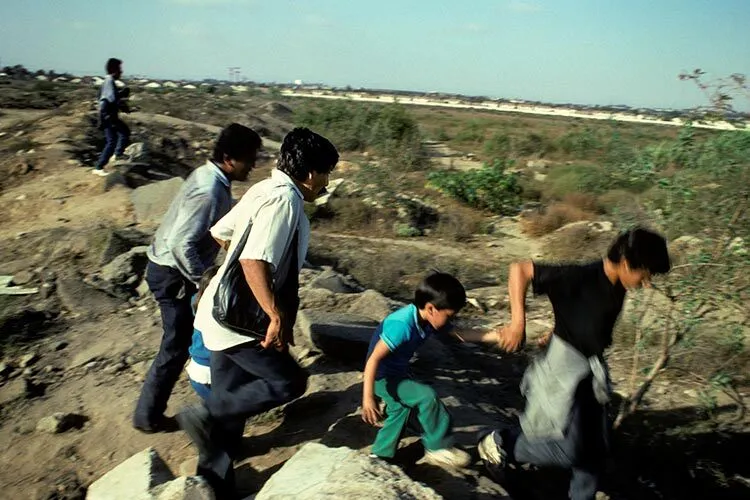


Every year, thousands of Mexicans who migrate to the United States return home with hopes of reintegrating into society, rebuilding their lives, and starting fresh. Yet they often face barriers to social and economic reintegration, from missing documents to skills that do not match the labour market.
This phenomenon was studied by José Jorge Mora, a migration expert and professor at the School of Social Sciences and Government at Tecnológico de Monterrey, Mexico City campus, together with Arturo Larios, as part of his master’s thesis at the National Polytechnic Institute (IPN).
Their research was conducted in the municipality of Mariscala de Juárez, Oaxaca, a rural municipality of around 4,000 inhabitants. In this place it is estimated that more than 25% of the population has migrated to the United States.
Returning Migrants
According to data from Mexico’s National Institute of Statistics and Geography (INEGI), more than one million people migrated from Mexico to the United States between 2018 and 2023. Additionally, around 150,000 migrants return to the country each year.
The researchers focused their work on analyzing how and why some returning migrants manage to successfully reintegrate into the economic and social life of their communities, while others face obstacles that lead them to consider migrating again.
To better understand these differences, the team combined qualitative and quantitative methods. “We wanted to understand what their experience in the United States was like, what the journey back had been, and what resources they had upon returning,” explains Mora.
To understand migrants’ experiences, the researchers conducted interviews and applied the Return Migration and Reintegration Survey (EMIRR), a tool they developed by integrating questions from three major databases—the National Survey of Demographic Dynamics (ENADID), the Migration Surveys at Mexico’s Borders (EMIF), and the National Survey of Occupation and Employment (ENOE)—and adapting them to the rural context of the municipality in Oaxaca.
Mora says that from the initial interviews, the team aimed to build trust with participants to gather more honest and accurate responses in the surveys.
In total, they collected information from 124 return migrants, who shared insights about their time in the U.S. labor market and their return to Mexico, both socially and economically. The researchers then conducted an econometric analysis to identify correlations between the most significant variables.
Topics discussed with participants included their migration experience in the United States, the reasons for their return—whether voluntary or due to deportation—family and community ties before and after migration, available resources for reintegration, and their future expectations.
Ceasing to Exist
One of the main findings the researchers identified was the lack of official documentation among return migrants who had spent many years—even decades—abroad.
Many no longer had valid forms of identification, such as voter ID cards or birth certificates. Without these documents, access to basic services becomes limited, including obtaining a driver’s license, enrolling in school, or accessing public programs.
“When it’s been decades, you basically stop existing. You no longer have an INE ID, you’ve lost touch with the labor market, and you’ve disappeared from the SAT [Mexico’s tax authority],” explains Mora. “Many returnees are caught in a limbo. Some do come back with their families.”
Entrepreneurship Barriers and the Desire to Migrate Again
The study also found that while most return migrants hoped to start a business, few were successful. For instance, nearly 70% tried to launch an enterprise, but only 38% managed to do it.
Mora points out that people ran into complicated bureaucracy and a lack of institutional support, which led many to abandon their plans.
They ended up using their savings, originally intended for investment, just to get by. In some cases, this prompted thoughts of returning to the U.S.: “If you can’t get the business off the ground within the first six months, you start the journey all over again.”
The researchers also identified a disconnect between the skills migrants acquired in the United States and those required by the local labor markets in their rural communities, which translates into fewer job opportunities. For instance, although specialized trades like landscaping, construction, or customer service exist in Mexico, rural areas often practice them differently or do not demand them at all.
“It’s as if there’s a brain drain when people leave Mexico for the U.S. They learn trades and develop skills that, locally, they just can’t put to use,” says Mora. “They might become skilled in carpentry, but here, construction is done differently. Local labor markets aren’t set up for these kinds of skills.”
Factors That Influence Successful Reintegration
Through econometric analysis, the researchers identified factors that influence the success of a return migrant’s economic and social reintegration. For example, people are more likely to start a business when they are married, have higher levels of education, speak English, hold legal migration documents, and have spent more time back in the country.
On the social side, the study examined indicators such as access to and participation in social programs. Key factors included having sent remittances before returning, maintaining family or community ties, and spending more time living again in Mexico.
In the end, the study found that 65% of the surveyed migrants are looking to return to the United States, largely because the conditions for reintegration in their home communities have proven difficult.
Implications for Public Policy
Mora emphasizes that the study provides evidence to help shape public policies that support migrant reintegration across different regions of the country. “This methodology can be adapted to other areas in Oaxaca, Chiapas, and Guerrero—places with little migratory tradition and greater public policy needs,” he explains.
He adds that there is a pressing need for programs that help migrants recover their legal identity by facilitating access to official documents, support entrepreneurship through fewer bureaucratic hurdles and better guidance, recognize skills acquired abroad—such as English proficiency—and expand access to education and social services, including healthcare and school enrollment for children born in the United States who may lack Mexican documentation or return outside the standard academic calendar.
According to Mora, the next phase of the research will focus on population groups that face greater challenges reintegrating into economic and social life—particularly women, who increasingly participate in migration but have historically been excluded due to cultural norms and traditions.
The goal will be to identify the key factors that enable women to reintegrate successfully and to propose gender-sensitive policies to support returning female migrants.
“If we see migrants as heroes when they go abroad, send remittances, and provide resources, we should see them the same way when they come back—offering support and welcoming them in a warmer, more humane way,” says Mora. “To put it in simple terms, we need to give them a job—create programs that allow them to be present again, whether in their own communities or elsewhere in the country.”
Did you find this story interesting? Would you like to publish it? Contact our content editor to learn more: marianaleonm@tec.mx