

Promoting research is fundamental for Mexico to move toward a sustainable and equitable future, but it is equally important that this knowledge reaches the public so they can understand and use it in an informed way. An award sponsored by four of the country’s leading educational institutions seeks to recognize the achievements of those dedicated to disseminating knowledge in the sciences, engineering, and humanities.
Dissemination is essential for societies because it connects the knowledge produced in laboratories, universities, and research centers with the society that uses, needs, and lives the consequences of that knowledge.
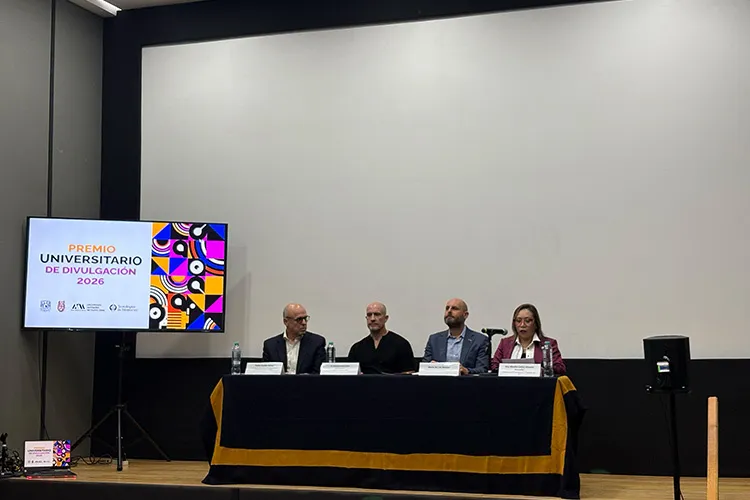
This Thursday, September 17, a press conference was held at the Old San Ildefonso College to present the award and invite the public to participate.
During the presentation, Pedro Castillo, leader of the University Consortiums initiative at Tecnológico de Monterrey, emphasized the importance of science having a greater presence in the public conversation: “If we talked less about other things that have much less impact and talked more about science and better understood the knowledge we are creating, we would surely transform our country for the better,” Castillo said.
The University Dissemination Award is jointly promoted by the Monterrey Institute of Technology, the National Autonomous University of Mexico (UNAM), the National Polytechnic Institute (IPN) and the Metropolitan Autonomous University (UAM).
The initiative reflects these institutions’ commitment to Mexican society and to synergy across different capabilities.
“This award is a demonstration of the collaboration between institutions and universities, and it is a call to all science communicators to do better outreach so that they are recognized,” said Manuel Suárez, Director General of Science Outreach (DGDC) at UNAM.

What does the University Dissemination Award Recognize?
By adapting specialized knowledge into formats that are understandable and accessible to everyone, dissemination not only promotes knowledge, but also democratizes it. When research remains solely within the academic community, its reach is limited.
It also helps citizens to make informed decisions, to strengthen the relationship between science and society, to make the scientific process visible, not just its results, and to awaken scientific vocation in other people.
“For some people [science dissemination] will confirm a curiosity that already existed; for others, it may open a path that they had not even imagined until then,” said Martha Vázquez, Secretary of Research and Postgraduate Studies at the IPN.
The award seeks to recognize the careers of people committed to dissemination, so instead of rewarding a single story or piece, it distinguishes the careers of those who have carried it out continuously, publicly and free of charge for at least three years.
Also, through its category of priority attention groups, it seeks to distinguish people who carry out dissemination activities and belong to groups that face situations of vulnerability, such as women in situations of violence, migrants, older adults and LGBTIQ+ people, among others.
“Those who do outreach do it in subway stations, schools, public squares, markets, prisons, with indigenous communities, with people with disabilities, and there is no award in our country that thanks them for this effort; that is the driving force behind this call for entries,” said Mario De Leo, Director of Knowledge Communication at UAM.
Thus, the award is also a way of recognizing that outreach is not simply a favor done to science, but an activity with its own intellectual value that should be supported and promoted.