
By Jimena del Carmen Álvarez Chávez
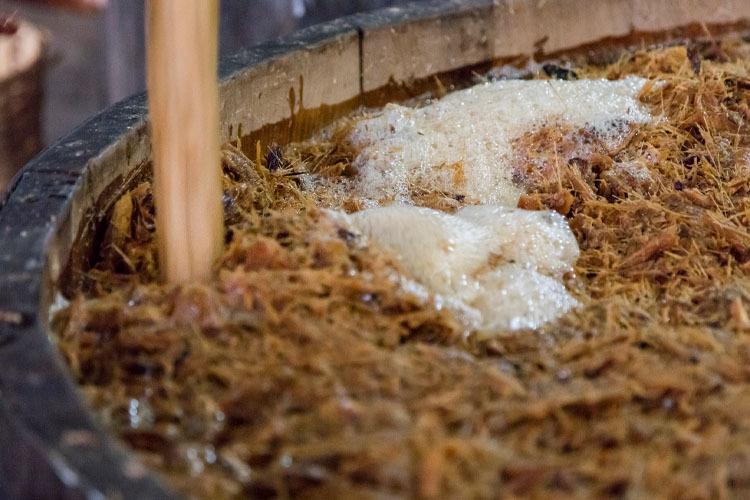
In the mezcal industry, agave bagasse is often seen as a homogeneous waste—a byproduct of production that’s unavoidable. But this apparent uniformity is deceptive.
Bagasse changes throughout the year. Climate, sunlight, and water availability directly influence the agave’s genetic expression, which in turn affects the composition of bioactive compounds that remain after mezcal production.
Understanding these variations is not just a scientific matter—it’s an industrial opportunity.
A study by the Sustainable Bioproducts group at Tecnológico de Monterrey, which analyzed samples collected across all four seasons of 2023 from three artisanal producers in the State of Mexico, revealed clear seasonal differences in nutrients and antioxidants.
The results showed a distinct pattern: warm months favor the accumulation of lipids and proteins, while cold months concentrate carbohydrates and sugars. In summer, lipids reached 11.73% and proteins 5.15%, while in winter these values dropped to 2.03% and 2.26%, respectively.
Carbohydrates and total sugars followed the opposite trend, peaking in winter (86.45% and 46.98%) and dropping in summer (74.92% and 14.82%). Reducing sugars were highest in autumn (12.46%), soluble fiber peaked in spring (21.78%), and was lowest in winter (7.80%).
That same spring season also saw the highest concentration of antioxidant compounds that protect the plant from environmental stress; total antioxidant capacity was highest in autumn and lowest in winter.
These differences are significant. They determine how bagasse can be used. In winter and spring, its high carbohydrate content favors energy applications; in summer, elevated lipids and proteins make it suitable for functional formulations, while spring’s soluble fiber and antioxidants enhance its potential as a prebiotic ingredient.
What mezcal leaves behind
Research on agave is driven by the plant’s bioactive properties—antioxidant, prebiotic, and nutritional—that could benefit human health.
At Tecnológico de Monterrey, processing technologies like ohmic heating and extrusion have also been explored to maximize the functional value of agave.
Ohmic heating applies an electric current directly to the material, generating uniform internal heat, while extrusion combines pressure and temperature to modify the material’s structure.
These techniques increase fiber availability and release simple sugars that beneficial gut bacteria can ferment, reinforcing bagasse’s prebiotic potential.
For example, ohmic heating increased soluble fiber in bagasse by 18.3% and total fiber by 41.3%, while also boosting phenolic concentration and antioxidant activity.
These results suggest that agave bagasse has high potential as a low-glycemic prebiotic ingredient. As fiber content rises, sugar levels decrease. After these treatments, fiber availability and antioxidant potential improve, making it particularly attractive to the food industry.
Math to make the most of agave
In the study “Ohmic heating-assisted pretreatment of agave bagasse to increase bioactive compounds bioaccessibility,” predictive mathematical models were developed to optimize ohmic heating conditions and maximize the release and availability of bioactive compounds.
By precisely adjusting factors like moisture, voltage, and treatment time, the release of bioactive compounds can be optimized. The models demonstrated 90% accuracy, closely mirroring experimental results.
This approach shows that mathematical modeling is a powerful tool for refining functional food processes, enhancing both nutritional quality and potential health benefits.
Regarding agave bagasse bioaccessibility, in vitro digestion simulations showed that both sugars and phenolic compounds became available for intestinal absorption or fermentation by gut microbiota. This indicates that this agro-industrial byproduct has real potential as a prebiotic ingredient.
In a context where the food industry seeks to reduce waste, develop functional ingredients, and move toward circular economy models, agave bagasse is no longer just a byproduct—it’s a strategic asset. The key is not only processing it better but also understanding when to do so.
.
References
- Álvarez-Chávez, J., Dufoo-Hurtado, E., Santos-Zea, L., & Ramírez-Jiménez, A. K. (2025). Looking into New Sources of Bioactives: Seasonal Variation in Bioactive Compounds and Dietary Fiber of Agave Bagasse from Mezcal Production. Foods, 14(9), 1632.
- Álvarez-Chávez, J., Castrejon, A., Gaytán-Martínez, M., & Ramírez-Jiménez, A. K. (2025). Effect of Ohmic heating, ultrasound, and extrusion on the bioactive composition and nutritional value of Agave bagasse from Mezcal production. Innovative Food Science & Emerging Technologies, 100, 103897.
- Álvarez-Chávez, J., Gaytán-Martínez, M., & Ramírez-Jiménez, A. K. (2025). Ohmic heating-assisted pretreatment of agave bagasse to increase bioactive compounds bioaccessibility. Innovative Food Science & Emerging Technologies, 104, 104076.
.
Author
Jimena del Carmen Álvarez-Chávez. Biotechnologist with a specialization in Molecular Biology. She is currently a doctoral candidate at Tecnológico de Monterrey. Her research focuses on turning agro-industrial waste into functional ingredients. She has presented her doctoral research at national and international conferences and has also published science communication articles in TecScience.