

Two new artificial intelligence tools developed at Tecnológico de Monterrey can support the day-to-day work of its researchers, from organizing information and reviewing and comparing scientific literature to structuring summaries, presentations, and other specialized materials.
These tools, Skill and Agent, are part of TECgpt, the generative AI ecosystem created by Tec de Monterrey to enhance human capabilities, foster faculty creativity, and enrich teaching through secure and private technology.
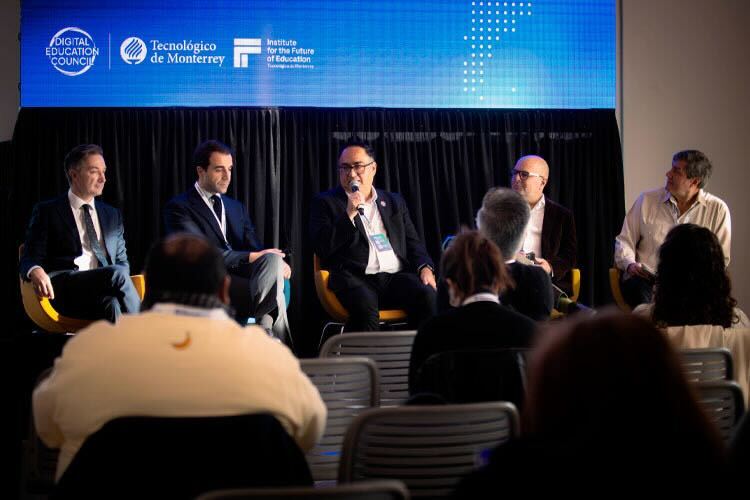
These developments were unveiled during the third edition of Tecnológico de Monterrey’s AI Day. “We are moving artificial intelligence from exploration to practical application, integrating it into academic, administrative, and clinical processes to generate real value that accelerates innovation,” said Carles Abarca, Vice President of Digital Transformation at Tecnológico de Monterrey.
An ecosystem that supports researchers
TECgpt aims to democratize access to these technologies within the university community, making it easier to carry out tasks in academic, scientific, administrative, and operational settings. One of its goals is to “support and coach different institutions in the agile, efficient, and structured development of AI-based solutions,” explains Manuel Terán, Manager of the Center for Architecture and Intelligence Enablement.
For researchers, this support translates into access to platforms that can be integrated into their workflows without requiring advanced knowledge of programming or artificial intelligence.
Edgar Barroso, a researcher at the School of Social Sciences and Government, notes that the usefulness of any AI assistant depends on both the model and the researcher’s judgment.
“For researchers, it is now uncommon to rely on a single tool. There are multiple AI platforms (ChatGPT, Claude, Gemini, Elicit, Consensus, Scispace, Scite, Connected Papers), and each excels at a specific task. The main value of TECgpt is that it provides a space with institutional guarantees.”
This is key for protecting the confidentiality of materials such as unpublished hypotheses, preliminary data, or grant proposals, which should not be uploaded to public tools.
According to Barroso, potential uses of TECgpt in research include:
- An epistemic interlocutor and confidential workspace (not just a text generator): TECgpt can be used to challenge methodological decisions (“What would a reviewer object to?” “Argue why my hypothesis is false”). Its value lies in cognitive friction and the quality of dialogue.
- Composing critical dialogues between sources: TECgpt allows different papers to “converse” in order to identify convergences, tensions, or gaps, making it easier to work with selected literature. It also supports routine tasks such as formatting references, drafting emails, or organizing notes.
- Building a disciplined and documented prompting practice: It is now essential to record prompts, models, versions, and dates for each relevant use of AI. Editorial policies are moving toward greater transparency, so documenting this from the outset strengthens both the process and reproducibility.
Skills: prompts that streamline processes
One of the most significant innovations in the TECgpt ecosystem is TECgpt Skills, a tool that allows users to create customized prompts (instructions) to automate tasks and improve productivity.
“Instead of designing a prompt from scratch every time, users can reuse and adapt them for specific tasks.” Once created, these skills can be shared as templates, saving time for others.
Some examples of existing skills include: “Create a problem scenario,” “Design a challenge,” “Design your course unit strategy,” and “Design a learning activity.”
In fact, thousands of these tools have already been developed within the institution. “We currently have around 4,000 skills created by faculty and staff.”
If you want to learn how to create a skill and use automated prompts, check out this guide.
Agent: an intelligent, personalized assistant
Another new component of the ecosystem is TECgpt Agent, a platform capable of creating personalized intelligent agents trained on specific information. These agents can recognize intent, respond to queries, and perform concrete tasks.
“Unlike a general chatbot, these agents can specialize in a topic, project, or document base. You can create your own expert based on the information you provide,” explains Terán.
This opens up new possibilities for researchers, who could automate tasks such as reviewing scientific literature, consulting curated bibliographies, interpreting scientific databases, structuring reports and presentations, suggesting appropriate methodologies based on research area, and drafting specialized texts.
Once created, an agent can be used individually, shared with colleagues, or made available to other research groups within the institution.
How to create an agent in five steps
If you are a Tecnológico de Monterrey researcher and want to create a personalized AI agent, follow these steps:
- Log in to MiTec; access the TECgpt ecosystem; select the TECgpt Agent icon; click “Create new agent.”
- Assign an icon, name, description, and welcome message.
- Select the model, creativity level, and define the main prompt.
- Under “Upload documents,” choose “Upload files” to select documents from your device.
- Publish your agent to start using it in TECgpt.
For more information, see the guide here.
Toward hybrid teams
For Manuel Terán, the central theme of these tools is democratization: “How to reach most of the Tec community without requiring extensive knowledge of artificial intelligence.”
This represents a significant shift in how researchers interact with technology. Instead of depending on technical specialists, they can incorporate AI directly into their processes and adapt it to their needs.
The institution’s long-term vision goes even further. Work is underway to develop more autonomous agents capable of connecting to multiple data sources, executing complex tasks, and even collaborating with one another.
Terán describes the goal as moving toward “hybrid teams,” where humans and AI systems work together to solve problems.
In this scenario, AI can amplify researchers’ capabilities by reducing time, automating repetitive processes, and allowing scientists to focus on higher-value tasks such as interpretation, innovation, and knowledge generation.
With this ecosystem, Tecnológico de Monterrey is not only adopting artificial intelligence—it is strategically integrating it into its research model to redefine how science is produced in the digital age.