

Currently, millions of people with diabetes rely on daily insulin injections to control their blood glucose. In response, Mexican researchers are exploring the possibility of transplanting pancreatic islets into the anterior chamber of the eye.
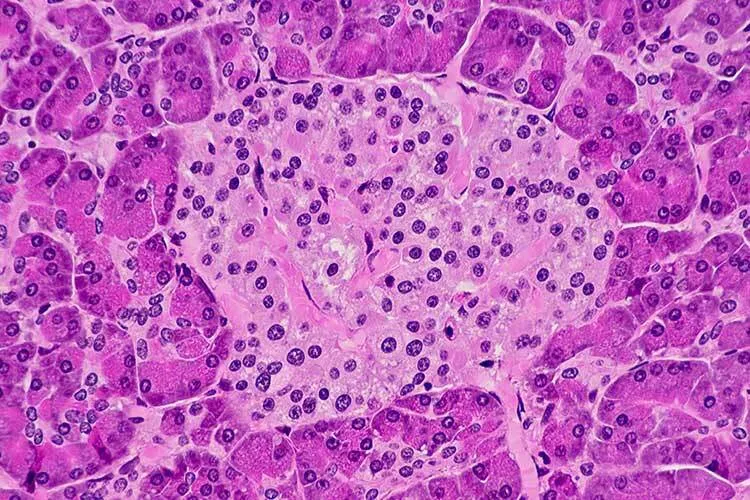
Pancreatic islets are clusters of cells within the pancreas that produce hormones, such as insulin. Transplanting them has become an alternative therapy that helps patients restore their body’s ability to produce the hormone.
Traditionally, these are extracted from a deceased donor, cultured and isolated, and then injected into the patient’s liver; however, they are usually accompanied by immunosuppressants to prevent rejection.
Therefore, researchers around the world have sought alternatives, such as performing the transplant in the eye. “Between the iris and the cornea is the anterior chamber,” says Judith Bernal, a postdoctoral specialist at the Institute for Obesity Research. “It has a privileged immune system where rejection is less likely.”
The eye, being semi-isolated, has special immunological characteristics that not only reduce the need for immunosuppressants but also allow the islets to proliferate and endure.
Bernal, along with Hugo Alves, researcher at TecSalud, Per-Olof Berggren, distinguished visiting professor of the School of Medicine and Health Sciences (EMCS) and of the Faculty of Excellence, and other collaborators, seeks to bring this technology to Mexico.
Bernal recently received the L’Oréal-UNESCO For Women in Science Award, one of the most important recognitions for young female researchers in the country.
A New Platform for Studying Siseases and Advanced Treatments
Bernal’s project not only seeks to offer a therapeutic alternative for type one diabetes—and, in extreme cases, type two diabetes—but also proposes a new experimental platform to study the islets’ cell signaling, metabolism, and inflammatory responses, which could drive advanced therapies in the future.
“We can see, through the microscope, how the islet changes in response to different treatments and how the disease changes in parallel,” explains the researcher.
This would allow real-time monitoring of how these animals respond to different drugs and of the factors that affect their survival.
In addition to pancreatic islets, they are also looking to inject pancreatic and liver cancer spheroids. Spheroids are three-dimensional (3D) aggregates of tumor cells that mimic the structure of real tumors.
“The eye gives us a crystal-clear window to monitor how the tumor behaves,” says Bernal.
Furthermore, they also want to use the platform to study organoids —miniature three-dimensional structures similar to organs made in the laboratory— to study treatments, drugs, and interventions in real time.
Thus, the anterior chamber becomes a laboratory where advanced and personalized treatments for diabetes, cancer, and other diseases can be developed.
Innovative Technologies for Real Life
Anterior chamber transplants are rare globally and are only performed at a few research centers. To date, they are not available in Mexico.
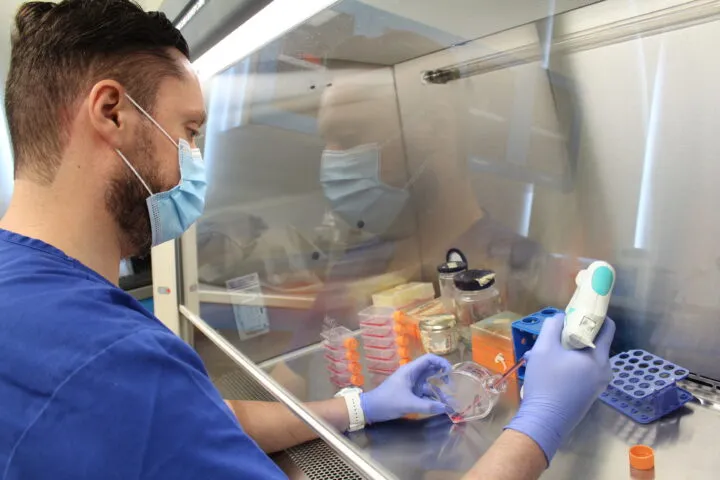
So far, Bernal and his team are in the experimental part of the project, standardizing the extraction of the islets, the creation of spheroids, as well as the transplants in animal models.
“We are analyzing how many islets are required for a positive reaction to occur, for example,” Bernal says.
In their ambitious plan, by the end of 2026, they would be performing the first transplants on human patients.
“The idea is to develop new technologies that don’t stay at the laboratory level, but have practical applications,” says Bernal.
Did you find this story interesting? Would you like to publish it? Contact our content editor to learn more: marianaleonm@tec.mx