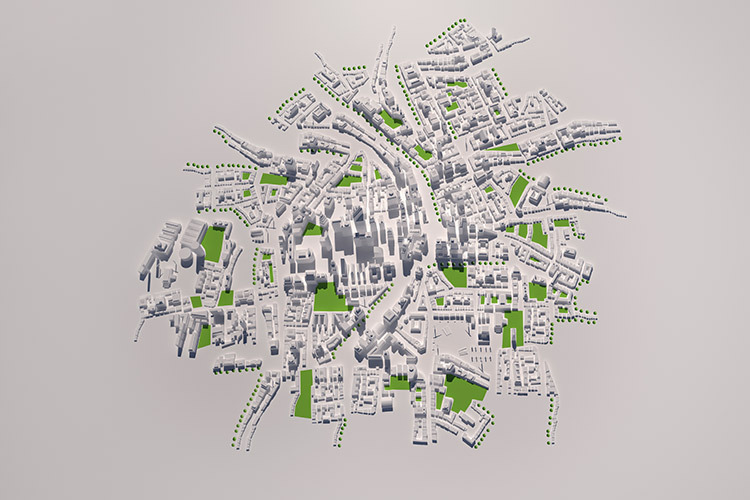


A city with greater and more complex economic diversity can lead to its inhabitants being more separated, depending on their income level.
“Urban growth is often associated with more inclusive places,” says Marco Cruz, director of the Regional Department of Sustainable and Civil Technologies, Mexico City, at Tecnológico de Monterrey.
During his postdoctoral stay at the Center for the Future of Cities, he began to wonder if this association really existed, the researcher says.
To study it, he and a group of researchers analyzed 74 metropolitan areas in Mexico and found that there are two characteristics particularly related to segregation: the complexity of the economic activities that a metropolis concentrates and the way in which its territory expands.
Understanding what drives segregation is important because it determines the opportunities a person will have. “Where you grow up and develop has consequences for you throughout your life,” Cruz points out.

How are Economics and Segregation Related?
In the study, the authors analyzed metropolitan areas with very different profiles and combined information on income segregation, economic structure, population, and urban expansion.
To measure segregation, they used an index that identifies how spatially separated population groups are based on their income.
Economic complexity, meanwhile, was estimated based on the diversity and specialization of productive activities in each metropolitan area. A less complex economy is, for example, one that depends almost exclusively on a single activity, such as tourism or mining.
They also observed how the built-up area of cities had changed between 1990 and 2020. With these variables, they constructed a snapshot of the economic and urban characteristics of each metropolis.
Next, they used cluster analysis to identify patterns among the 74 metropolitan areas. “Basically, what we found is that the more sophisticated an area’s economy is, the more segregation it will generate,” says Cruz.
It’s Not how Much a City Grows, but How it Grows
The result was five groups with distinct characteristics. One of them, made up mainly of border cities such as Tijuana, Ciudad Juárez, and Reynosa, combined significant urban expansion and fragmentation with a relatively complex economy and high levels of income segregation.
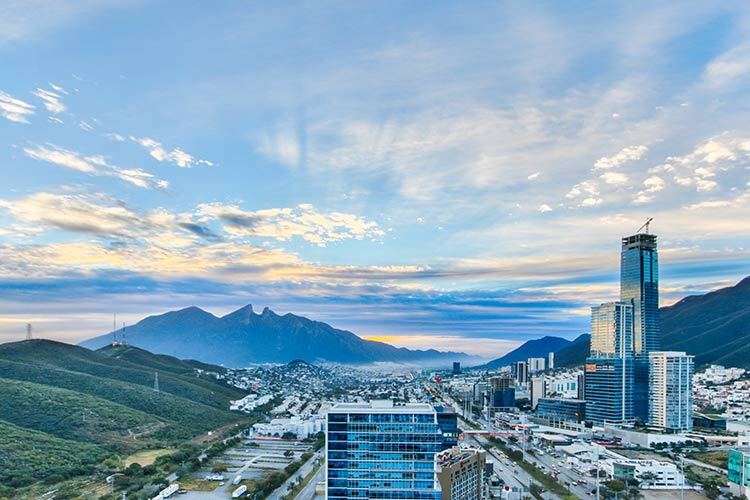
Another group included Mexico City, Monterrey, Guadalajara, Querétaro, and León. These metropolitan areas stood out for having the highest levels of economic complexity, GDP per capita, and income segregation.
But the case of Cancun explains why the results of the study cannot be resumed as more GDP generating mor segregation.
Between 1990 and 2020, its population increased fivefold and its built-up area quadrupled. Furthermore, it boasted a high GDP per capita and an economy whose complexity had grown beyond its initial reliance on tourism. However, its level of spatial segregation remained moderate.
This contrast led researchers to examine in greater detail which factors were associated with segregation. In their statistical analysis, they found that economic complexity and urban sprawl were the main predictors of income segregation. In contrast, GDP growth, by itself, did not show a statistically significant relationship when economic complexity was taken into account.
The difference is important as the results suggest that it’s not simply how much an economy grows that matters, but what kind of economic activities it drives and how that growth translates into tangible results across the country.
“There is a need for cities to join global markets, which end up being somewhat unfair,” the expert points out.
Segregation has Consequences
Segregation by income level has real consequences for the population. Among the main ones are stigmatization, the neighborhood effect, and the geography of opportunity.
Stigmatization refers to the subjective criminalization of an individual based on where they live. The neighborhood effect occurs when people normalize risky behaviors, such as drug addiction or armed robbery, because of the neighborhood they inhabit. The geography of opportunity refers to the fact that employment opportunities are fewer for segregated people.
“Due to the fragmentation of cities caused by this sophistication the lower economic strata are generally located in more disadvantaged places, with less infrastructure and transportation,” Cruz emphasizes.
The study raises a central idea for understanding urban inequality in Mexico: a city can grow, generate wealth and develop a sophisticated economy, but the way that wealth is distributed in space —and the way the city expands— can determine who ends up living close together and who remains separated.
“Economic transformation, in the end, turns out to be a paradox,” says the researcher.
And although their area of expertise is not public policy, they believe that based on this research and others, actions could be promoted that foster proximity, where cities grow by integrating people from all social strata in the same territory.
Housing, infrastructure, transportation, and accessibility can be addressed so that the benefits of economic growth are not just enjoyed by a few.
“We need to think about how to grow as a city in an inclusive way,” Cruz concludes.
Did you find this story interesting? Would you like to publish it? Contact our content editor to learn more: marianaleonm@tec.mx