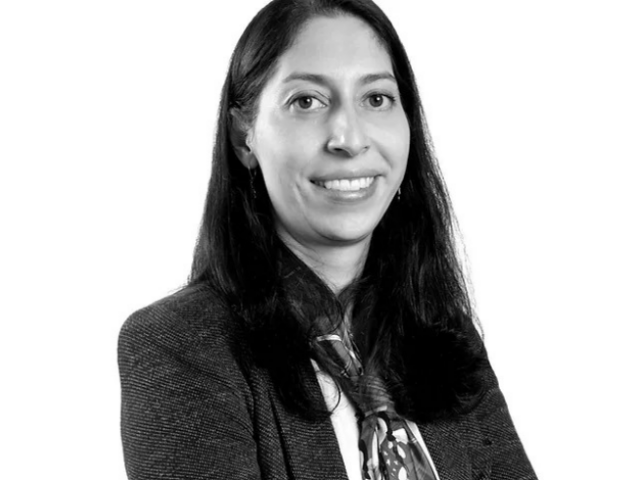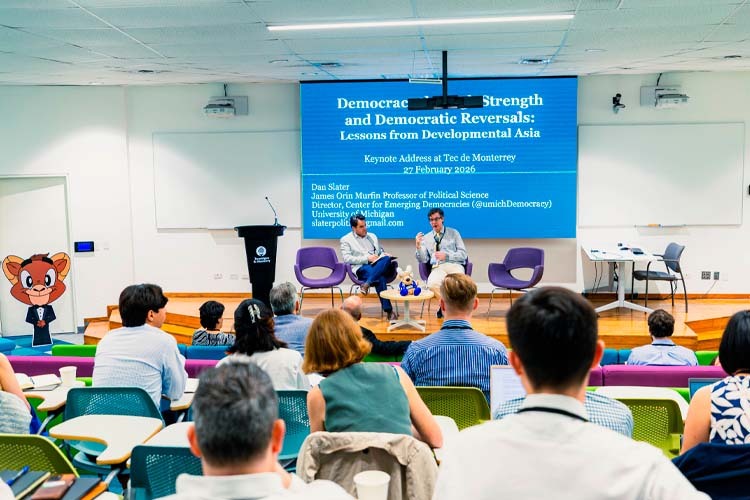


Dan Slater delivered his keynote lecture on democracy, development, and democratic backsliding to academics and students at Tecnológico de Monterrey.
Conventional political theory explains how democracy emerges when regimes collapse: after an economic crisis or the fall of a dictator. However, Dan Slater, director of the Center for Emerging Democracies at the University of Michigan, poses a counterintuitive hypothesis: the most stable democracies tend to arise during periods of strong economic development, when authoritarian regimes are at their most stable.
During the National Conference for Political Science and International Relations, held by the Escuela de Ciencias Sociales y Gobierno at Tecnologico de Monterrey, Slater presented his theory that the most stable democracies in the world tend to arise during periods of high economic development, when authoritarian regimes are at their most stable point.
“A set of theories suggests that development, in reality, reduces the risks of democratic transition for authoritarian leaders,” he said.
In his book From Development to Democracy: The Transformations of Modern Asia, co-written with Joseph Wong, Slater explains why some East and Southeast Asian countries democratized after decades of rapid growth, while others did not. But the implications of his work extend beyond Asia’s borders, with clear connections to the current political moment in Mexico.
When Authoritarianism Reforms
Slater’s starting point is a critique of conventional political theory. The majority of democratic transition models assume that authoritarian regimes relinquish power only when they have no other alternative: due to economic collapse, the strengthening of an opposition party, or unsustainable social pressures. Slater calls this the logic of “little choice.”
However, in Asia, the expert observed a different pattern. The regimes that achieved the most stable transitions did so not from a position of crisis, but from one of confidence. “What economic development does is reduce the risk of democratization for economic and political elites,” Slater explained in his presentation.
This strategic decision to reform rests on two pillars of confidence shared by political and economic elites, allowing a regime to make the transition on its own terms and timeline.
The first pillar is “victory confidence” — the belief that the governing party is popular and institutionalized enough to remain competitive, or even dominant, in a free and fair electoral system. The second is “stability “confidence”—the assurance that the country’s economic development, specifically the rise of a stable middle class and the reduction of poverty, will prevent radical unrest or violence against established elites during the transition.
When these factors align, democratization becomes a tool to revitalize power. Slater points to the so-called “status cluster” in Northeast Asia as the gold standard: regimes that used decades of growth to build the popular legitimacy needed to pivot toward democracy from a position of strength. Taiwan, South Korea, and Indonesia are examples of regimes that made that bet. In all three cases, authoritarianism was reformed rather than dismantled. “These are regimes that redefine their legitimacy,” said Slater. “They don’t do it suddenly. These are sequential concessions that happen over time.”

Development and the Risk of Democratic Erosion
The same states that produced decades of growth also conditioned their citizens to evaluate their rulers almost exclusively on economic terms. “Developmental states create developmental voters,” explained Slater. Politics becomes centered on economic performance: candidates are judged by GDP growth, jobs, and the cost of living. Questions of institutions, rights, and the rule of law take a backseat.
In theory, this would facilitate transitions: pragmatic citizens, focused on economic results, are less susceptible to political radicalization. But in practice, this same pragmatism becomes a democratic vulnerability. “This can create conditions for democratic erosion,” warned Slater, “in the sense that it has a demobilizing effect. People become so focused on economic development that they become less concerned about democratic integrity and human rights violations that don’t affect them personally.”
This phenomenon explains why some prosperous countries are experiencing democratic backsliding. Slater pointed specifically to Indonesia—a country with a well-functioning economy—as a case where the public has effectively given the administration a “free pass” to erode human rights because their material needs are being met.
These tradeoffs are not exclusive to Asia. Slater drew a direct line to the United States, suggesting that many citizens prioritize the price of eggs at the grocery store over the preservation of democratic institutions and checks and balances. If a leader delivers stability and growth, the development-oriented voter is typically slow to protest the quiet dismantling of institutional safeguards.
Mexico and the Idea of “Democracy Through Strength”
The question that framed the subsequent debate was direct: where does Mexico fit into this theory?
To answer it, the moderator, Miguel Angel Toro of the School of Social Sciences and Government, drew a parallel with Indonesia under Suharto—a dominant party that governed for decades, achieved some degree of economic development, and survived the transition by participating in elections. In Mexico, the Institutional Revolutionary Party (PRI) exercised similar control for over 70 years, with one key feature that Slater highlighted: its opponents came from opposing ideological wings, making it unnecessary to divide them through reforms. They were already divided.
For Slater, several features of the Mexican process fit the “democracy through strength” model: electoral reforms were gradual and sequential, the governing party never collapsed, and concessions were unilateral rather than negotiated. “I think these are ways in which a ‘democracy through strength’ interpretation could enrich our understanding of Mexico’s democratization,” he said.
Even when the party finally lost the presidency in 2000, it did so with a high degree of confidence in the outcome. Because the PRI remained dominant at the municipal and state levels, its leaders believed they could “coexist” with an opposition president. This institutional depth allowed Mexico to make the transition without the systemic collapse seen in countries where the ruling party lacks confidence in stability after losing power.
Prosperity, Security, and Democratic Legitimacy
Slater closed the discussion with a statement that captures the central tension of his research: “Democracy is a universal value, but it is not the supreme value. It must solve people’s basic problems of prosperity and security if people are going to support it.” When it fails to do so, people sacrifice it—not necessarily out of authoritarian conviction, but out of pragmatic exhaustion.
The risk, he explained, is not only that governments erode democracy from above. Development is the foundation upon which solid democracies are built, but it is not a permanent shield. Sustaining democracy requires continuous civic engagement and institutional vigilance: economic “miracles,” on their own, do not guarantee its permanence.
Did you find this story interesting? Would you like to publish it? Contact our content editor to learn more at marianaleonm@tec.mx