
By Karla Arias López Arriaga / Ciencia Amateur
Reviewed by María Cristina Velasquillo
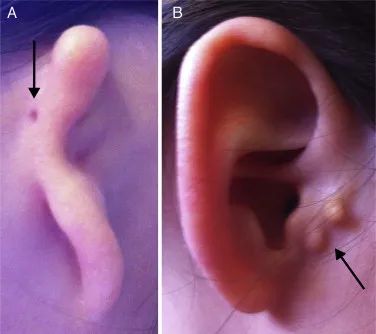
The outer ear, or auricle, often goes unnoticed—until it’s missing or malformed. That’s the case with microtia, a condition in which the ear fails to fully develop during pregnancy. It may be absent or appear as a small, underdeveloped outer ear.
Sometimes the lower part of the ear forms, but the upper section is missing. In other cases, there’s only a small bump of skin where the ear should be. The most severe form is anotia, in which the auricle is absent.
Between 1978 and 2010, the prevalence of microtia in Mexico was 7.37 cases per 10,000 newborns—higher than in the United States and many European countries.
Growing up without an outer ear can affect both body image and emotional well-being.
Emotional challenge
Psychological studies have examined rates of depression, hostility, social withdrawal, and aggression among people with microtia. About 20% of patients show symptoms of depression, and 36% experience social difficulties.
Some research suggests that children aged 7 to 9 with microtia report higher levels of anxiety and depression than those aged 3 to 6. However, after receiving medical treatment, both groups show significant improvements.
Doctors and engineers have been working to better understand the tissue structure and mechanical properties of the ear’s building material: auricular cartilage.
Micro-indentation: a novel mechanical test
One emerging approach is micro-indentation—a mechanical test that measures how soft or firm a material is. In the case of the ear, it’s used to assess how auricular cartilage responds to stretching or compression.
The device applies vertical pressure with a tiny tip to measure the force required to deform or break the cartilage. Think of it like pressing your finger into a pillow to see how soft or firm it is—only here, the “pillow” is ear cartilage.
Once that’s understood, it’s worth noting that this mechanical test offers major advantages—despite being performed with a microscopic tip.
One key feature is that it can be applied to materials with irregular shapes, requiring only about 8 mm² of auricular cartilage—far less than other devices, which demand larger samples. It also works without any special tissue preparation.
Auricular prostheses
Knowing the varying stiffness levels in different parts of the outer ear helps in designing realistic, customized auricular prostheses for children, ensuring they meet specific structural and size parameters.
These measurements are also critical for creating three-dimensional, cell-based ear structures. While these may not yet function like a natural auricle, the technique can improve quality of life for children living with microtia.
References
- Sánchez O, Méndez JR, Gómez E, Guerra D. Estudio clínico epidemiológico de la microtia [Clinico-epidemiologic study of microtia]. Invest Clin. 1997 Dec;38(4):203-17. Spanish. PMID: 9527388.
- Du, J., Jia-Ke, C., Zhuang, H., Guo, W., Yan, W., & Liu, G. (2008). An investigation of psychological profiles and risk factors in congenital microtia patients. Journal of plastic, reconstructive & aesthetic surgery : JPRAS, 61 Suppl 1, S37-43
- Andrews, J., Kopacz, A. A., & Hohman, M. H. (2024, March). Ear Microtia. Nih.gov; StatPearls Publishing.
- Aguinaga-Ríos, M., Frías, S., Arenas-Aranda, D. J., & Morán-Barroso, V. F. (2014). Microtia-atresia: Clinical, genetic and genomic aspects. Boletín Médico del Hospital Infantil de México, 71(6), 387–395.
- Johns, A., Lucash, R., Im, D., & Lewin, S. (2015). Pre and post-operative psychological functioning in younger and older children with microtia. Journal of plastic, reconstructive & aesthetic surgery : JPRAS, 68 4, 492-7 .
- Yuh, C., O’Bryan, C., Angelini, T., & Wimmer, M. (2021). Microindentation of Cartilage Before and After Articular Loading in a Bioreactor: Assessment of Length-Scale Dependency Using Two Analysis Methods. Experimental Mechanics, 61, 1069 – 1080.
- Mónica Aguinaga-Ríos, Frías, S., Arenas-Aranda, D. J., & Verónica Fabiola Morán-Barroso. (2014). Microtia-atresia: aspectos clínicos, genéticos y genómicos. Boletín Médico Del Hospital Infantil de México, 71(6), 387–395.
Author
Karla Arias López Arriaga is a Biomedical Engineering student at Tecnológico de Monterrey with experience in hospital management, tissue engineering, agile project management, and biomedical 3D modeling.
This article was reviewed by María Cristina Velasquillo, professor at the School of Engineering and Sciences, Tecnológico de Monterrey. She holds a Ph.D. in Science from UNAM and is a researcher at Mexico’s National Institute of Rehabilitation (INR). She is a member of the National System of Researchers and the Mexican Society for Tissue Engineering.