
By Diego Arellano and Fidel Guerra | Amateur Science
Contributing authors: Ma. Cristina Reyes and Gerardo R. Amores
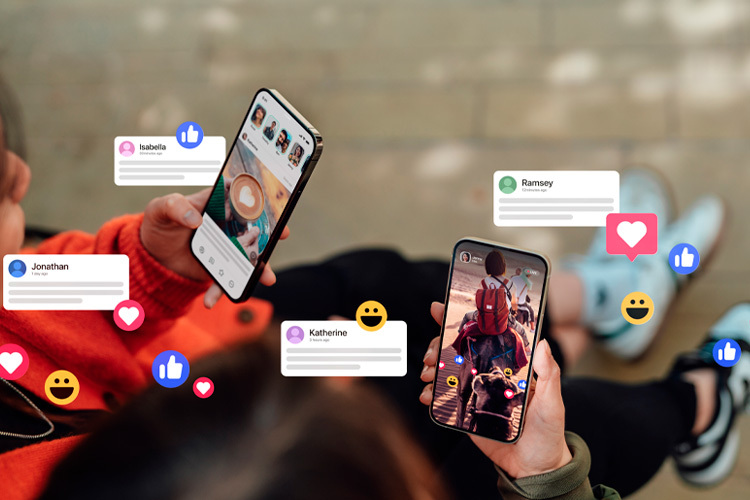
From an environmental standpoint, digital pollution is generated by the infrastructure that sustains social media. Data centers, networks, and devices consume vast amounts of energy, producing CO₂—the greenhouse gas most closely linked to climate change. It is well documented that using TikTok for one hour generates more than 150 grams of CO₂ [1].
At the same time, from a mental health perspective, excessive and irresponsible use of social media can lead to problematic patterns similar to addiction, with negative emotional, social, and academic consequences.
The Bergen Social Media Addiction Scale (BSMAS), an internationally validated psychometric instrument, assesses behaviors such as constant preoccupation with social media, the need to spend increasing amounts of time online, and difficulty reducing use [2].
Is there a relationship between social media addiction and digital carbon footprint? The research project “Social Media Affects the Mind and the Environment” explores this question through a survey of 232 upper–secondary students from Tecnológico de Monterrey.
To conduct the study, researchers used the six-item BSMAS to measure salience, mood modification, tolerance, withdrawal, conflict, and relapse. Responses ranged from “very rarely” (1) to “very often” (5), yielding total scores between 6 and 30 points [2].
To estimate each student’s digital carbon footprint, participants reported their average daily time spent on social media (2, 4, 6, 8, or 10 hours), which was then converted into minutes. Using conversion factors published by international organizations—an average of 1 gram of CO₂ per minute for smartphone-based social media use—researchers calculated individual CO₂ emissions [1].
The formula used was:
Digital CO₂ (kg/year) = minutes per day × 1 g/min × 365 ÷ 1,000
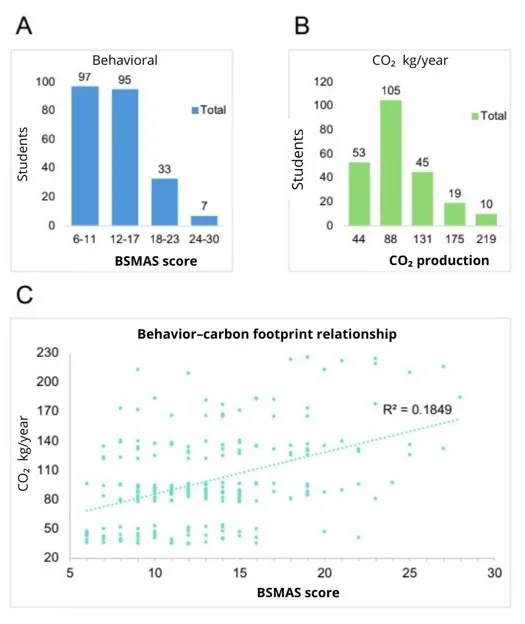
A) Histogram of students’ scores on the BSMAS.
B) Histogram of CO₂ production per student in kg/year.
C) Scatter plot of total BSMAS scores versus digital CO₂ (kg/year), including regression analysis and Pearson’s r = 0.422, p < 0.001.
Analysis and results
The findings show that social media use can have a dual impact—both psychological and ecological.
Average behavioral scores reached 13 ± 0.3027 on the BSMAS, indicating a moderate level of addiction. For international adolescent samples, scores above 24 are considered indicative of addiction [3].
Students reported an average daily social media screen time of 271 minutes (approximately 4.5 hours). When incorporated into the emissions model, this translated into an average annual digital carbon footprint of 99 kg of CO₂ per student, equivalent to driving a small car for 466 kilometers or charging 8,000 smartphones.
Statistical analysis revealed a clear, though moderate, relationship between the two variables (r = 0.422, p < 0.001), indicating that higher behavioral engagement with social media is associated with greater digital energy consumption. While the correlation was modest, it was statistically significant.
Notably, not all students with high BSMAS scores spent more time online. Some reported high levels of anxiety or a strong need to stay connected despite spending fewer hours on social media. This suggests that digital addiction does not always translate into higher energy consumption but may instead reflect an emotional dependency on technology.
What can be done?
Social media use affects both our minds and the planet. Sustainability in the digital age requires looking beyond recycling or water conservation—our online behaviors also matter.
Small daily choices—such as reducing screen time, using Wi-Fi instead of mobile data, disabling autoplay, or turning devices off at night—when multiplied by millions of users, can make a significant difference.
Incorporating these habits into environmental education could help younger generations understand that caring for the planet also means being mindful of how we use technology.
.
References
- Derudder, K. (2023). What is the environmental footprint for social media applications? 2021 Edition (Nov 10). Greenspector.
- Arrivillaga, C., Griffiths, M. D., Rey, L., & Extremera, N. (2024). Validation of the Spanish version of the Bergen Social Media Addiction Scale (BSMAS) among Spanish adolescents. Current Psychology, 43(40), 31582-31591.
- Luo, T., Qin, L., Cheng, L., Wang, S., Zhu, Z., Xu, J., … & Liao, Y. (2021). Determination the cut-off point for the Bergen social media addiction (BSMAS): Diagnostic contribution of the six criteria of the components model of addiction for social media disorder. Journal of Behavioral Addictions, 10(2), 281-290.
.
Authors
Diego Arellano-Gómez – Senior student at PrepaTec, Tecnológico de Monterrey.
Fidel Guerra-De la Vega – Senior student at PrepaTec, Tecnológico de Monterrey.
Reviewers
This article was supervised by Ma. Cristina Lucila Reyes Santoyo, Director of the Academic Department of Sciences at PrepaTec, Tecnológico de Monterrey, and Gerardo Ruiz Amores, molecular biologist, researcher, and adjunct professor at PrepaTec.