

Designing smart cities can create more sustainable and resilient environments that reduce environmental impact and improve quality of life. To achieve this, the use of data and artificial intelligence (AI) are key.
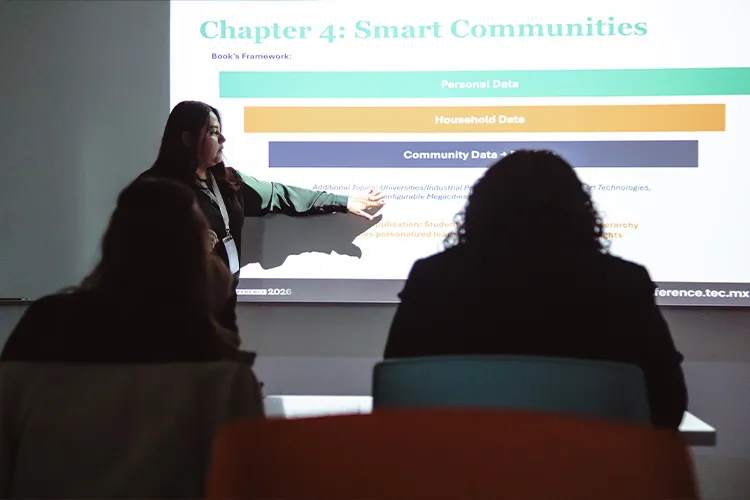
“We have the citizen and this citizen then interacts, forming communities and in turn these form cities,” said Isabel Méndez, researcher at the School of Architecture, Art and Design (EAAD) and the School of Engineering and Sciences (EIC) of the Tecnológico de Monterrey, during the presentation of the book Data and AI Driving Smart Cities, which took place on the second day of the IFE Conference 2026.
The book presents the Smart C3 model, a framework that connects citizens, communities, and cities through the strategic use of data and AI techniques. The goal is for this model to be used to build more sustainable, inclusive, and people-centered urban environments.
An Interdisciplinary and International Book
The book was written by an interdisciplinary and international group that includes researchers from the Institute of Advanced Materials for Sustainable Manufacturing (IAMSM) of Tec de Monterrey, the California Institute for Energy and Environment (CIEE) at Berkeley and the Polytechnic School, Arizona State University, as well as the Department of Building, Civil and Environmental Engineering of Concordia University, Canada.
Far from a homogeneous vision, the Smart C3 model is committed to understanding human diversity as essential to analyzing learning and social participation.
In its first chapters, it argues that not all people interact with technology in the same way and proposes classifying so-called smart citizens according to personality traits and behavior.
This classification allows for the design of educational experiences that are more tailored to the real motivations and needs of each group.
An informed citizen is defined as someone who uses technology to engage with their community, address local issues, and participate in decision-making. They do this by reporting problems in the city using electronic devices or by providing feedback to authorities.
Using Gamification to Explore
Another central focus of the book is the use of gamification and serious games –interactive applications with a primary purpose other than entertainment– as tools to increase motivation and active learning.
Through game dynamics with educational objectives, the model seeks to ensure that people not only consume information, but also participate, experiment, and make decisions.
In this approach, learning becomes a closer experience with the challenges of contemporary urban life.
“What we propose could also be extended to an educational context,” said Méndez, one of the book’s authors. By applying personality classification to students of different grade levels, classes could be calibrated to achieve better results.
Immersive Technologies, Robotics, and Data for Improved Learning
During the presentation, Méndez highlighted how emerging technologies can transform educational spaces, such as virtual and augmented reality applications.
These tools allow the simulation of complex situations—such as city management or the resolution of community problems—in safe and controlled environments, promoting a deep understanding of abstract concepts.
“We also analyze social media, especially for sentiment analysis, to find out if the user feels angry, neutral, or how they are experiencing the situation,” Méndez highlighted.
Another innovative component is the use of social robotics in the classroom. According to the Smart C3 model, robots can act as personalized tutors, offering support tailored to different learning paces and specific needs.
Finally, the book addresses the role of data analytics platforms and digital twins, which allow for real-time evaluation of the impact of educational technologies and dynamic adjustment of content. In this way, learning ceases to be static and becomes an adaptable and measurable process.
Overall, the proposal suggests that educating for smart cities involves integrating technology, data, and a human approach into a single vision.
Did you find this story interesting? Would you like to publish it? Contact our content editor to learn more: marianaleonm@tec.mx