

The term alpha male is everywhere. It appears in self-help books, on the YouTube channels of self-proclaimed masculinity gurus, and even in television series. The concept typically describes a man who presents himself as a natural leader, assertive, self-assured, and capable of providing for his family.
Although it may sound innocent and somewhat aspirational, it is often also used to justify sexist and violent attitudes, sowing the idea that there is something in our biology that defines women as caregivers and men as providers.
The concept actually arose from the misinterpretation of animal behavior, and during the last few decades, research has begun to tell a very different story.
That’s the question explored in this episode of TecScience’s Spanish-language podcast, Historias para Mentes Curiosas. You can listen to it here: “The Alpha Male Myth: Were Women Born to Be Caregivers?”
The Origin of the “Alpha Male”
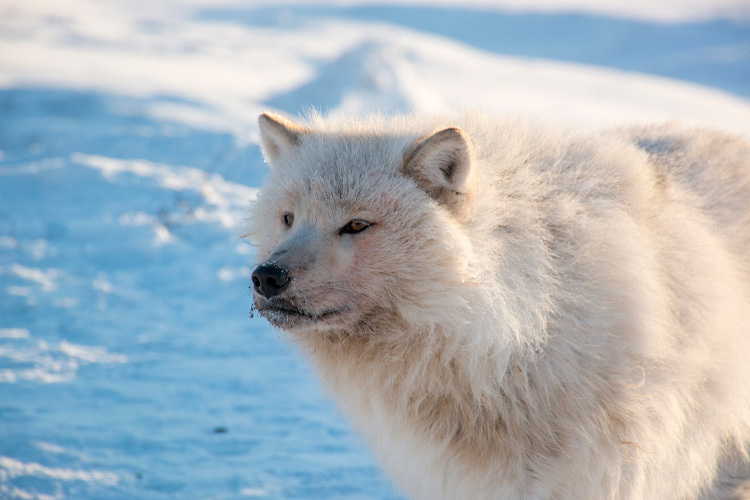
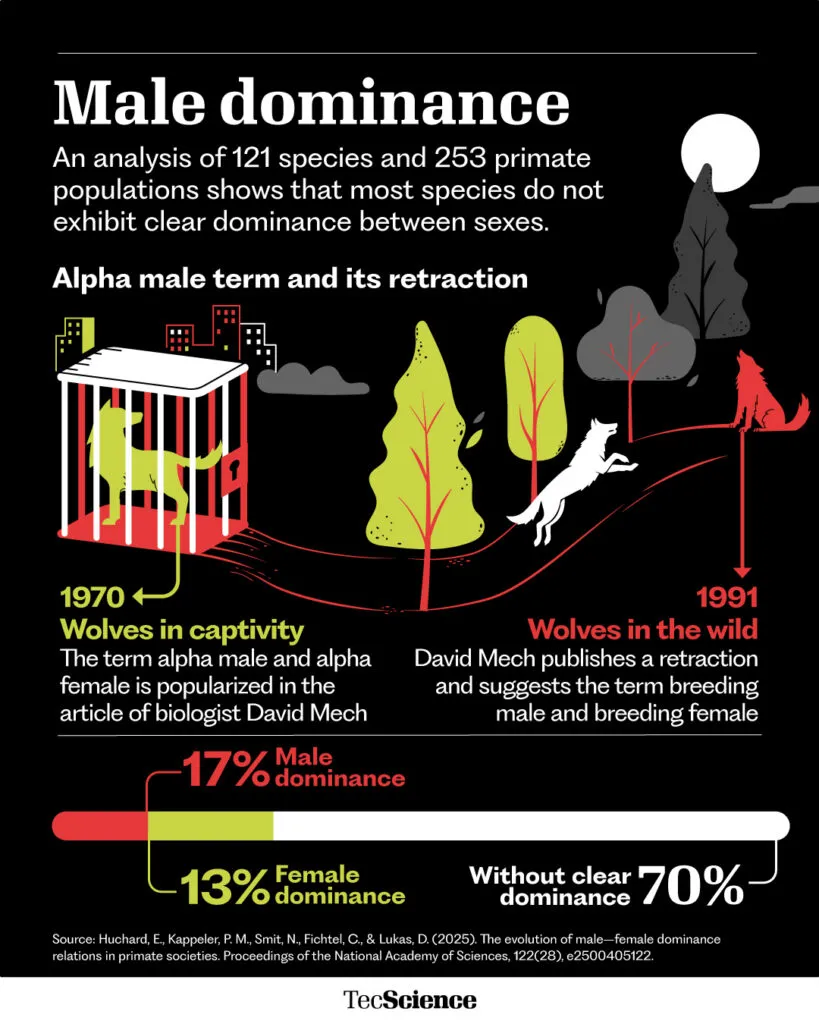
The origin of alpha lies in the study of wolf behavior. In 1970, biologist David Mech published a very famous book that brought together all the information available at the time about the species.
“I’ve been a wolf biologist for my entire career,” says David Mech, researcher at the U.S. Geological Survey and professor at the University of Minnesota.
Among some of his descriptions was the social organization of the packs, which was then based mainly on knowledge gleaned from captive wolves.
The male, who managed to dominate the others through aggression to acquire resources, was named alpha, as was the female who did the same.
Shortly after, the media picked up the term and popularized it so much that it ended up being applied to other species, such as gorillas or humans. Now it is used to give supposed scientific support to gender roles.
The Idea of the Alpha Male Falters
However, what the media failed to mention is that when Mech decided to study wolves in their natural habitat, the idea of the alpha male began to falter.
As him and other researchers continued their studies of these animals, they realized that the herds were not groups of males or females of different origins, but families with a father, a mother, and their offspring.
“Even though I learned that in the 60s and 70s, the idea that I didn’t think the alpha term was appropriate to use for a wolf pack really didn’t come to me until in the 90s,” Mech recalls.
In that decade, the researcher traveled to Ellesmere Island, near the North Pole, where the wolves had not had much contact with humans and were not afraid of them.
“As I watched them, it eventually dawned on me that why are we calling these top ranking animals the alphas when all they are is the parents, just like the ones of a human family,” the expert explains. In his observations, both parents obtained resources for their offspring peacefully, with little to no conflict with other packs.
In 1999, he published his conclusions in an article in which he retracted from the term alpha and proposed that they instead be called simply breeding male and breeding female.
Despite this, by then the term alpha was so popular that there was no way to stop it or reverse its impact.
Primates: A History of Behavioral Diversity
If the term alpha male in wolves is based on a misinterpretation, what about primates, our closest relatives?
Although it is true that there are species —such as chimpanzees and mountain gorillas— that have a marked size difference between females and males and establish a dominance hierarchy, it is actually an uncommon strategy in this group of animals.
An analysis of 121 species found that in 70% there is no clear dominance between sexes, in 17% there is male dominance and in 13% female dominance.
Rather than a single model of social organization based on power, primates show enormous diversity and flexibility in the way males and females relate to one another.
The muriquis or woolly spider monkeys of the Brazilian forest are an example of this.
“They are one of the most peaceful animals in the world that we know of,” says Karen Strier, a primatologist at the University of Wisconsin, Madison. “The relationship between females and males is pretty much egalitarian.”
Males and females form friendships, but the females leave their original group in order to mate, which makes them extremely independent.
And in other species where the male is larger and stronger, different strategies have been observed, such as kindness and friendship, to achieve reproduction.
“We also know from the studies of many researchers, including people who studied baboons —which are one of the most sexually dimorphic species— that there’s an alternative strategy,” says Strier.
According to her, there are males that support the females and even take care of offspring that are not their own.
“Females preferentially associate and mate with these males who are nice,” notes the primatologist, who has studied the muriquis for decades.
A Great Hunter who Turned Out to be Female
If we look at the history of our own species, the idea that men provide and women nurture becomes blurry. For some years now, a new paradigm has emerged that establishes that both sexes hunted and gathered among our ancestors.
A key researcher in this is archaeologist Randall Haas, who is also a professor at the University of Wyoming and an expert on ancestral hunter-gatherer societies.
In 2013, he and his team discovered a nine-thousand-year-old ceremonial burial site in the Andean highlands of Peru. There were remains of many people, but one in particular caught their attention. They named it Warawara.
“It was a young adult individual buried with a large tool kit near their hip,” Haas recalls. “These 22 objects were all stacked on one another, about six of them were projectile points, so very clearly a hunting toolkit.”
While discussing their findings, the scientists spoke about Warawara as a great hunter, a chief they assumed was male.
A few weeks later, Jim Watson, a bioarchaeologist from the University of Arizona, traveled to the site to analyze the remains and told Haas that he had the impression that those of the great hunter were actually those of a female.
In shock, Haas confirmed it by sending the bones to be examined through a method capable of determining with high precision the sex of a skeleton using the proteins in tooth enamel.
“We confirmed at that moment that the individual was a female,” the researcher recalls. The proteins associated with the Y chromosome —related to the male sex— were absent, while those associated with the X chromosome were present in abundance.
Rewriting the History of Ancestral Hunter-Gatherer Societies
After the unexpected discovery, Haas decided to investigate further. He and his team reviewed studies from 107 archaeological sites in the Americas where the sex of bones found during the same period as Warawara, the great huntress, had been estimated.
“When it all summed up, it was like 11 females and 16 males buried with hunting tools,” the archaeologist points out.
By analyzing the spear points under a microscope to see the wear patterns and confirm whether they were used for this activity, there was no doubt that the people buried there used them to hunt large animals.
Haas published a study that, along with other research, confirms that women participated in hunting more actively than previously thought, and that this is something that repeats all over the world.
“These are broadly economically and biologically driven patterns, and I do think they would be much more pervasive than just the Americas,” he reflects.
The reason we didn’t know this before is because of biases that have existed in archaeology, anthropology, and biology, but not necessarily because of ill-intent.
Often, when hunters’ burials were discovered, it wasn’t even determined whether they were male or female. In other cases, when the sex was estimated and a female was found with spears, it was assumed the tools were used for cooking.
Women Hunt Too
What Haas and his team found happens in hunter-gatherer societies today. Contrary to what many believe, there are currently dozens of these societies around the world, and in most of them women actively hunt.
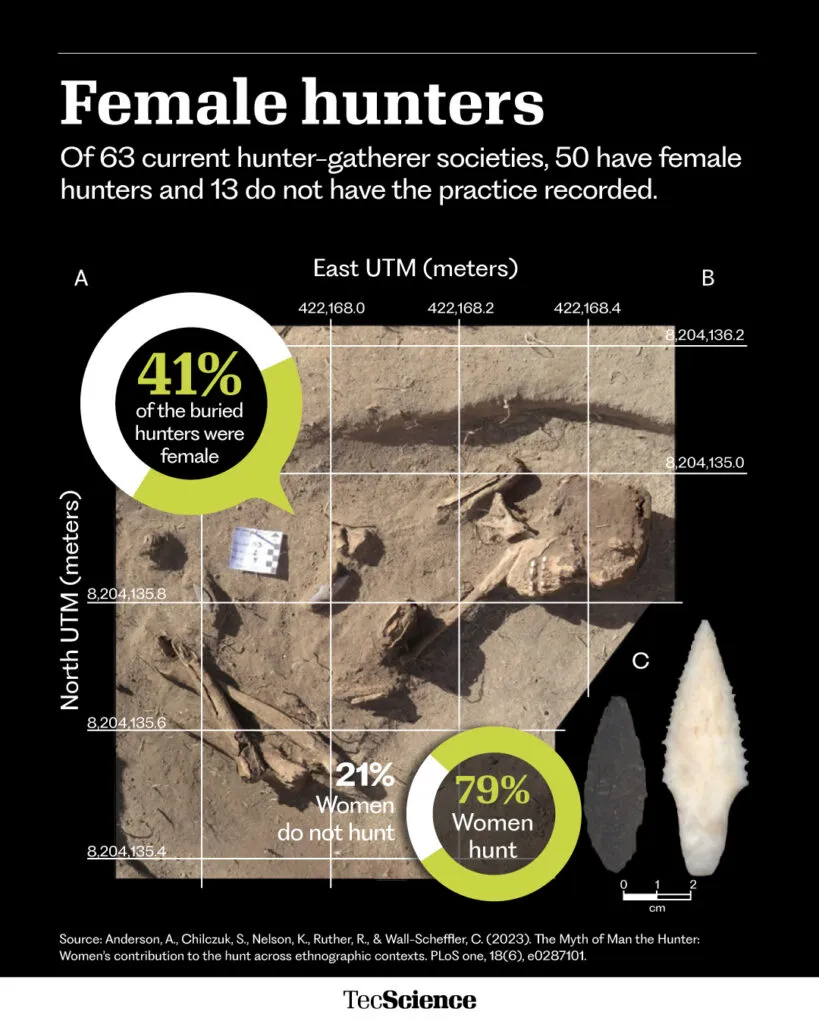
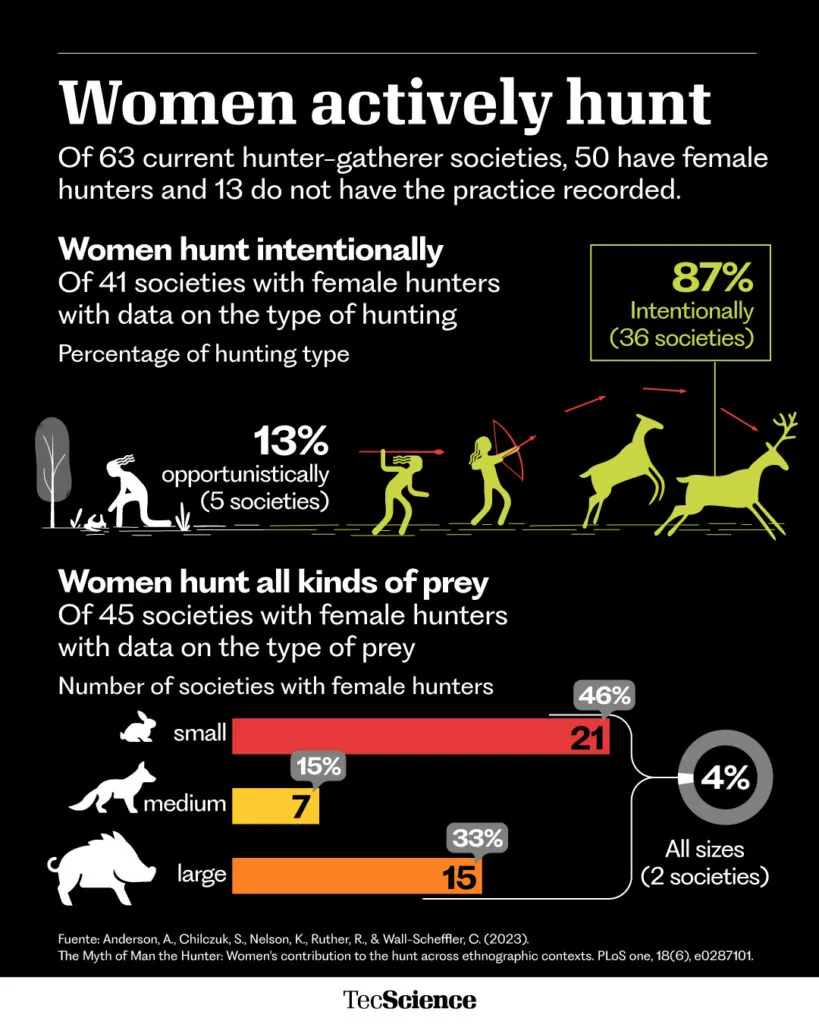
In a recent study, a group of researchers found that out of 63 societies analyzed, 50 had documentation of women hunting, which represents 79%.
“Women are really creative in the tools that they use for hunting, whereas in many cultures men will only hunt with a bow and arrow,” says Cara Wall-Scheffler, a researcher and professor at Seattle Pacific University and one of the authors of that study.
According to their research, female hunting is mostly deliberate and intentional, not opportunistic. Furthermore, 46% hunt small game, 15% medium game, and 33% large game.
“If you’re talking about huge game, then you have humans often killing as a coordinated team, like a drive,” the expert says. “Women and children are totally a part of this.”
Flexibility is our Greatest Evolutionary Advantage
With all this knowledge, it is difficult to argue that current gender roles are an inevitable consequence of our biology.
“The sort of sexual division of labor we experience in society today is not permanent,” says Haas. “It is changeable, it has changed a lot in the past, so there’s nothing natural or fixed about the ways we organize today.”
In reality, if we look at nature and our own history, we find that what truly characterizes us is cooperation and adaptability.
“We are the only single species of primate that is everywhere in the world,” Wall-Scheffler points out. “One of the reasons is because we can learn from each other and be flexible.”
Wolves do not organize their packs in just one way; primates have developed multiple social strategies, and our ancestors did not necessarily divide tasks according to the roles we take for granted today.
Although there is no single origin for the myth of the alpha male and man the hunter, the reality is that these are relatively recent ideas that have not always defined us.
“There’s the story that men are violent and promiscuous because evolution makes them do it,” says Wall-Scheffler. “Before, it was God who made them do it.”
The researchers hope to leave behind the notion that biology justifies the oppression of women and the violence of some men. They also hope that people will recognize that biology does not have to dictate how they have to behave or what they have to do.
“I hope that people feel empowered to recognize that their gifts can be used regardless of what their biology might be,” Wall-Scheffler concludes.
Did you find this story interesting? Would you like to publish it? Contact our content editor to learn more: marianaleonm@tec.mx