
By Miqueas Díaz Maya, Marco Ulloa and Rodolfo Silva
In about 80% of the Gulf of Mexico and the Caribbean Sea, wave conditions show a trend toward greater power: every 10 years, wave power increases by as much as 0.25 kilowatts per meter of wave front.
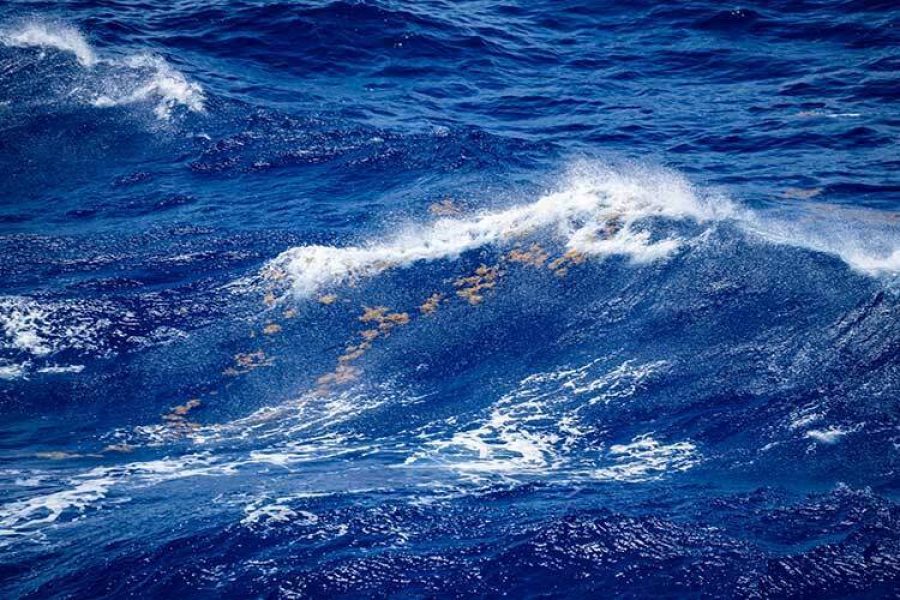
To put this change—which may seem small—into perspective, wave action can be thought of as an enormous hammer constantly pounding the coasts, with increasing power.
If this trend continues for decades, its effects and potential risks will need to be considered for oil platforms, ports, ships along their maritime routes, and coastal ecosystems.
Greater wave power could also be harnessed to generate electricity from the movement of waves, but doing so requires technologies capable of capturing that energy while withstanding marine conditions.
However, changes in wave power are not uniform throughout the year. Winters and springs show the strongest increases, driven by the intensification of cold fronts moving into the Gulf from the north. In summer and fall, parts of the eastern Caribbean show the opposite trend. The sea becomes more energetic in some places and seasons than others, and these differences become more pronounced across the seasons.
These findings come from the study Wave Climate Trends and Teleconnections in the Gulf of Mexico and the Caribbean Sea, which analyzed wave conditions continuously for 42 years [1], hour by hour, across the Gulf of Mexico and the Caribbean Sea.
The researchers used data from a numerical wave model—a computer program that simulates how waves are generated and propagate based on wind data—to reconstruct sea conditions between 1981 and 2022.
A Changing Sea
One of the systems most widely used by the international oceanographic community is WAVEWATCH III [2], developed by the U.S. National Oceanic and Atmospheric Administration (NOAA).
Using detailed data on wind speed and direction from the ERA5 reanalysis [3]—a global climate dataset that combines observations with model data—WAVEWATCH III reconstructed wave conditions hour by hour from 1981 to 2022.
The results were validated against data from 11 oceanographic buoys distributed across both basins, confirming that the findings accurately represent conditions observed over those four decades.
The study also examined whether global climate indices—El Niño, the North Atlantic Oscillation, and the Atlantic Multidecadal Oscillation—influence wave propagation. In the Caribbean, the answer is yes, and the effect is substantial.
In recent years, El Niño has been a major topic of conversation: droughts in Indonesia, torrential rains in Peru, unusually warm or cold winters. What is less widely known is that this phenomenon, which originates in the tropical Pacific, can also alter waves in the Caribbean, more than 2,000 kilometers away. The connection becomes clear when looking at the strongest El Niño events—1982–83, 1997–98, and 2015–16—when wave power in the central Caribbean increased noticeably.
The mechanism is relatively straightforward: El Niño weakens the trade winds, air currents that normally blow from east to west across the tropical Pacific. This shift changes both how waves are generated in different regions and the swell that can travel thousands of kilometers before reaching other coasts.
The Gulf of Mexico, by contrast, is a semi-enclosed basin and responds less to these global climate indices. Its wave conditions are driven primarily by local processes, including winter northerly storms and tropical cyclones in summer.
Ocean in Motion: The Challenge
For Mexico, with more than 11,000 kilometers of coastline and an economy that ranges from small-scale fishing to oil extraction, understanding how wave conditions have changed over four decades is essential.
On one hand, more energetic winter waves increase risks to marine infrastructure and can make navigation more difficult along routes connecting the Panama Canal with Gulf ports. On the other, areas where wave power increases steadily could represent an expanding renewable energy resource.
Wave energy converters—devices that transform the movement of waves into electricity—could find increasingly favorable conditions in these areas, creating an opportunity to diversify the country’s energy mix from its own coastlines.
The key is to learn how to read the pulse of the sea: understanding where, when, and how much wave power is changing will be essential to anticipating its effects on coastlines, adapting infrastructure, and, where feasible, harnessing a source of energy driven by the ocean itself.
References
- Diaz-Maya, M., Ulloa, M. & Silva, R. (2026). Wave Climate Trends and Teleconnections in the Gulf of Mexico and the Caribbean Sea. Journal of Marine Science and Engineering, 14, 853.
- WAVEWATCH III Development Group. User Manual and System Documentation of WAVEWATCH III® Version 6.07; NOAA/NWS/NCEP/MMAB: College Park, MD, USA, 2019; p. 465.
- Copernicus Climate Change Service (C3S). ERA5: Fifth Generation of ECMWF Atmospheric Reanalysis of the Global Climate; Copernicus Climate Change Service: Reading, UK, 2017.
Authors
Miqueas Díaz Maya. Postdoctoral researcher at the Center for Advanced Research in Applied Science and Advanced Technology (CICATA), Altamira Unit, at the National Polytechnic Institute (IPN). His work focuses on numerical wave modeling and the use of marine energy as a renewable resource.
Marco Ulloa. Research professor at the Center for Advanced Research in Applied Science and Advanced Technology (CICATA), Altamira Unit, at the National Polytechnic Institute (IPN). His research encompasses physical oceanography and limnology, with an emphasis on developing low-cost electronic instrumentation and understanding processes that occur in inland waters as well as along the northeastern coast of Mexico.
Rodolfo Silva. Research professor at the Institute of Engineering at the National Autonomous University of Mexico (UNAM). His work combines coastal engineering and ocean energy research, with a particular focus on the processes governing interactions among waves, coastlines, and marine infrastructure.