

Learning humanities in an immersive environment could lead to greater student presence and engagement than a traditional classroom. To understand what changes in their brain and body in these different environments, a group of researchers from Tec de Monterrey compared the learning experience between a semi-immersive classroom and a traditional one.
Experts believe that in particular, the traditional methods used to teach humanities, such as reading texts or analyzing works of art, could be complemented by experiences that involve other senses.
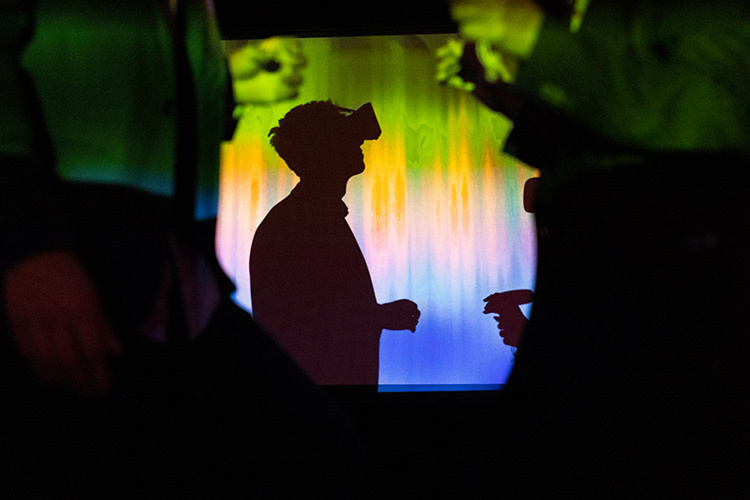
To analyze it, they worked in the Neurohumanities Lab, an experimental space that uses projections, sound, movement and facial expression recognition systems to generate immersive experiences.

“The arts and humanities can take advantage of these innovative technologies to create spaces that involve more and new cognitive processes,” says Manuel Cebral, a research professor at the School of Humanities and Education (EHE) of Tec de Monterrey and one of the authors of the article.
The study was conducted in collaboration with researchers from the EHE and the School of Engineering and Sciences (EIC) of Tec de Monterrey.
The experts compared a semi-immersive humanities class with a traditional class. In both scenarios, they measured variables such as brain activity, body arousal, heart rate, and facial expressions to go beyond simply asking students if they felt engaged.
The Semi-Immersive Experience Resulted in a Greater Sense of Presence

To test the idea that immersion can improve the humanities classroom experience, researchers recruited 24 students between the ages of 18 and 25. They divided them into two groups: 12 in the semi-immersive experience and 12 in the traditional one.
In both types of activities, students participated in activities inspired by René Descartes’ book, The Passions of the Soul. These activities revolved around emotions such as love, hate, desire, joy, and sadness.
The students expressed emotions, associated words with them, worked with literary fragments, and observed a painting, while the researchers recorded their brain, physiological, and emotional responses.
To do this, they used different types of sensors to record the electrical activity of the brain and body, using an electroencephalogram (EEG), changes in skin conductance and heart rate, as well as facial expressions using automated emotion recognition.
They also analyzed the participants’ words and responses and, at the end of the activities, administered a questionnaire to find out how present and involved they had felt.
Overall, the semi-immersive experience produced some clear differences compared to the traditional one, as students reported a greater sense of spatial presence, showed a greater variety of expressed emotions, and differences in brain activity patterns and physiological response.
“They were able to link more words and used more varied ones, and the emotional and somatosensory processing was greater,” Cebral explains.
However, in one of the activities, the traditional group showed a greater sense of presence than the semi-immersive group. According to the researchers, the difference could lie in the design of the activity.
This suggests that a technologically sophisticated experience does not necessarily generate greater involvement if the activity does not require active and meaningful participation from the student.

The Future of Immersion in Education
For Cebral, this study is a starting point and not a definitive conclusion, as it has several limitations.
The first is that a single session is insufficient to determine whether such an experience modifies behaviors or attitudes in the long term.

Furthermore, the study had a small sample size and “although the difference between the two groups was statistically significant, it wasn’t that great either,” Cebral says.
Therefore, in the future the team plans to conduct longitudinal studies that will allow each participant to be compared with themselves and with their baseline state, in addition to incorporating more precise measurements of the brain’s response to words and images.
Rather than demonstrating that a semi-immersive experience makes students learn better, the study suggests that it can change the way students engage physiologically and subjectively with the content that is taught.
The study raises the possibility that technologies traditionally used to study the brain, emotions, and behavior could also become tools for investigating questions that are specific to the humanities.
Did you find this story interesting? Would you like to publish it? Contact our content editor to learn more: marianaleonm@tec.mx