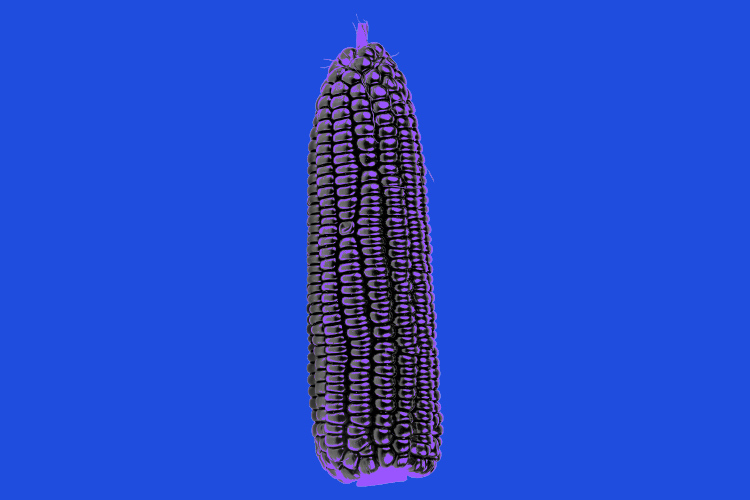


Soil salinity limits agricultural productivity, and fungal contamination of seeds poses a risk to consumer health. In response to these problems, a group of researchers has created a pre-planting treatment that combines ultraviolet light radiation and a spirulina solution, which they have tested on native maize varieties.
When the soil has a high concentration of salts, seeds may have difficulty absorbing water and beginning their development. This affects germination, root growth, and the initial development of the plants.
On the other hand, when a grain has large amounts of starch, such as maize, it can be susceptible to fungal infections that in turn release toxins that are dangerous to humans, and have been associated with cancer and metabolic problems.
To find solutions, global research has focused on seed priming, a set of pre-planting treatments that activate physiological processes and prevent infections.
In a collaborative project, researchers from the School of Mechanical and Electrical Engineering (ESIME) of the National Polytechnic Institute (IPN), the School of Architecture, Art and Design (EAAD) and the AI for Manufacturing & Supply Chain Institute (AIMS) of Tec de Monterrey, tested one of these techniques on native maize seeds.
“The goal is to have alternative methods that do not harm the soil and environment, but that can address the main problems we face when planting,” says Claudia Hernández, a researcher at ESIME and leader of the study.
Traditionally, treatments involve aggressive substances that can damage the ecosystems where they are used.
Two Treatments that Enhance Each Other
Ultraviolet radiation —specifically UV-C, which has a short wavelength— can stimulate certain physiological responses in seeds and help reduce microorganisms that are present on their surface.
On the other hand, spirulina, a cyanobacterium used as a food supplement, is rich in amino acids, vitamins and minerals, so it acts as a biostimulant to promote the early development of seedlings.
Previous research by the group led by Hernández at ESIME had already studied ultraviolet radiation and biostimulants in different seeds separately, but they wanted to understand how they worked when combined, as well as the duration of irradiation and concentration that offered the best results in native maize specifically.
“Although they each have an effect on physiological and health quality, we expected that combining them would make it more powerful,” explains Hernández.
The methodology used to answer their questions involved first placing the seeds inside a UV-C irradiation prototype for 10 to 15 minutes. Next, they submerged the seeds for several hours in a solution of water and spirulina. Finally, they placed the seeds in Petri dishes lined with filter paper, where they measured germination, initial growth, and the presence of fungi.
They performed different combinations of irradiation duration and spirulina concentration and found that the ideal is to expose the native corn to 10 minutes of radiation and a solution with 0.5 grams of the biostimulant per liter of water.
“We also analyzed four different UV-C radiation prototypes to find out how they responded,” says Juana Isabel Méndez, a research professor at EAAD who participated in the study.
From the Laboratory to the Field
After performing various statistical analyses, they found that this treatment results in a higher germination rate, a greater number of germinated plants, greater tolerance to salinity, and less fungal infestation.
With this, the research demonstrates that the combination of both treatments is a sustainable alternative to improve certain markers in native maize.
Among the limitations of the study, the researchers point out that these are experimental tests of germination and early development, not agricultural yield trials, because they do not demonstrate how much the harvest would increase under real growing conditions.
They also point out that technology adoption can be complicated in the field, so further evaluations are necessary.
According to Hernández, in interactions with farmers they found that it is necessary to first raise awareness so that they know that seeds can be contaminated, even when it is not visible to the naked eye.
“We need to discuss these and other results with them so that we can provide feedback and the final proposal can be accepted by the people naturally,” says Hernández.
Thus, this type of research, along with social and political actions, could improve the way we produce food.
“Sometimes, the seed being given to the population is not of the best quality,” Méndez says.
Did you find this story interesting? Would you like to publish it? Contact our content editor to learn more: marianaleonm@tec.mx