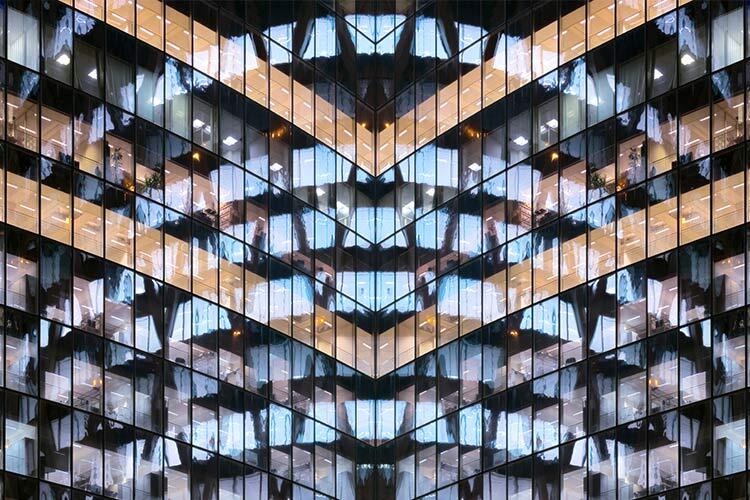


A group of researchers has created a smart window that can generate electricity, reduce the heat that enters a building, and even function as a lamp at night. In cities with high temperatures like Monterrey, this technology has the potential to reduce air conditioning use and energy consumption.
Traditionally, windows simply separate the inside from the outside, but the researchers behind GEMMA saw in them the possibility of improving the sustainability of buildings and contributing to their decarbonization.
The proposal combines several layers with different functions, which seek to control what part of the solar radiation enters the building, which is transformed into electricity, and which is converted into light.
“The technologies we use already exist; what we are doing is integrating them,” says José Huertas, a research professor at the School of Engineering and Sciences (EIC) of Tecnológico de Monterrey.
Currently, up to 30% of a building’s energy consumption is spent on air conditioning systems and, ironically, these same systems increase the temperature outside the buildings, generating heat islands.
In the context of climate change, having a window that can reduce the amount of heat that enters could keep interiors cool and lessen cities’ dependence on conditioning technologies.
So far, the smart window is just a prototype, but in tests conducted by the team, it already shows a 20% reduction in the amount of heat that passes through. Simulations show that it could decrease the energy needed to cool a building by 3.9% annually.
The Layers of GEMMA
GEMMA works with layers that perform different tasks. The first is an anti-reflective absorbent film whose function is to capture solar radiation and reduce the amount of energy that bounces back into the interior.
Next comes a semi-transparent perovskite solar cell, a titanium and calcium oxide mineral with a crystalline structure that allows the creation of solar panels that are not completely opaque.
The team is working on manufacturing these cells using Direct Ink Writing (DIW), a 3D printing technique that allows this mineral to be deposited in thin layers. In this way, the cells harness solar radiation that is invisible to the human eye while allowing visible radiation to pass through.
“What we are looking for is that what we save in energy will cover the cost of replacing the traditional window,” Huertas explains.
The next layer is a smart film based on polymer-dispersed liquid crystals (PDLC). When it receives electricity, its molecules align and the window can switch from opaque to transparent, allowing the user to regulate the amount of light entering the space.

Next comes the lighting layer made of gels with suspended nanoparticles that redirects light inwards in a controlled manner. Finally, there is the thermal insulation layer that prevents unwanted heat transfer to the interior.
For now, GEMMA is still a prototype under development, but the researchers, Huertas, Manuel Ávila, a research professor at EIC, and many graduate and postgraduate students are looking to take it to a technological maturity level of TRL 2 to TRL 4.
“In the future, let’s say a year from now, the plan is to move it to a building or an office, and let it work to see if it performs well,” says Huertas.
The dream is to continue finding collaborators and investors so that eventually —in a few years— entire buildings can have these windows.
Did this story interest you? Would you like to publish it? Contact our content editor to learn more: marianaleonm@tec.mx