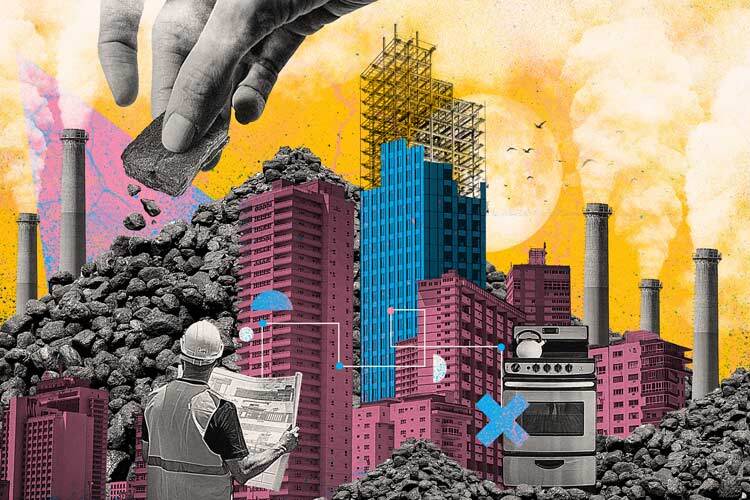


In July, South Korean automaker Kia announced a $649 million investment to boost production in Mexico of the EV3, its first fully electric vehicle to be manufactured in Nuevo León. The investment includes plans to develop a charging network, build a solar park, and construct a wastewater treatment plant.
The investment is among the projects aligned with Plan México, a federal government strategy aimed at strengthening the country’s productive sectors while promoting a transition toward more sustainable industries.
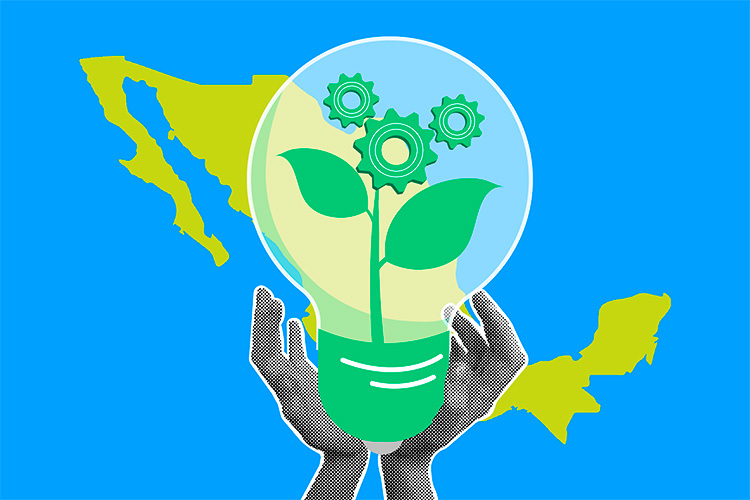
The arrival and growth of industries tied to the energy transition, such as electric mobility, are among the developments that Greening Mexico seeks to understand. Led by researchers at Tecnológico de Monterrey, the project examines green industrial policies in Mexico and the capacity of individual states to foster these sectors.
What Is A Green Industrial Policy?
Industrial policies are tools governments use to promote productive sectors, including tax incentives, preferential loans, and subsidies designed to attract greater investment.
When these policies have a green focus, they aim to support sectors related to renewable energy, batteries, solar panel components, and electricity transmission infrastructure.
However, Mariana Rangel Padilla, a research professor at the School of Social Sciences and Government (ECSG), says that developing these sectors also has environmental impacts. That is why it is important to study how green industrial policies are designed and implemented, as well as their effects on the regions where they are put into practice.
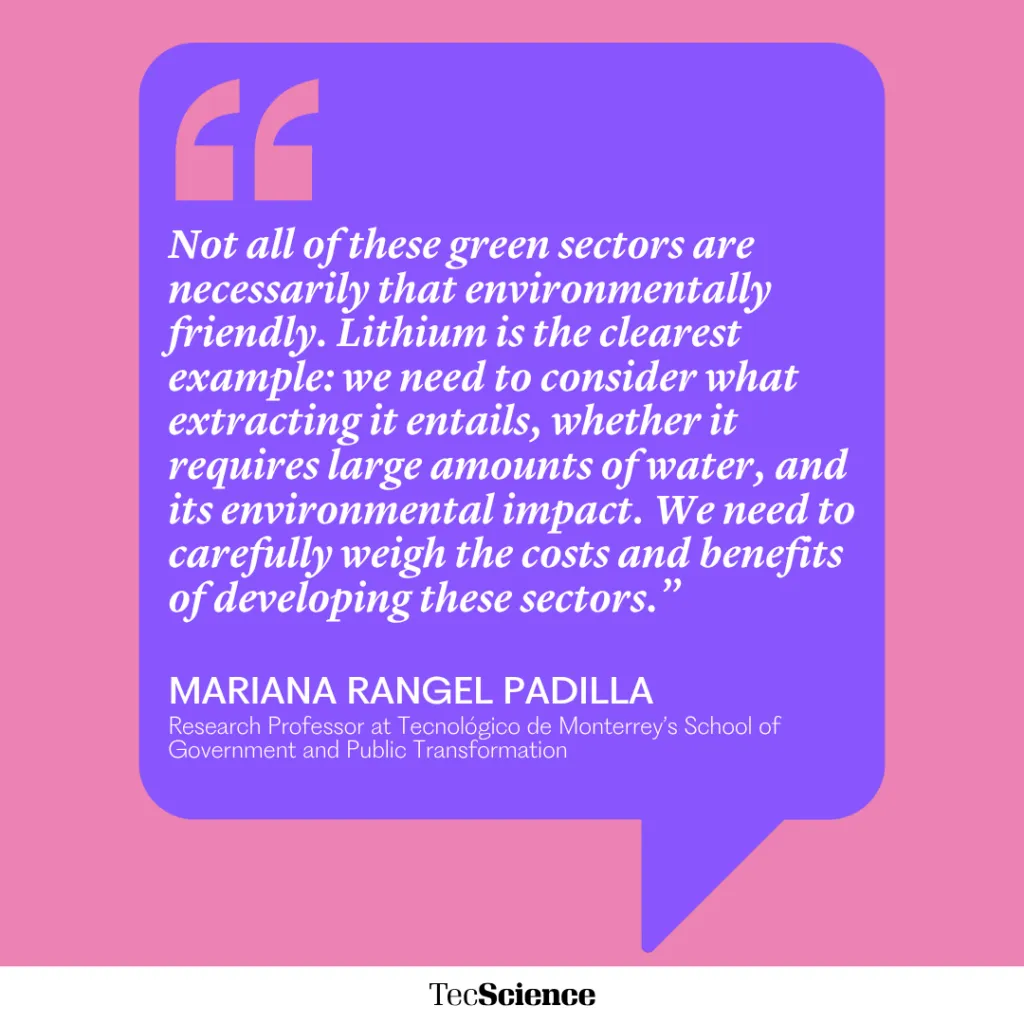
“Not all of these green sectors are necessarily that environmentally friendly. Lithium is the clearest example: we need to consider what extracting it entails, whether it requires large amounts of water, and its environmental impact. We need to carefully weigh the costs and benefits of developing these sectors,” Rangel Padilla says.
What Conditions Enable Industries Supported By Green Policies To Thrive?

Rangel Padilla explains that the initiative seeks to understand the conditions that allow these industries to develop in different regions of the country, as well as the role played by public policy, financing, talent development, and coordination among governments, businesses, and universities.
“It doesn’t happen by chance. Goals are set, negotiations take place, and stakeholders assess what incentives are needed, which suppliers need to come in, and what kinds of skills technicians and engineers need to develop,” Rangel Padilla says.
The project also involves Ernesto Stein and Sebastián Mazzuca, researchers at the ECSG who are part of Tec’s Faculty of Excellence program. It is also being carried out in collaboration with the Net Zero Industrial Policy Lab at Johns Hopkins University.
State Capacity For A Green Transition
For state governments, designing green industrial policies is not enough; they must also put them into practice with financial resources, skilled personnel, and technical expertise.
“Collaboration among government, businesses, and academia is essential because no single actor has a complete understanding of what is needed. There is a strong need for coordination, both on the government side, in terms of training, regulations, and standards, and on the business side, to share information about their expectations and needs,” Rangel Padilla adds.
For example, Rangel Padilla says the project evaluates factors such as the experience and tenure of officials responsible for these policies, particularly those in middle-management positions within state governments, as well as their knowledge of the industry and their ability to connect businesses, governments, and other stakeholders.
“Having an official who understands the industry or the business world, knows the costs companies face, and can bring different stakeholders together is very different from having someone whose skills are not suited to developing and implementing industrial policy.”
From Case Studies To A National Database
To assess these capabilities, the researchers are combining case studies with the development of a database that will enable quantitative analysis. They compare states that have adopted similar policies to examine how those policies have been implemented and identify factors that may explain different outcomes in areas such as job and business creation and the integration of local suppliers into new projects.
To build the database, the researchers are working with the Net Zero Industrial Policy Lab to gather information on policies and state-level capabilities across Mexico’s 32 states. The repository will be used to test hypotheses about the factors that may influence the adoption and implementation of these policies.
One of the sectors the project is currently studying is electric vehicles. The team is gathering data on the development of the industry in Nuevo León, Puebla, and San Luis Potosí to analyze the strategies pursued by each state.
Greening Mexico: An Observatory For Green Industrial Policies
The researchers are also developing the Greening Mexico Industrial Policy Observatory, a digital platform that will track industrial policies as they are implemented.
The tool is expected to launch by the end of 2026, the researcher says. She explains that the platform will use interactive maps to show where these initiatives are announced, track their implementation, and analyze coordination among governments.
It will also include information on electric mobility strategies, industrial parks with net-zero emissions targets, and the capabilities of state energy agencies.
In addition to producing scientific publications, the team wants its data and case studies to be useful to policymakers.
“We want to produce policy briefs that identify bottlenecks or success stories, while also looking at how closely federal and subnational policies are aligned,” Rangel Padilla says. “If we can identify some of the factors behind successful outcomes and opportunities for Mexico to enter new niches, we can use green growth as a driver of development.”
Did you find this story interesting? Would you like to publish it? Contact our content editor to learn more at marianaleonm@tec.mx