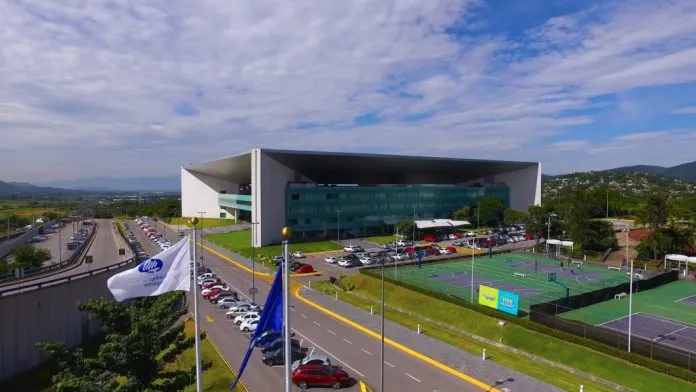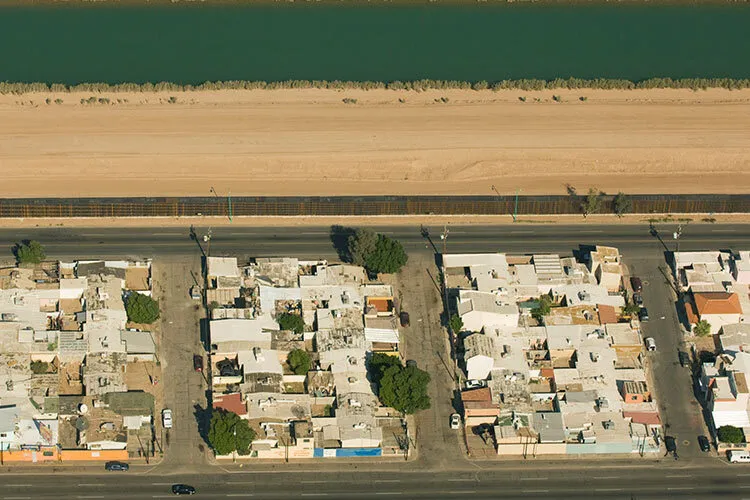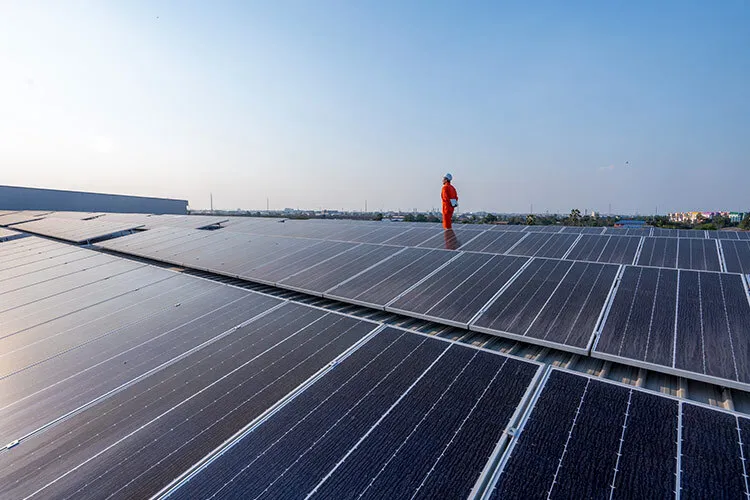


Many industrial buildings and warehouses in Mexico are constructed with metal roofs because they are an economical and practical option.
However, this solution has a significant drawback: metal roofs absorb large amounts of solar radiation.
During the day, the metal heats up and transmits that heat into the building, raising the temperature and making the spaces uncomfortable for those who work there.
The most common way to deal with this problem is by using ventilation or air conditioning, which involves higher energy consumption and costs.
The study Passive Thermal Enhancement of Composite Metallic Roofs Through Rooftop PV Integration: A Calibrated Case Study in Mexico proposes a simple and sustainable alternative: taking advantage of photovoltaic solar panels to generate energy and reduce heat.
“The idea is based on passive architecture,” says Isabel Méndez, researcher at the School of Architecture, Art and Design (EAAD) and the School of Engineering and Sciences (EIC) at Tec de Monterrey.
“It’s about how you can propose a space that requires the least possible use of active technologies, such as air conditioning.”
When placed on the metal roof, the panels act as a permanent shade, blocking some of the sun’s direct radiation. They also create a small gap between the panel and the roof, allowing heat to dissipate before reaching the interior.
To verify the effect, a multidisciplinary team analyzed three industrial warehouses in the State of Mexico.
The team included researchers from EAAD, EIC, the Institute of Advanced Materials for Sustainable Manufacturing (IAMSM) and the California Institute for Energy and Environment at the University of California, Berkeley.
They compared the buildings’ thermal behaviour with and without solar panels installed.
“With the energy models I do, I can model any space, anywhere in the world,” says Méndez.
Metal Roofs and the Thermal Challenge in Industrial Buildings
Through energy simulations based on real data and local weather conditions, the researchers assessed how the indoor temperature changed throughout the year.
The goal was to find out how much electricity could be generated and to understand if this integration could improve thermal comfort without additional cooling systems.
The results were clear: buildings with solar panels on their roofs heated up less. Compared to metal roofs exposed to the sun, the buildings with panels registered lower interior temperatures, especially during peak solar radiation hours. In some cases, the difference was enough to make the space feel noticeably cooler.
“The simple orientation of the panel prevents direct solar radiation from entering,” Méndez explains.
This temperature drop had a direct impact on thermal comfort: the models showed that the hours of the day in which the interior of the building remained in more comfortable ranges, without the need for air conditioning, increased.
For industrial spaces, where climate control is often limited, this improvement can make a significant difference in the quality of the work environment.
Energy and Comfort as Part of the Same Design
The most interesting aspect is that this thermal benefit complements the panels’ primary function: generating renewable energy.
In other words, the same infrastructure fulfils two objectives simultaneously. On the one hand, it produces clean electricity, and on the other, it acts as a passive solution for mitigating heat.
“The sustainability of the processes is a very important part for us,” says Cristopher Muñoz, professor at EIC, Campus Hidalgo.
This approach encourages us to rethink how industrial buildings are designed and adapted to warm climates.
Instead of viewing solar panels solely as an energy source, the study shows that they can also be an architectural and environmental tool.
“After long periods of work in extreme heat, dehydration and other long-term illnesses can occur,” says Muñoz.
In the context of climate change, high temperatures and the need to reduce energy consumption, integrated solutions like this offer a practical and accessible path towards more efficient, comfortable and sustainable buildings, without adding complex or expensive technologies.
Did you find this story interesting? Would you like to publish it? Contact our content editor to learn more: marianaleonm@tec.mx