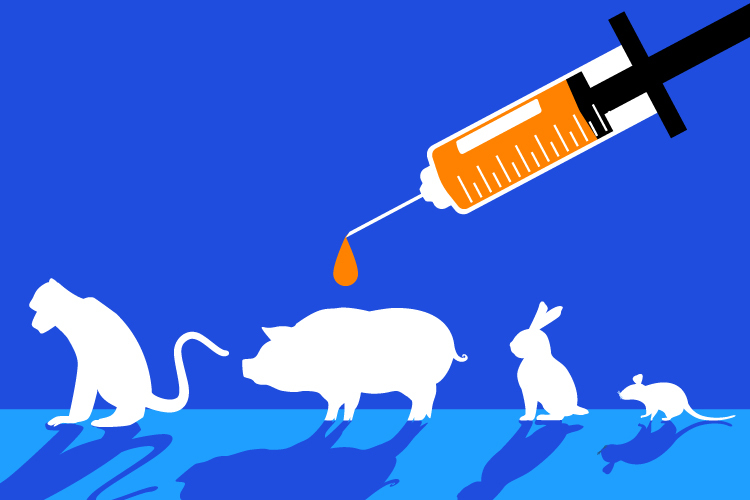


To graduate from my Bachelor’s Degree in Biology at the Faculty of Sciences of the National Autonomous University of Mexico (UNAM), I wrote my thesis in a laboratory that studies memory and learning. Our models were lab rats and mice.
At first, I was so excited about learning and contributing to the development of science that I didn’t pay much attention to how it made me feel to experiment with sentient beings.
Eventually, the more I experimented with them, the more I realized how deeply intelligent, tender, and unique they are. The more my empathy grew towards them, the harder it became to see them solely as study subjects.
Like many other scientists who have experimented on animals, I began to question if they are truly necessary for the advancement of research and whether there was a way to prevent so many from dying in the name of science and for the benefit of humanity.
Over time, I decided to focus on my career as a journalist, but my concern about the ethics behind the use of animal models never faded.
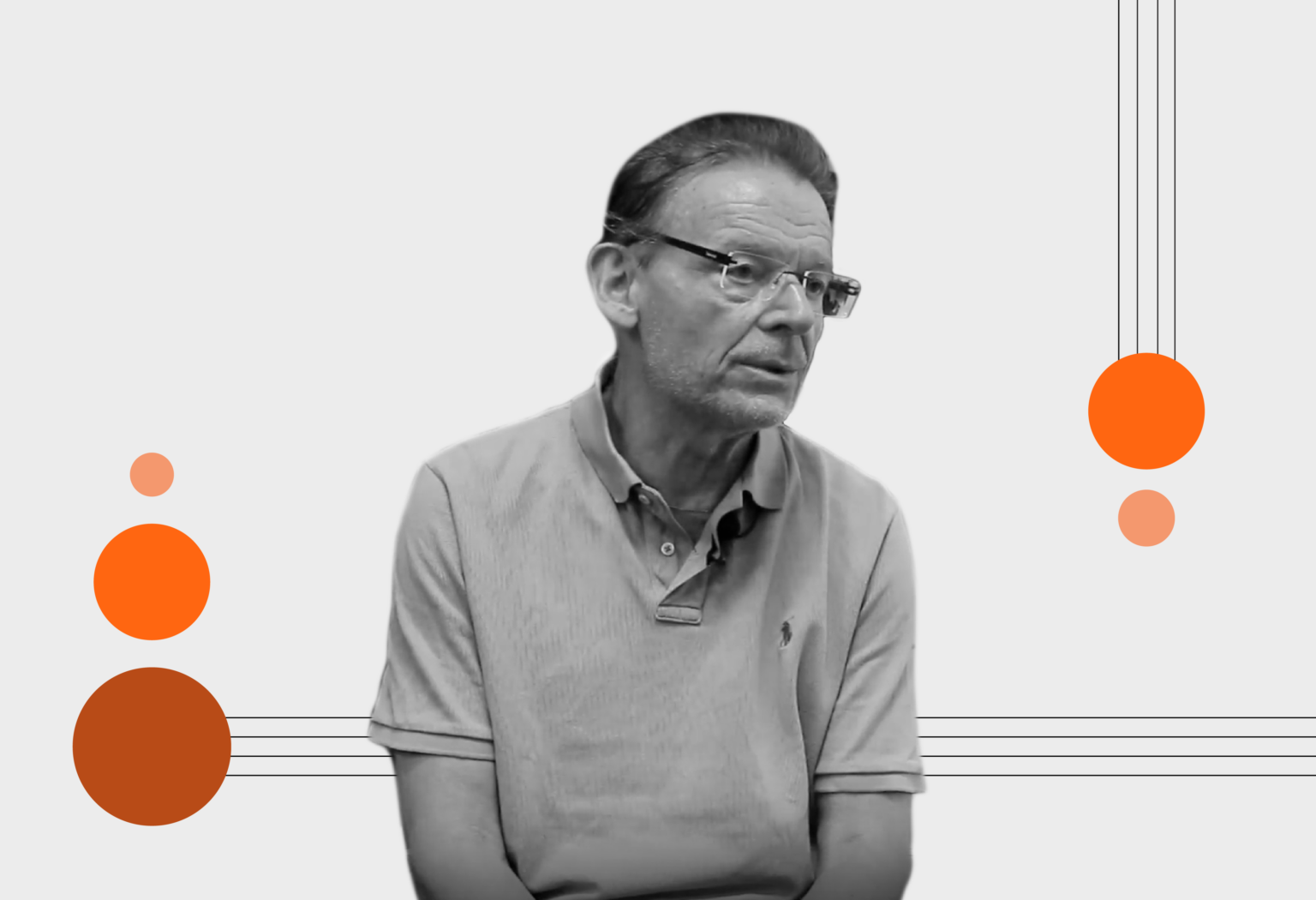
“I followed my mentor into pharmacology and toxicology,” says Thomas Hartung, a professor at Johns Hopkins University and director of the Center for Alternatives to Animal Testing (CAAT). “I did my share of animal experiments in this education, but I always needed a big glass of whiskey in the evening.”
Hartung, like me, began to experience feelings of guilt and sadness when experimenting on animals and decided to do something about it.
Throughout his career—spanning more than thirty years—he has demonstrated that many pharmacological and research processes don’t actually require these organisms, that there are ways to replace them and become less dependent on them.
We Have Alternatives, but the Transition To Replace Them is Slow
Although Hollywood movies portray otherwise, most people who conduct research do not like experimenting with animals and respect and value them greatly. In the lab where I worked, every Day of the Dead, a colleague would set up an altar to the mice and rats she had experimented on.
This doesn’t mean there aren’t cases where people use experimentation as an excuse to abuse and mistreat animals, but, in general, their use is increasingly regulated, which provides them with some protection.
Despite these regulations—and that most scientists recognize that they are the unsung heroes of science, pharmacology, and medicine—research into reducing their use has not advanced as rapidly as some of us would like.
“I think we’re taking too long,” says Hartung, who in 1996 designed an in vitro version of a test for pyrogens—fever-producing agents that can contaminate injectable drugs—that didn’t require rabbits.
This test was approved as an alternative to the use of this animal model, but to date, the pharmaceutical industry often continues to use these animals.
Fortunately, thanks to animal rights movements and scientific efforts, there are increasingly more laws to protect them. A clear example is that 45 countries, including Mexico, now have laws prohibiting animal testing for the development of cosmetic products.
“While this approach –using animal models– is completely anthropocentric, that doesn’t mean that animal welfare isn’t considered,” says Elena González, a research professor at the Institute for Obesity Research (IOR) of the Monterrey Institute of Technology and president of the Institutional Committee for the Care and Use of Laboratory Animals (CICUAL).
According to her, in all research or educational activities that require animal models at the institution, ensuring that they live in dignified, healthy, and hygienic conditions is prioritized.
The six Rs: Reduce, Refine, Replace, Relevance, Performance, and Reproducibility
Although it may sound new, seeking to improve the way we use animals in science has been advancing for years. In 1950, for example, Laboratory Animal Science emerged, based on the ethical principles of the three Rs: reduce, refine, and replace.
- Reducing refers to using the fewest animals possible to extract the most information.
- Refining refers to improving procedures to ensure your well-being, minimizing your pain and suffering as much as possible.
- Replacing refers to using alternative methods of experimentation whenever possible.
“Right now we’re already working on the 6 Rs, also focusing on relevance, performance, and reproducibility,” says González.
Relevance refers to how relevant the study will be to human health, performance refers to monitoring the quality and applicability of the results obtained, and reproducibility refers to focusing on reproducible results so that clinical trials can be completed more quickly.
These principles are now used in the various bioethical guidelines for animal testing that exist around the world.
In Mexico, animal use is regulated by Mexican Official Standard (NOM) 062, which specifies how the production, care, and use of laboratory animals should be carried out to ensure they receive ethical and dignified treatment.
But to stop using animals in science, medicine, and pharmacology, we would first need to find equally or more effective alternatives to replace them.
Machine Learning, 3D Models, and Organs-On-a-Chip to Replace Animal Models
Machine learning is one of the options for replacing animals in science, research, and medicine. Hartung and his team have used this approach to analyze large toxicological databases to predict potential harmful effects of substances or medications on the human body.
Over time, they’ve shown that when these models are well-designed, they can match or exceed the predictive accuracy offered by animal testing. “Our current model is based on 140 million substances,” says Hartung.
There are also organs-on-chips —miniature 3D-printed models made from human cells—that allow for the study of diseases, organ interactions and the testing of drugs. Over time, they could completely replace the use of animals in clinical trials.
Another innovation involves 3D models of human organs and tissues that are increasingly realistic, allowing doctors to rehearse before surgery or medical students to learn without using animals, such as pigs.
With these and other technologies, such as Artificial Intelligence (AI), computational models, and advanced human simulators, the use of animal models could be reduced until they are only used when it is strictly necessary.
Hartung argues that, in addition, as humanity we must change our mindset and accept that these living beings are not always the best way to study human disease.
“In science, a big problem is that we have not been addressing the shortcomings of animal testing systematically,” says the researcher. “We should not use the black-box rats, mice, and rabbits just because they can walk; they’re not 70-kilogram rats.”
With all this, my hope is that as humanity, with the reflections of those of us who have been close to these experiments and the efforts of those seeking to replace them will bear fruit—soon.
Were you interested in this story? Would you like to publish it? Contact our content editor to learn more: marianaleonm@tec.mx