

In 2018, part of humanity’s history was lost in a fire that tore through Brazil’s National Museum in Rio de Janeiro. The blaze destroyed nearly the entire anthropology and history collection, which housed close to 20 million items, including fossils, dinosaur bones, mummies, documents, and archaeological artifacts from Latin American cultures, as well as from the Egyptian, Greek, and Roman civilizations.
For archaeologists, historians, and researchers, the fire underscored the vulnerability of cultural heritage and the urgent need to find new ways to preserve collections, such as technologies that enable their digitization and analysis, including artificial intelligence (AI) and machine learning.
But the challenge goes far beyond simply “scanning” artifacts or documents. Javier Pereda, a research professor at the School of Humanities and Education at Tecnológico de Monterrey, explains that preserving cultural heritage digitally requires an entire infrastructure of servers, databases, and platforms capable of processing massive amounts of historical information.
“It serves different purposes: the most immediate is preservation and protection — which, in fact, is an obligation — but having digital records also makes it possible to manage these collections in a more accessible and sustainable way,” says Pereda, a web scientist specializing in digital historical heritage, a field focused on the infrastructures and digital ecosystems used for preservation.
Digitization also allows documents to be reused and transformed into new knowledge. People can access materials as electronic archives and use them for research, a practice known as the “reuse of digital objects.”
The Responsibility of Digitizing Knowledge
Through these databases, people can access historical materials that would otherwise be difficult to consult, such as Nahua manuscripts housed at The British Library in Europe. “What happens if you’re Mexican or belong to a Nahua community? You can’t just travel to London to access your own knowledge. Institutions have certain obligations to digitize this content and make it accessible in ways that allow it to be reused.”
Much of the heritage safeguarded by these organizations also remains out of public reach. “What we see represents less than 1% of the collections. Most of it is kept in storage, either to protect the materials or because of their fragility. So we’re caught between the risk of losing information and not even knowing what we actually have.”
This kind of infrastructure aims to make public investment in digital heritage worthwhile by turning collections into systems that generate value for innovation projects and product development in the creative industries, including cultural studies, audiovisual productions, virtual tours, immersive museum experiences, and video games.
Cultural Heritage With a Return on Investment
“In the United Kingdom, economic studies are conducted to ensure that for every pound invested there is a fourfold return, and that can be measured through different forms of value, whether social, economic, or cultural,” the researcher explains. “If you begin opening access to Indigenous knowledge about medicinal plants, that can help generate medicines, pharmaceuticals, and vitamins — and create an enormous economy around it.”
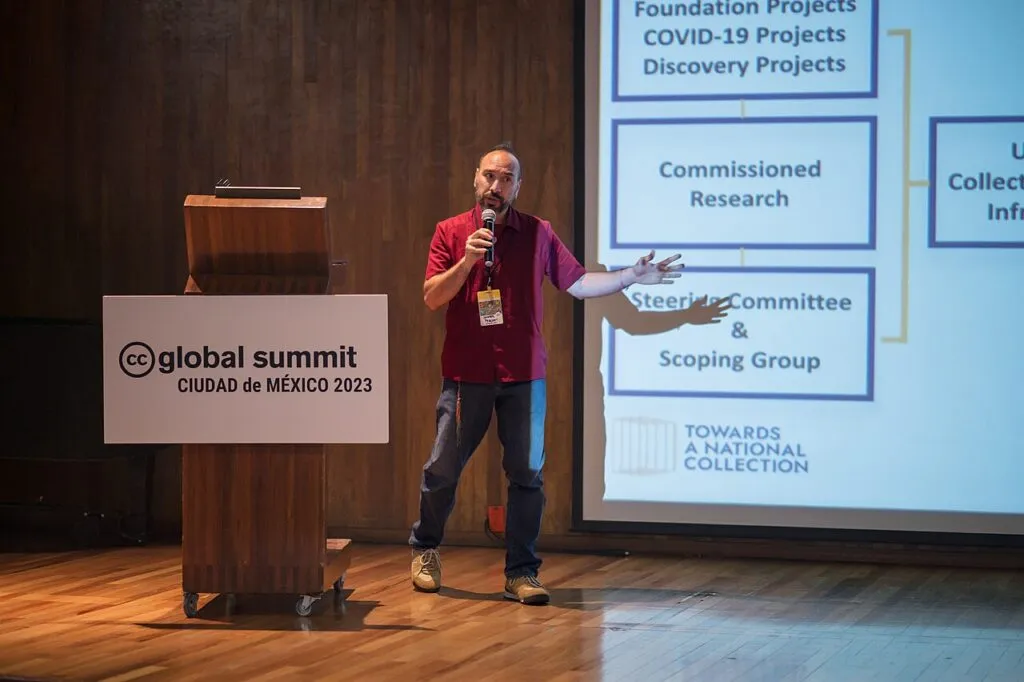
It is precisely in the U.K. where one of the most ambitious projects in this field is taking shape: the creation of a large-scale digital infrastructure. Known as the National Research Infrastructure for Cultural Heritage (N-RICH), the initiative emerged from the Towards a National Collection program and is funded by the Arts and Humanities Research Council with an investment of £2.2 million. Pereda serves as one of its international co-leads.
The infrastructure is designed to connect the collections of cultural institutions across the United Kingdom, making them easier to access, organize, and analyze using AI and computational tools. The Mexican researcher contributed to the design of infrastructure models, digitization strategies, and systems capable of integrating massive amounts of information.
That data also includes intangible heritage, such as oral archives, archaeological sites, natural environments, and even digital models known as digital twins.
“The goal is not simply to digitize collections, but to build the entire environment needed for computational analysis, including data integration across institutions, the use of AI to process massive volumes of information — including controlled automation — and the development of systems that allow these datasets to be connected, analyzed, and reused securely and at scale,” he explains. “There’s little value in having digitized collections if no one can actually use them in computational processes.”
The Importance of the Human Eye for Context
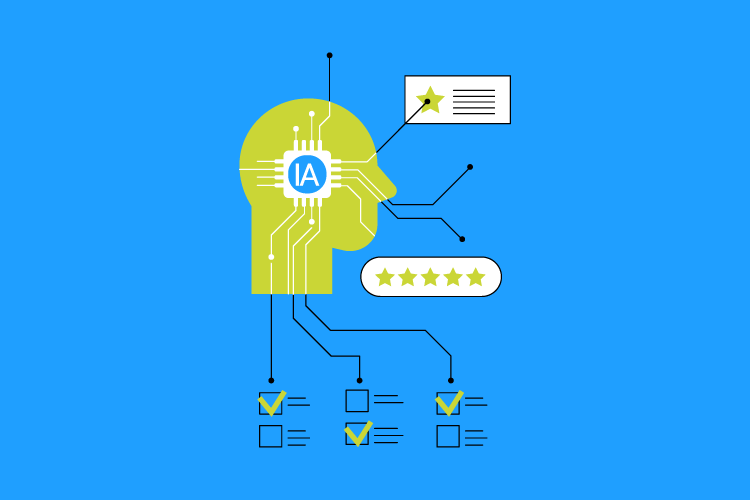
Pereda explains that tools such as OCR (Optical Character Recognition), machine learning, and pattern recognition are being used in projects to process thousands of historical documents, automate transcriptions, and connect information scattered across archives. “Instead of spending an entire month reading 10 documents, you can do it in half an hour,” he says.
Even so, there are significant challenges in using AI tools because these technologies do not truly understand the historical context of the data they process. For example, some AI models still carry biases or remain “Anglocentric” because they were trained primarily on information from the Global North, making accurate analysis more difficult when Indigenous languages are involved.
Pereda emphasizes that the participation of specialists remains essential for correctly interpreting and contextualizing information processed with AI, whether it involves describing an object, tracing the history or origins of a dance, or identifying the language of a document.
Is It Feasible to Digitize “History” in Mexico?
Could Mexico develop a digital infrastructure for cultural heritage similar to N-RICH? Javier Pereda believes the country does have the potential to build a project of that scale, particularly because of the vast historical wealth preserved in institutions such as the General Archive of the Nation, which holds millions of documents that remain largely unexplored.
“It’s not that there’s no interest in accessing knowledge — it’s that there’s so much of it that the task becomes overwhelming. Moreover, much of Mexico’s history has been built around just five documents; hundreds of others have never been examined or are only now beginning to be explored thanks to historians,” Pereda reflects.
From Tecnológico de Monterrey, the researcher has collaborated on the exploration of concepts and policies related to digital infrastructure with institutions such as Mexico’s Ministry of Culture, the National Institute of Anthropology and History (INAH), and MEXICANA, the Cultural Heritage Repository of Mexico.
The challenge of creating an initiative on that scale, he says, lies in strengthening both technological and human capacities, encouraging long-term investment, and designing public policies for data protection, governance, and collection management.
“Together, we aim to transform cultural heritage into an active infrastructure capable of generating knowledge, innovation, and new forms of creation,” he says.
Were you interested in this story? Do you want to publish it? Contact our content editor to learn more marianaleonm@tec.mx