

A graduate student presents his capstone project to three industry experts, who listen attentively. As he explains his proposal, he remains calm: his voice is steady, and he breathes evenly while keeping an eye on the timer. He has the situation under control until a difficult question comes up. The moment becomes tense: his heart rate rises, his words falter, and for a brief instant he loses concentration.
This is one of the scenarios designed by researchers at EGADE Business School at Tecnológico de Monterrey, where biometric technologies and artificial intelligence (AI) are used to study how emotions influence processes such as negotiations and professional presentations.
The exercise is part of a project that aims to analyze emotional responses in situations like these. To examine the reactions, the system records the student’s physiological signals during the activity.
A smartwatch measures his heart rate, and a headband records brain activity. An AI model processes the data to identify moments of anxiety, insecurity, or nervousness. With that information, the system generates a report that allows the student to pinpoint critical moments and adjust his strategy to better manage his emotions.
A Project That Explores Emotions in Learning
The experiment is part of the project “Biometric Technology in Business Education: Visualizing the Invisible in Learning,” led by Eloísa Pérez and Omar Velasco from the Educational Innovation Department, along with Isaac Lemus and Jairo Alonso Orozco, research professors at EGADE Business School.
“What we aim to do is integrate this methodology, or framework, to design classroom learning experiences that foster self-awareness; in other words, help students consciously learn how to regulate their emotions,” explains Pérez, director of Educational Innovation. “Based on direct, real-world data, we can conduct more precise analyses and gain a deeper understanding of people from another perspective—what is usually invisible.”
The initiative emerged from a Novus educational innovation call that encourages professors at Tecnológico de Monterrey to experiment with new educational technologies. It was implemented in the Experiential Classroom, a space within the Living Lab of the Institute for the Future of Education, located inside Expedition FEMSA on the Monterrey campus, where faculty have access to technologies designed to analyze people’s emotional responses.
How Biometrics and AI Work Together
The team developed a series of pilot experiences in EGADE graduate programs, such as the Master in Finance and the Master’s of Business Administration (MBA).
They also conducted trials in an undergraduate course at the School of Humanities and Education, where around 60 students participated in negotiation simulations, role-playing exercises, and presentations before executives.
Students used devices that recorded physiological signals, such as smartwatches capable of measuring heart rate, body temperature, and perspiration. They also wore headbands that track brain activity to identify patterns of concentration or mental fatigue. The data collected by these sensors is processed in real time using analytics tools and AI models.
“We run a test before the experience in which students talk about their self-perception, how comfortable they feel, and how they perceive themselves in a negotiation or communication setting. There’s also a reflection afterward to understand how they felt, and that’s the information we analyze to see whether their perception of their emotional awareness matches the data,” the director explains. “What we receive is essentially zeros and ones”, but based on that information, and with the technical support of the Living Lab team, we look for strategic insights.”
What the Data Reveal
Professor Isaac Lemus implemented one of the pilot experiences with MBA students through negotiation simulations, in which participants assumed different roles within a consulting scenario.
First, they acted as team leaders and negotiated with a consultant about the performance of a project. Then they switched roles and negotiated with an unsatisfied client. After analyzing the data collected through biometric sensors, both students and professors reflected on the emotional patterns that emerged during the negotiations. “One of the main insights we found is that people don’t get as nervous when presenting, but rather when they are questioned,” Lemus notes.
Meanwhile, Jairo Orozco used the system in the MBA Integrative Project course. After working on a solution to a real problem for a company, students present their proposals to industry experts, who ask questions and evaluate their ideas. In this case, both students and evaluators wore biometric sensors during the pitch to record their emotional responses in real time.
“In class, you usually evaluate whether the student defined the problem well, conducted good interviews, and generated strong insights, but this evaluation goes further than that. The real world is different—it involves how you behave, how you express yourself, and how you handle the most critical moments,” says Orozco. “We also wanted to see how the student and the expert connect what emotions arise and what emotional peaks the experts experience simultaneously with the students during the presentation. Many times you can sense when the other person becomes interested, and we wanted to see whether those moments would also appear in the data.”
Biometrics and AI for Teaching Negotiation and Emotional Management
After each experience, students receive a report generated with AI about the physiological responses recorded during their presentation. The reports include graphs and videos highlighting the moments when emotional changes were detected, along with recommendations for improving stress management and communication.
Lemus explains that after receiving their reports, some students were surprised and eager to explore the topic further. “Some people approached me after the session because they saw themselves clearly reflected in the results and wanted to learn more about how to work on emotional control,” the professor says.
The researchers’ goal is to develop a methodology that integrates biometric technology, AI, and negotiation-based learning experiences, along with principles from neuroscience, to better understand how the brain reacts in moments of pressure and uncertainty.
The Next Step: Scaling the Methodology
Although the development and initial pilots were carried out in business courses, the director notes that this methodology could be scaled to other areas of learning.
“The next step is to complete the data analysis to consolidate the methodology and, from the area of curricular innovation, promote its implementation on a larger scale. We also want to evaluate the cost of the equipment, what infrastructure is required, and what implications it would have for operations,” Pérez explains.
The team is also exploring a new line of research aimed at developing predictive tools based on the use of AI and the biometric data collected in the experiments. The goal is to create models capable of anticipating how students react in high-pressure situations and helping them design strategies to manage their emotions and improve their performance during negotiations and in other professional contexts.
“Now we have very powerful analytical tools. So education is moving toward understanding what we do with that information and how we make decisions based on it,” Orozco adds.
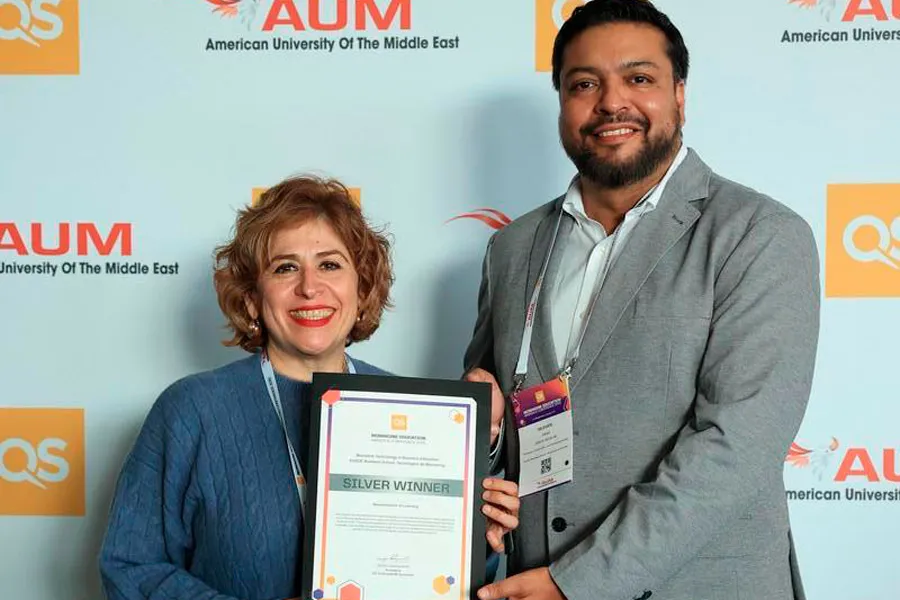
The project was recognized at the QS Reimagine Education Awards 2025 in the Neuroscience of Learning Award category, where it was named a Silver Winner. In addition to generating scientific publications, the project aims to lay the groundwork for new ways of evaluating negotiation, communication, and leadership skills through biometrics and AI.
Did you find this story interesting? Would you like to publish it? Contact our content editor to learn more at marianaleonm@tec.mx