
In the summer of 2026, the United States is experiencing the largest cyclosporiasis outbreak in its recent history. Beyond the number of reported cases, this event underscores a growing global public health challenge: ensuring the safety of fresh foods that travel through complex international production and distribution chains before reaching consumers’ tables.
Between May 1 and July 20, 2026, the Centers for Disease Control and Prevention (CDC) had confirmed 1,645 cases of cyclosporiasis across 34 states, with 141 people (9%) hospitalized and no deaths attributed to the outbreak. In addition, public health authorities were investigating more than 5,100 additional cases consistent with the disease, suggesting that the true scale of the outbreak could be considerably larger because of underdiagnosis and delays in laboratory confirmation. The largest clusters have been identified in the US Midwest, particularly in Michigan, where thousands of people have been reported with gastrointestinal illness associated with the outbreak.
Cyclosporiasis is an intestinal disease caused by the protozoan Cyclospora cayetanensis. Although it generally receives less attention than other foodborne pathogens such as Salmonella or Escherichia coli, it can cause large outbreaks with significant public health and economic consequences. Its main symptoms include prolonged watery diarrhea, abdominal pain, loss of appetite, fatigue, and weight loss. In immunocompromised individuals, young children, and older adults, the disease can be particularly debilitating.
Unlike many gastrointestinal infections, Cyclospora has a unique epidemiological characteristic: the oocysts shed by an infected person are not immediately infectious. They must remain in the environment for several days or weeks to mature before becoming capable of causing infection. As a result, direct person-to-person transmission is uncommon, and outbreak investigations typically focus on common environmental sources of contamination, particularly water used to irrigate or wash fresh produce.
Epidemiological investigations conducted by the CDC and the US Food and Drug Administration (FDA) point to leafy greens distributed through fast-food restaurants and other commercial establishments as the most likely source of the outbreak. However, microbiologically confirming the source remains one of the greatest challenges.
Detecting Cyclospora in fresh produce is technically difficult because of the parasite’s low concentration, the lack of highly sensitive standardized detection methods, and the perishable nature of the products under investigation. Consequently, field epidemiology, traceability studies, and patient interviews continue to be essential tools for identifying the source of these outbreaks.
This outbreak illustrates an increasingly common reality: the globalization of food systems has also transformed the epidemiology of foodborne diseases. A product harvested in one country may be processed in another, distributed across multiple regions, and consumed by millions of people within days. When contamination occurs at any point along that chain, its consequences can quickly spread across hundreds or even thousands of kilometers.
Modern agriculture also faces additional challenges driven by climate change, water scarcity, and the growing demand for fresh produce year-round. Changes in temperature and rainfall patterns may favor the persistence of certain parasites in the environment and alter the risks associated with irrigation water. At the same time, agricultural intensification requires increasingly robust food safety surveillance and traceability systems.
The response to the outbreak also illustrates the evolution of modern epidemiology. Today, foodborne disease investigations combine epidemiological interviews, spatial analyses, genomic sequencing when feasible, digital traceability systems, and collaboration among regulatory agencies, reference laboratories, and public health authorities. Cyclospora, however, remains an important exception, as significant limitations still exist in genetically characterizing the parasite with the same level of precision achieved for many bacterial pathogens.
For Mexico, this outbreak offers valuable lessons. As one of the world’s leading exporters of fresh fruits and vegetables, the country has a strong interest in strengthening food safety surveillance systems, promoting good agricultural practices, and enhancing international cooperation on food safety. Confidence in international markets depends not only on product quality but also on the ability to prevent, detect, and respond promptly to contamination events.
Universities also play a strategic role. Institutions such as Tecnológico de Monterrey can contribute through applied research in microbiology, epidemiology, data science, artificial intelligence for food traceability, rapid pathogen detection technologies, and One Health approaches that integrate human, animal, and environmental health. Educating professionals capable of working in multidisciplinary teams will be essential to addressing increasingly complex public health risks.
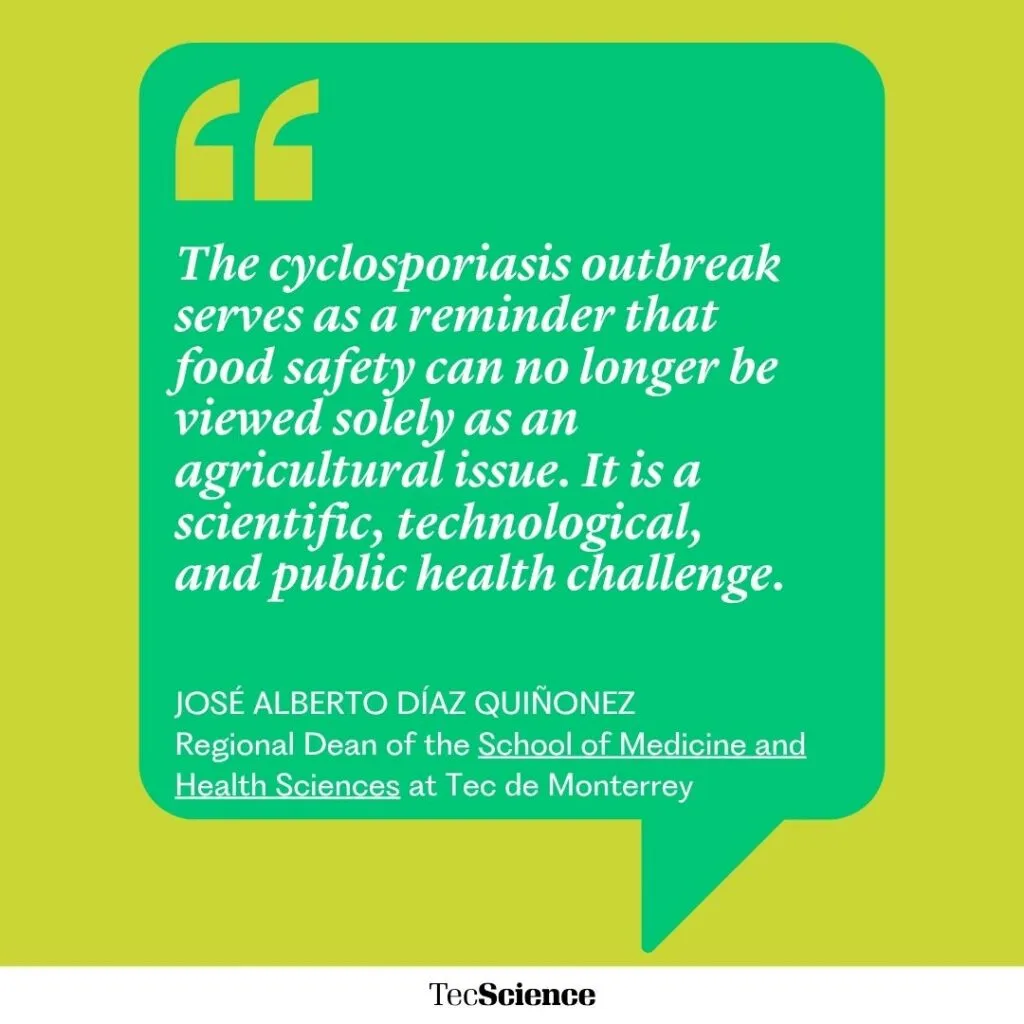
The 2026 cyclosporiasis outbreak serves as a reminder that food safety can no longer be viewed solely as an agricultural or regulatory issue. It is a scientific, technological, and public health challenge that demands international cooperation, innovation, and continuous surveillance. In a world where food crosses borders every day, protecting public health requires science to move even faster than pathogens.
Author
José Alberto Díaz Quiñonez is Regional Dean (Mexico City) of the School of Medicine and Health Sciences at Tecnológico de Monterrey. He is a member of the National Academy of Medicine of Mexico, the National System of Researchers, the Mexican Academy of Sciences, and the Mexican Society of Public Health.
References
- US Food and Drug Administration. Cyclospora. Retrieved July 20, 2026, from https://www.fda.gov/food/foodborne-pathogens/cyclospora
- Centers for Disease Control and Prevention. Surveillance of Cyclosporiasis. Retrieved July 20, 2026, from https://www.cdc.gov/cyclosporiasis/php/surveillance/
- Brown C. Cyclosporiasis: as “explosive diarrhea” sweeps US, what’s behind the outbreak and what is Trump’s role? BMJ. 2026;394:e100317. Published July 17, 2026. doi:10.1136/bmj-2026-100317