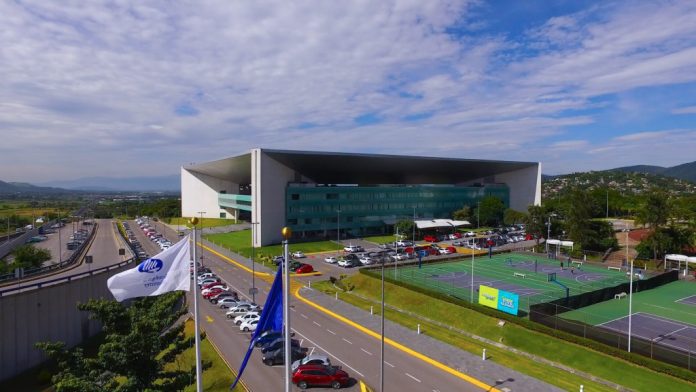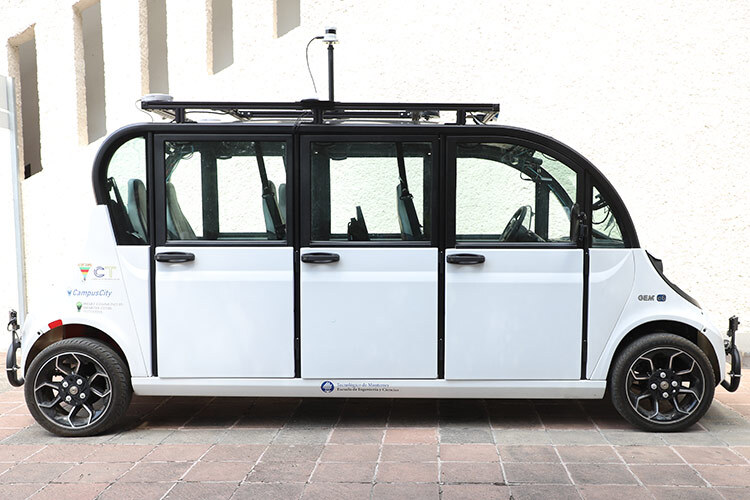


An electric minibus capable of operating without human intervention regularly circulates the Monterrey campus of Tecnológico de Monterrey as part of ongoing tests in smart mobility and automated driving.
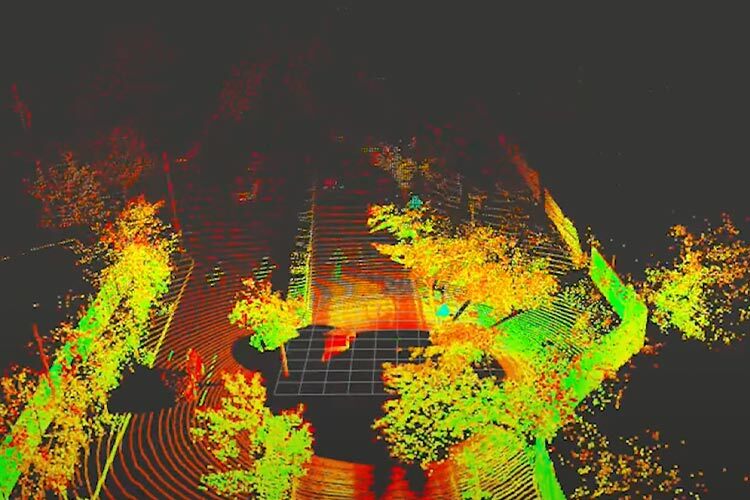
This is the NEV, an autonomous vehicle equipped with technologies that allow it to navigate a four-kilometer experimental route within Distritotec entirely on its own. To do this, the NEV relies on laser sensors (LiDAR), radars, cameras, geolocation antennas, onboard computers, and control algorithms.
The project is part of Bloom Drive Intelligence, a research and innovation ecosystem at Tec focused on autonomous and intelligent mobility. It also fosters entrepreneurship and collaboration among academia, industry, government, and society.
A Transdisciplinary Ecosystem for Smart Mobility
The ecosystem is an evolution of the Conscious Technologies Group, a research team focused on artificial intelligence, smart transportation, and biometrics, explains Jorge Lozoya, a researcher at the School of Engineering and Sciences (EIC) on the Monterrey campus and national leader of Tec’s Mobility Research Group and Bloom Drive Intelligence.
Its focus shifted toward electric and smart mobility after receiving funding from Fundación FEMSA to set up laboratories with specialized talent. Since then, it has functioned as a living lab where real-world technologies are tested in controlled urban environments, bringing together a wide range of disciplines.
“Our projects are interdisciplinary because they bring together all branches of engineering—electronics, electrical, software development, and mechanical systems—but they also have a transdisciplinary approach, since we collaborate with urban planners, architects, anthropologists, and experts in the humanities,” Lozoya explains.
Testing Autonomous Mobility on Mexican Highways
This year, the team extended its technology validation strategy to La Carrera Panamericana, collaborating with the Politecnico di Milano and entering the rally with the first electric and autonomous vehicle ever to participate. The experiment managed to complete nearly 450 kilometers of the route—out of a total 1,500—in autonomous mode, traveling through seven cities under real traffic conditions.
For the project, the Tec-Polimi team designed a system made up of two vehicles: a smart lead car—nicknamed El Fantástico—operated by Bloom Drive Intelligence, and an autonomous vehicle developed by the Italian researchers. The team also included professional drivers like Luis “Chapulín” Díaz, who was trained to operate and validate the autonomous driving system.
“The race served as a platform to showcase the work being done by Bloom Drive Intelligence, the School of Engineering and Sciences, and Tec’s Mobility Group,” says Lozoya.
While La Carrera marked a major milestone in Bloom Drive Intelligence’s efforts to validate and promote autonomous technology, the ecosystem is also advancing other projects. These are being tested in controlled urban environments, with a focus on digitalizing the urban landscape and transitioning to electric mobility.
Digitally Mapping Urban Spaces for Smarter Mobility
One of the first projects the team developed was PiBot, a multifunctional robot capable of interacting with people either autonomously or via teleoperation. Designed primarily for service, monitoring, or security tasks, PiBot can also leverage artificial intelligence to generate reports that help people “amplify” their operational capacity.
Another initiative is the digital twin for urban mobility, a project that merges data, artificial intelligence, and urban modeling. It involves the digitalization and three-dimensional representation of an urban area—in this case, distritotec—which can be fed with information from public databases, including weather conditions, traffic data, and footage from surveillance cameras.
As part of this project—and for the past two years—the team has been working with the Technical University of Munich (TUM) to develop a tool that creates a real-time “digital shadow.”
“We use data available from social media and the internet to generate a digital shadow of mobility events in the city. The goal is to build a digital twin capable of predicting and preventing mobility disruptions in urban areas.”
Lozoya also highlights the Vocho Tec initiative, a project that began when an EXATEC alumnus donated a classic Volkswagen Beetle to be converted into an electric car. The research team redesigned the vehicle’s electrical system and outfitted it with a battery pack compatible with standard charging stations.
They also added sensors and control systems, turning the car into an educational tool for training and experimentation with new battery technologies and electric components.

“One New Tech-Based Company Per Year”
Bloom Drive Intelligence also promotes science- and technology-based entrepreneurship as a way to scale up its research initiatives. Currently, the team has two startups within Tec’s entrepreneurial ecosystem (EBCTec): PiBot as a Service and Primo EV.
PiBot offers two types of services: custom robot design tailored to clients’ specific needs, and robot rentals for carrying out targeted tasks. These services are geared toward the manufacturing, retail, and healthcare industries.
Meanwhile, Primo EV is a startup focused on designing and manufacturing intelligent electric vehicles for both urban and industrial environments. Its services include cargo transport, passenger mobility, surveillance, and urban transit.
“The goal is to launch at least one new tech-based company per year and ensure that our patents don’t just get registered, but are actually licensed by industry,” says Lozoya, who hopes that in the medium term, one of the team’s startups will be acquired by a larger company.
The researcher adds that a major milestone for the team would be securing the first official approval for the use of autonomous vehicles in public transportation services in Mexico.
In addition to its technology development efforts, the launch of two startups, and participation in La Carrera Panamericana, the team also stands out for training specialized talent. Students and graduates from the School of Engineering and Sciences have been invited by industrial partners to collaborate, notes the leader of Bloom Drive Intelligence. The team has also successfully secured funding in partnership with local and international industry, attracting half a million dollars to support project development in 2025.
For Jorge Lozoya, the true value of Bloom Drive Intelligence lies in creating projects that go beyond the lab and classroom to become real-world solutions for society’s challenges. “Technology only matters if it improves people’s lives,” he states.
Did you find this story interesting? Would you like to publish it? Contact our content editor to learn more: marianaleonm@tec.mx