
By Mario Villada-Balbuena and Claudia Camacho-Zuñiga
Before antivirals and vaccines against SARS-CoV-2 became available, a simple practice helped save thousands of lives: washing our hands. This action could inactivate the virus by disrupting the stability of its ribonucleic acid (RNA).
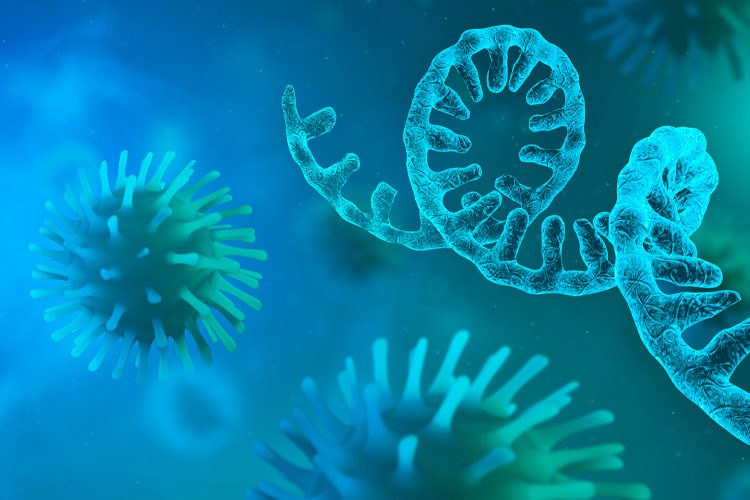
The SARS-CoV-2 virus has an outer shell, known as a capsid, that protects its genetic material, proteins, and ribonucleic acid (RNA). These macromolecules interact with human cells through a mechanism similar to a key fitting into a lock. Both must have the correct configuration and spatial arrangement for the virus to replicate.
When we wash our hands, soap breaks down the capsid, exposing the RNA to an environment that alters its three-dimensional arrangement. As a result, the RNA can no longer fit into its corresponding “lock” and loses its ability to replicate.
This is just one example of why studying molecular stability is important beyond its intellectual and scientific challenges. Understanding how biomolecules reach equilibrium in response to inter- and intramolecular forces and interactions is at the heart of biophysics.
RNA: How Do We Study It?
RNA molecules consist of sequences of nucleotides, the fundamental building blocks of genetic material. Each nucleotide is composed of a phosphate group, a ribose sugar, and a nitrogenous base (adenine, cytosine, guanine, or uracil).
RNA molecules can vary in both sequence and length. They contain a vast number of atoms—hence the term macromolecule—making the study of their motion computationally demanding. Researchers rely on advanced numerical methods and powerful computers capable of performing complex calculations in a short time.
In 2017, the study One-bead coarse-grained model for RNA dynamics proposed a simplified representation of RNA in which an entire nucleotide is treated as a single “bead.” This coarse-grained model considered interactions between adenine and uracil, as well as bonds between cytosine and guanine, known as Watson-Crick base pairs.
The model successfully captured the overall behavior of these systems and predicted the three-dimensional structures of RNA molecules containing up to 100 nucleotides based solely on their sequence. However, it was limited at atomic scales, meaning it could not predict the position of every individual atom.
In 2024, the study Mechanical unfolding of RNA molecules using a knowledge-based model introduced a significant advance by incorporating much more detailed interactions between nucleotides through the use of optical tweezers.
These experiments are known as optical tweezers because they use a highly focused laser beam to trap and manipulate matter as small as individual atoms. In essence, light allows researchers to manipulate single molecules.
Tweezers Made of Light
This new RNA model, which incorporates optical tweezers, requires less computational power while successfully describing how RNA molecules behave when unfolded by light.
Initially, the molecule resists the gradual increase in force without showing noticeable changes in its extension. However, once a critical threshold is reached, it unfolds abruptly.
After unfolding, the molecule’s length changes very little.
Understanding this behavior opens the door to numerous medical applications. By measuring both the force applied to a molecule and its resulting extension, researchers can calculate the energy required to modify its three-dimensional configuration.
This knowledge could eventually allow us to design the “keys” that determine whether the “locks” open or remain closed. In other words, molecular configuration is crucial in determining whether these molecules can perform their biological functions, whether beneficial or harmful to human health.
If soap helped us take the virus apart, light may help us understand it—and eventually design more precise ways to control it.
References
- M. Villada-Balbuena y M. D. Carbajal-Tinoco. One-bead coarse-grained model for RNA dynamics. J. Chem. Phys. 146, 045101 (2017).
- M. Villada-Balbuena y M. D. Carbajal-Tinoco. Mechanical unfolding or RNA molecules using a knowledge-based model. J. Chem. Phys. 161, 165104 (2024).
.
Authors
Mario Villada-Balbuena. Ph.D. in Physics from CINVESTAV-IPN and a B.Sc. in Physics from UAEMex. He has collaborated on computational biophysics projects using high-performance computing, funded by CINVESTAV-IPN and SECIHTI. He is a member of the SECIHTI Soft Condensed Matter Network and the Biophysical Society (USA). He is a professor in the Department of Sciences at the School of Engineering and Sciences (EIC), Tecnológico de Monterrey, Toluca Campus, and a science communication contributor to TecScience.
Claudia Camacho-Zuñiga. Ph.D. in Materials Science from UAEMex, a master’s degree in Chemical Engineering, and a degree in Engineering Physics from Universidad Iberoamericana. She is a Level I member of Mexico’s National System of Researchers. She is currently a researcher at the Institute for the Future of Education and a professor at the School of Engineering and Sciences, Tecnológico de Monterrey, Santa Fe Campus. She is also a science communication contributor to TecScience.