
By Angélica Janeth Cortez Soto and Yolanda Heredia
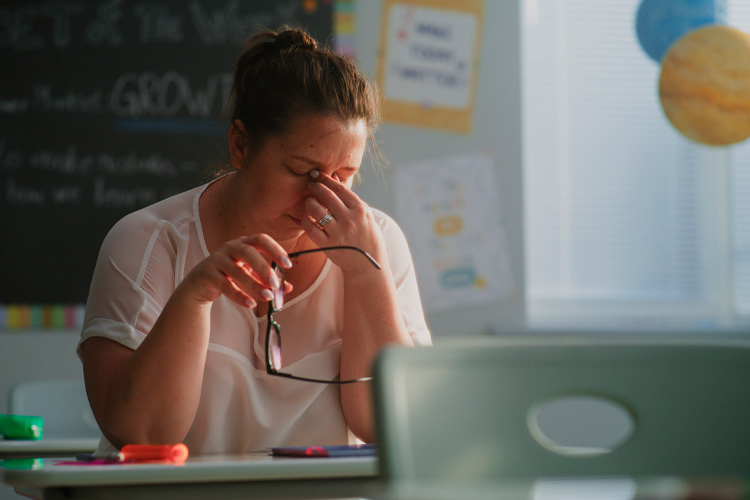
Teacher burnout in Mexico’s public schools is not the result of individual shortcomings. It is the predictable consequence of working conditions that exceed any person’s capacity to cope.
Excessive workloads, chronic underfunding, and persistent shortages of classroom resources steadily erode teachers’ well-being. Until these structural conditions are addressed, even the best teacher wellness initiatives are likely to have only limited impact.
That is the central finding of a qualitative study involving 20 preschool and elementary school teachers, with six cases examined in depth to illustrate the most contrasting experiences.
The analysis draws on the Job Demands–Resources (JD-R) model [1], which explains that burnout develops when job demands consistently outweigh the resources available to meet them. Within this framework, burnout among Mexican teachers is not a matter of personal resilience—it is the outcome of a system that demands too much while providing too little.
School principals play a critical role by fostering emotional support, mediating conflicts, and enforcing policies that protect teachers’ authority. District supervisors must coordinate support across schools, help manage parental demands, and reduce administrative burdens.
Without meaningful consequences for aggression or neglect, professional development can become a double-edged sword, placing responsibility on teachers for problems they cannot solve on their own.
Burnout is neither a fixed condition nor a personality trait. It is a dynamic process that accelerates or recedes depending on the balance between workplace demands and the resources available to address them [7][8].
The experiences reported by Mexican teachers mirror findings from high-income education systems [9][10] and post-conflict settings [11], while standing in stark contrast to the global commitment that every teacher should be able to work in conditions of safety and dignity [12].
Breaking this cycle requires recognizing burnout as a systemic problem—not a personal failure.
Five Causes of Teacher Burnout
In the study Perspectives on Burnout: Mexican Preschool and Primary School Teachers’ Experiences and Solutions, teachers identified five primary sources of burnout.
The first is inadequate infrastructure and institutional support. In high-income countries, time pressure—including after-hours lesson preparation, relentless work pace, and chronic workload—is often the leading source of stress [2]. In Mexico, however, these pressures are compounded by unsafe physical conditions and limited educational resources. At the same time, cultural expectations that teachers serve as caregivers and protectors place an additional emotional burden on the profession [3].
The second is micromanagement and the loss of professional autonomy. Constant oversight, excessive paperwork, and decisions that require approval outside the classroom undermine teachers’ professional judgment and increase emotional exhaustion.
The third is violence and insecurity. Student misbehavior is recognized internationally as a major occupational stressor, but in Mexico it is compounded by widespread violence.
All six participants described exposure to some form of violence, ranging from direct threats—including student aggression, hostile interactions with parents, and the presence of organized crime near schools—to more pervasive challenges such as child abuse and workplace harassment. Violence was not confined to the teachers with the highest levels of burnout; it emerged across the entire spectrum of experiences.
Unlike teachers in many other education systems, Mexican educators often face these threats with little institutional protection.
The fourth driver is parental neglect and the expanding role of teachers. Four of the six participants linked their burnout to limited family involvement, including inconsistent discipline, lack of academic support at home, and unmet basic needs among students. As a result, many teachers assume parental responsibilities without the institutional support needed to sustain those additional demands.
The fifth is compassion fatigue—the emotional exhaustion that comes from supporting students through prolonged hardship [4]. Its effects are intensified by the chronic shortage of school psychologists. Without adequate mental health support, teachers absorb students’ emotional distress until empathy gradually becomes exhaustion.
Collective Action Matters
The most frequently cited priority was access to school-based psychological support for both students and staff. Where comprehensive services are not yet feasible, the study recommends practical first steps such as facilitated peer support sessions, scheduled counseling hours, or rotating school psychologists while broader investments are developed.
Teachers also emphasized the need for genuine partnerships between schools and families through structured programs that establish shared responsibility, consistent with UNESCO’s recommendations for school-community collaboration [5]. In Mexico, parental involvement is often limited to occasional meetings rather than sustained initiatives that promote meaningful engagement.
Supportive school leadership also emerged as a key priority. Principals who encourage professional development, foster collaboration, and build trusting school cultures can significantly reduce burnout rates [6]. In a highly centralized system characterized by rigid hierarchies and bureaucratic oversight, effective leadership may be one of the few institutional resources capable of buffering workplace stress.
Perhaps the study’s most distinctive finding is that collective action protects teachers more effectively than individual coping strategies alone. Schools where staff addressed challenges together—through peer support, mutual advocacy, and shared responsibility—showed greater resilience. Where teachers remained isolated, burnout intensified.
These findings challenge the prevailing emphasis on individual solutions. Mindfulness workshops, self-care programs, and resilience training all have value, but they cannot replace the institutional conditions that allow teachers to thrive. Professional development remains important—the participants with lower burnout described practices such as structured planning, meditation, and making time for leisure—but these strategies are effective only when supported by meaningful structural change.
Main reference
Cortez Soto, A. J.; Heredia Escorza, Y. (2025). Perspectives on Burnout: Mexican Preschool and Primary School Teachers’ Experiences and Solutions. Journal of Education, 0(0).
Other references
- Bakker, A. B., & Demerouti, E. (2007). The job demands-resources model: State of the art. Journal of Managerial Psychology, 22(3), 309–328.
- Skaalvik, E. M., & Skaalvik, S. (2017). Dimensions of teacher burnout: Relations with potential stressors at school. Social Psychology of Education, 20(4), 775–790.
- Romero Andrade, M. (2024). El trabajo emocional docente en la dimensión del cuidado. Revista Mexicana de Investigación Educativa, 29(101), 389–413.
- Figley, C. R. (1995). Compassion fatigue: Toward a new understanding of the costs of caring. In E. B. H. Stamm (Ed.), Secondary traumatic stress: Self-care issues for clinicians, researchers, and educators (pp. 3–28). The Sidran Press.
- Landeros Aguirre, L. G., Lo Priore Infante, I., & López Santibáñez González, M. I. (Eds.). (2023). Transformar desde la educación: contribuciones del modelo social de la Fundación Alberto Baillères a la luz de la Agenda 2030. Oficina de la UNESCO en México D.F. y Fundación Alberto Baillères.
- Tornuk, N., & Gunes, D. Z. (2020). Perception of professional social support as a predictor of burnout level of pre-school teachers. International Journal of Current Instruction, 12(Special Issue), 105–114.
- Maslach, C., & Leiter, M. P. (1997). The truth about burnout: How organizations cause personal stress and what to do about it. Jossey-Bass.
- Hakanen, J. J., Schaufeli, W. B., & Ahola, K. (2008). The job demands-resources model: A three-year cross-lagged study of burnout, depression, commitment, and work engagement. Work & Stress, 22(3), 224–241.
- Oxley, L., Asbury, K., & Kim, L. E. (2024). The impact of student conduct problems on teacher wellbeing following the onset of the Covid-19 pandemic: An interpretative phenomenological analysis. British Educational Research Journal, 50(1), 200–217.
- Dzuka, J., & Dalbert, C. (2007). Student violence against teachers: Teachers’ well-being and the belief in a just world. European Psychologist, 12(4), 253–260.
- Rojas-Flores, L., Herrera, S., Currier, J. M., Foster, J. D., Putman, K. M., Roland, A., & Foy, D. W. (2015). Exposure to violence, posttraumatic stress, and burnout among teachers in El Salvador: Testing a mediational model. International Perspectives in Psychology, 4(2), 98–110.
- Global Coalition to Protect Education from Attack. (2015). Safe Schools Declaration. https://ssd.protectingeducation.org/
Authors
Angélica Janeth Cortez Soto. Adjunct professor at Tecnológico de Monterrey. She holds a Ph.D. in Educational Innovation and a master’s degree in Education from Tecnológico de Monterrey. Her research has been published in peer-reviewed journals including Frontiers in Psychology, Journal of Education, and Texto Livre, among others.
Yolanda Heredia Escorza. Research professor in the School of Humanities and Education at Tecnológico de Monterrey. She holds a Ph.D. in Comparative Social Welfare Policy and has extensive experience in educational research and public policy.