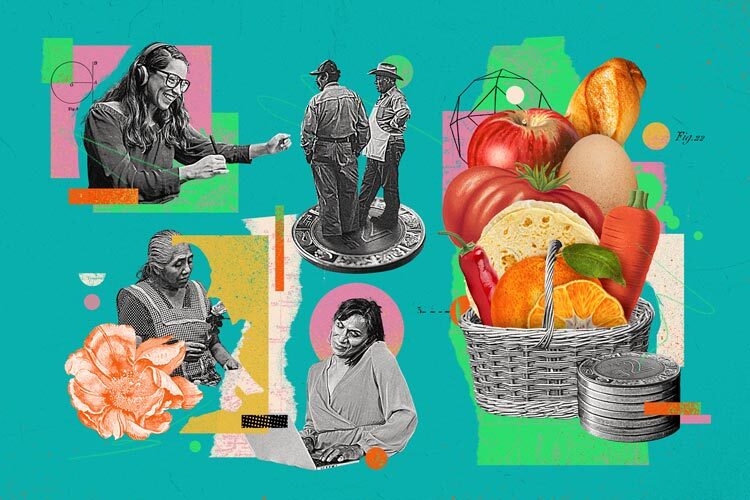


For many Mexicans, maintaining their lifestyle seems increasingly difficult. Buying food, paying rent, going to the doctor, and getting around all feel more expensive. This has created a feeling that money is no longer enough to cover expenses and might lead us to conclude that the prices of goods and services have simply increased more than wages. However, when we look closely at the data, the answer becomes much more complex.
Although the perception that money goes less doesn’t arise from nowhere, it doesn’t mean that everything has increased equally in price or that the country’s economic well-being has declined across the board.
Some indicators show an improvement in household income and well-being, while others reveal that essential assets for building wealth, such as housing, have become out of reach for many families.
“Housing inflation far exceeds general inflation,” says Héctor Villarreal, a research professor at the School of Government and Public Transformation (EGobiernoyTP) at Tec de Monterrey. “Even with a good salary, it’s not easy for a young couple, much less a young individual, to say: I’m buying a house.”
Understanding that wages have indeed increased, but that some goods and services have also increased dramatically, is key to explaining the apparent contradiction we are experiencing.

Wage Increases Vs Rising Prices of Goods and Services
In recent years, Mexico has experienced an unprecedented increase in the minimum wage. Since 2019, the National Minimum Wage Commission (Conasami) has approved annual increases of between 15% and 22% annually, which is well above inflation. As a result, the general minimum wage rose from 88.36 pesos per day (approximately US$4.59 at the 2018 average exchange rate) in 2018 to 248.93 pesos per day (approximately US$13.58 at the 2024 average exchange rate) in 2024.
This change is also reflected in household income. The 2024 National Survey of Household Income and Expenditure (ENIGH), conducted by the National Institute of Statistics and Geography (INEGI), reports that the average quarterly current income per household reached 77,864 pesos (approximately US$4,248 at the 2024 average exchange rate), representing a real increase compared to the previous survey. Furthermore, 65.6% of this income came from employment, indicating that wage increases have had a positive impact on family finances.
However, the feeling that money is no longer enough also depends on what households consume.
The ENIGH survey shows that Mexican families spend primarily on food, beverages, and tobacco, followed by transportation and communications. When these items increase in price, the impact on their budget is quickly felt.
Some foods, such as cheese, have increased significantly, while others have evolved in a much more moderate way.
“I dare say that in our country, a good food basket is indeed accessible to a large percentage of the population,” says Villarreal.
Something similar is happening with health services: there are excessively expensive private hospitals in the country, but the supply of low-cost medical consultations and services, such as consultations in pharmacies, has also expanded, broadening health access for different sectors of the population.
“However, if someone needs treatment for something more serious, it can be very expensive and public services are struggling to meet the needs of our population,” Villarreal warns.
The Breaking Point: Housing
The economic aspect that seems to have the greatest impact on the perception of lack of affordability in Mexico is housing.
According to the Federal Mortgage Society, during 2025 the price of homes purchased with mortgage loans increased by 8.7% nationwide, more than double the inflation rate recorded that year, which was 3.7%. The average home price reached 1.86 million pesos, with even greater increases in cities like Guadalajara, Monterrey, and Tijuana.
Although there is no official index in the country that measures the evolution of rents, through user experiences, there is a notion that it is becoming increasingly expensive to rent.
This dynamic has made housing one of the main economic challenges for young adults. Although many people have seen their incomes grow and have access to goods and services that were unthinkable a few decades ago, buying a house or apartment is much more difficult today.
“Among the reasons that have been put on the table is that many of the properties became speculative assets for investment funds,” Villarreal points out.
Other factors that could explain this phenomenon are the concentration of demand in certain cities—such as Mexico City—and urban areas, real estate speculation, gentrification, and the proliferation of short-stay companies, such as Airbnb.
Although the researcher acknowledges that more studies are still needed to fully understand the housing phenomenon, he recognizes that it is the factor that exerts the most stress on current costs.
The problem goes beyond the real estate market. The ability to access housing influences decisions such as becoming independent, starting a family, or building wealth, so its rising cost has effects that extend beyond personal finances.
A Paradox Beyond Inflation
Comparing the standard of living of different generations is also complicated. Currently, due to globalization and the use of social media, the aspiration for a lifestyle that is beyond one’s means is very real.
“It’s a valid issue, in which there are unmet aspirations, regarding aspects such as restaurants or clothing that may not be so accessible,” Villarreal points out.
On the other hand, many people have access to smartphones, digital platforms, technologically advanced cars, and travel at prices that were unthinkable thirty years ago. At the same time, buying a house, saving, and building wealth seems increasingly difficult.
According to the researcher, both realities can coexist. Households can consume more than before and, at the same time, feel that long-term goals are becoming increasingly distant.
Furthermore, inequality continues to define the reality of our country. “The difference between those who are better off and those who are worse off is very large,” he says.
Thus, the evidence does not confirm that the cost of living has worsened uniformly for all Mexicans, but it also does not disprove the feeling that money is buying less and less.
“The reality is that things have changed and today, we Mexicans are a different population with different habits,” Villarreal concludes.
Did you find this story interesting? Would you like to publish it? Contact our content editor to learn more: marianaleonm@tec.mx