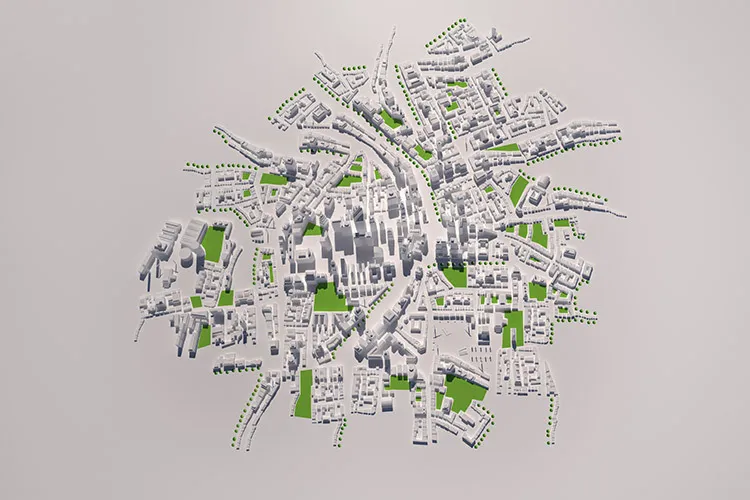


In Mexico, government leaders have presented plans to make cities more sustainable, smart and resilient for several decades. However, a new study found that these projects lack the mechanisms to ensure their implementation and the evaluation of their results.
“We were interested in understanding why there is such a disconnect between public policy and what is actually happening in the city,” says Ryan Anders, a research professor at the School of Architecture, Art and Design (EAAD) and one of the authors of the article.
Globally, these concepts are increasingly being incorporated into urban design, but often they do not translate into measurable objectives, budgets, or institutional responsibilities.
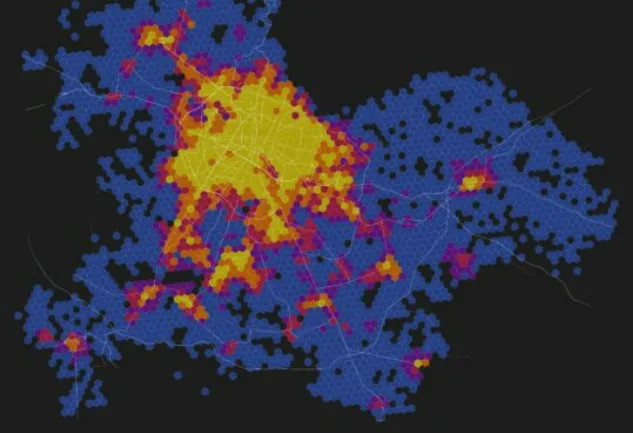
The researchers call this phenomenon planning for the sake of the plan and to understand it, they used Monterrey, Nuevo León, as a case study. To do so, they analyzed five official documents related to urban development of the city.
Through a quantitative analysis, they measured the frequency of occurrence of words associated with sustainability, resilience, and intelligence, analyzed the clarity of the definitions, and whether the plans included measurable indicators, as well as institutional commitments and responsibilities that allow for the execution and evaluation of the proposed actions.
“Essentially, we were trying to prove something that doesn’t exist due to a lack of data,” says Natalia García, a research professor at EAAD and one of the authors of the study.
Sustainable, Smart and Resilient Cities, but Only on Paper
Through this documentary analysis, the researchers found that the words sustainable, smart, and resilient are increasingly mentioned in urban development plans, with the latter two gaining prominence in more recent projects.
The researchers found that these use ambitious and ambiguous terms, but often lack elements to turn them into concrete actions.
“It is very problematic that they are concepts that are both comprehensive and vague at the same time,” says García.
For example, the Monterrey Urban Development Plan 2013–2025 talks about sustainable mobility and recognizes the problems associated with car dependency.
However, it does not establish sufficiently clear indicators, goals, or budgetary commitments to evaluate the achievement of those objectives.
Other documents found that, moreover, most of these plans are not legally binding, meaning the authorities are not obligated to implement them. Furthermore, they do not establish clear mechanisms for coordination with other municipalities to make them a reality.
The authors argue that the problem is structural and not limited to any particular administration. The documents studied were produced under governments of different political parties, including PAN, PRI, and Movimiento Ciudadano.
Why Don’t Urban Plans Become a Reality?
Although the phenomenon was only studied in Monterrey, the experts believe it is widespread in Mexico and probably the world.
“We can say that perhaps they work better or worse in a certain city, but it is very prevalent globally,” Anders points out.
And although the article’s objective was only to demonstrate that urban plans are often made in a way that makes it difficult for them to become a reality, the researchers could not help but wonder why.
This led them to begin working on a subsequent study in which they will conduct interviews with urban planning experts to understand it in greater depth.
Among the reasons that could be underlying this is the difference in human, technical and financial resources of the different municipalities.
“They become so vague or, on the contrary, so concrete that a municipality can leave a street half-paved because from then on it is no longer their responsibility,” García explains.
There is also the temporality of urban processes, which generally advance much faster than planning. Plans take time, and by the time they need to be implemented, the city has often already developed.
They pointed out that there is also a lack of political will, cooperation between municipalities and political parties, a lack of resources and of long-term vision.
“We need to be planning a city for 10, 15 or 20 years, and ask ourselves where do we want to go and how do we want to get there?” Anders asks.
The Future of Urban Planning
The researchers explain that to stop planning for the sake of planning, we need to move from a model that focuses on producing flawless documents for urban planning to one oriented towards achieving measurable transformations that improve the lives of the citie’s inhabitants.
To achieve this, they consider it necessary to establish indicators adapted to local conditions, clear institutional responsibilities, financial resources, and monitoring mechanisms that transcend changes in government.
Political reforms are also needed to incentivize its implementation, such as by giving awards and making agreements between institutions, governments, municipalities and political parties.
On the other hand, they also invite civil society to be more involved and demand that the plans promised in the campaigns are actually carried out.
“There is a big problem in the connection between the realities of the city and public policy, and it is so normalized that it is invisible,” Anders reflects.
Thus, we need to ask ourselves what a sustainable, smart, and resilient city really means, who we want to transform it for, and how we are going to achieve it.
Did you find this story interesting? Would you like to publish it? Contact our content editor to learn more: marianaleonm@tec.mx