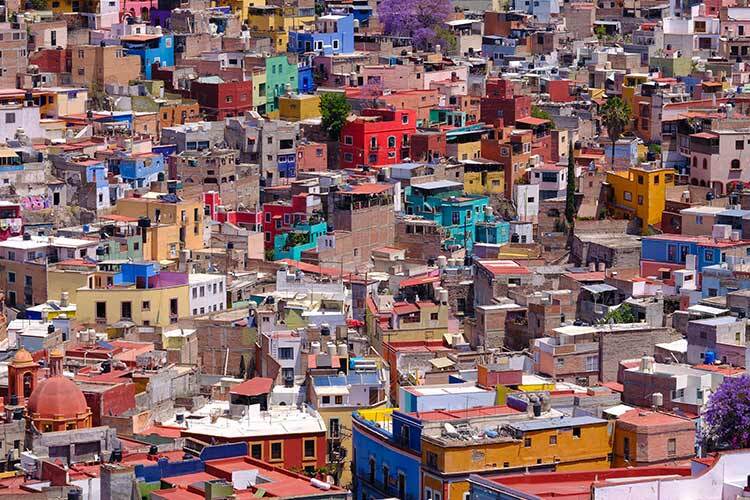


In Latin America, millions of people live in settlements that are considered informal. And although they are often perceived as disordered places, detached from the State, a comparative study between Colombia and Mexico proposes it is something much more complex.
By analyzing two countries in the region, the research suggests that the phenomenon is not black or white, but rather a gradient of grays shaped by governmental actions, social dynamics, and geographic characteristics.
“There has always been a dominant dichotomy when talking about what is regular or irregular,” says Lucía Elizondo, research professor at the School of Architecture, Art and Design (EAAD) at Tecnológico de Monterrey, and one of the authors of the article. “But there are many formal processes that have informal traits and vice versa.”
The analysis, a collaboration between Tec de Monterrey and the National University of Colombia, studied four settlements: two in Soacha, Colombia, and two in Monterrey, Mexico, to understand how informality occurs and what conditions it.
To do so, they combined fieldwork, interviews, and spatial analysis. They visited the territories, visually documented the physical characteristics of the environment, and spoke with residents to learn how they access housing, services, and infrastructure.
In addition, they analyzed variables such as street layouts, terrain type, construction materials, and levels of urban consolidation from an approach that studies how cities are progressively built and transformed.
Throughout history, Latin American governments have tried to regulate these housing developments, but until now —despite there being no exact figures— they still exist and are estimated to be increasing.
“We wanted to talk about the concept of informality and how it persists despite decades of public policies, studies, and approaches,” says Natalia García, research professor at the EAAD and another author of the article.
Two Different Ways of Making City
By studying two different contexts within Latin America, the researchers found that although both cases share inequality and a lack of access to housing, the causes and consequences of informality are different.
In Colombia, for example, residents can access and pay for services such as electricity or water even without legal ownership of the land. In Mexico, on the other hand, the provision of services usually depends on prior regularization, leaving many communities in a kind of limbo.
The differences also appear in who lives in these spaces. “Something that caught our attention is that the majority of those who inhabit them are women,” says Elfide Mariela Rivas, research professor at the EAAD and author of the study.
The origin of informality also changes. In Soacha, for example, so-called pirate urbanizations predominate, where intermediary individuals sell land illegally and then disappear. In Monterrey, it is more common for groups of people to organize themselves to occupy a certain space.
“This idea prevails that in the Global South the processes are very similar, but they are not,” says Elizondo.
The differences are also reflected in the physical form of the housing. In Soacha, they found neighborhoods built on steep slopes and complex terrain, located mainly on the peripheries. Monterrey, by contrast, presents housing on flatter terrain, many times in the city center.
These and other differences point to the fact that the political, social, institutional, and market context directly influence this. “The two logics somehow shape tangible aspects of the settlement,” says García.
From Informal to Self-Produced Settlement
Beyond explaining that informality is not part of a simple dichotomy, the article discusses how the State has allowed it to expand.
“The fact that there is not even a mapping of these settlements is serious; there is a lack of institutional recognition,” exclaims Rivas.
For the authors, the growth of these settlements is linked to the State’s inability to guarantee universal access to housing. “There is constant talk about the right to health, education, and housing,” says Elizondo. “But housing has not been achieved because it is not fully understood and is tied to the market.”
People usually end up in informal settlements because access to formal housing is insufficient, too expensive, or has requirements that part of the population cannot meet. Factors such as inequality, poverty, and real estate speculation push many families to seek alternatives.
In some cases, forced displacement, migration, or economic crises also play a role.
Faced with this, many people buy irregular plots of land or occupy empty spaces. There, they are capable of self-managing and organizing themselves, which is why the authors suggest that it should be seen as an alternative way of making a city.
Its inhabitants —students, professors, families, and workers— have responded by building their own habitat, which is why it is important to have a perspective that does not stigmatize them.
“It is an abandoned population that has done for itself what no one else has done for it,” emphasizes Elizondo.
In many cases, these communities develop support networks and forms of organization that do not exist in so-called formal developments. “It makes them very genuine and, I think, stronger communities,” points out Rivas.
For this reason, the authors suggest abandoning the term informal and opting for alternatives such as self-produced settlement.
Beyond Regularization
All of this does not mean that self-produced settlements do not have risks and that it is not the responsibility of the State to guarantee that their inhabitants live safely.
“If they are near a river or a steep slope where there can be landslides, that is dangerous” warns García.
However, the matter is not as simple as regularizing, since we would first need to ask ourselves what would it would be done for and who it would benefit.
Among their proposed solutions, the authors highlight:
- Diversifying the housing supply (not only finished constructions).
- Offering lots with services for progressive construction.
- Providing technical assistance to self-produced communities.
- Speeding up regularization processes.
- Generating public policies focused on protecting their inhabitants.
Also, academia and researchers can help through education. “Information is power,” says Rivas. “Maybe training and accompaniment can be provided in certain processes.”
Thus, rather than eliminating the so-called informality, the study invites us to understand it. It is clear that more than urban anomalies, these settlements are evidence of how millions of people have found ways to inhabit cities that were not designed for them.
Were you interested in this story? Do you want to publish it? Contact our content editor to learn more marianaleonm@tec.mx