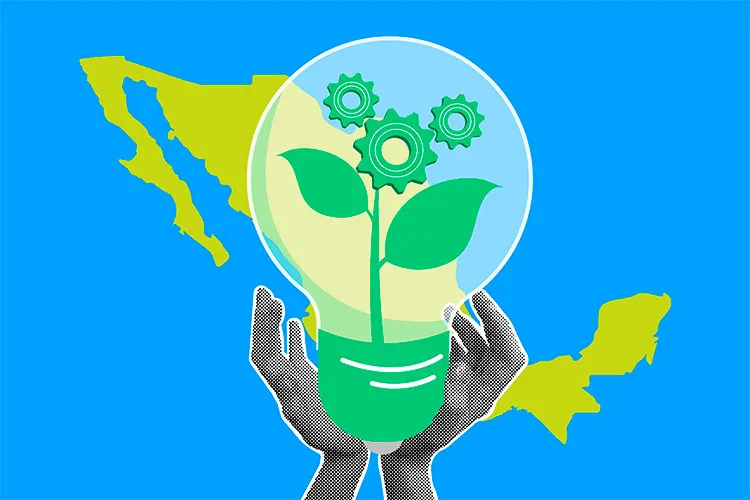

A few days ago, Mexico’s president, Claudia Sheinbaum, introduced an initiative that brings fracking back into consideration as a way to strengthen the country’s energy security in relation to the United States. According to information shared on April 15, 75% of the natural gas imported by Mexico comes from its neighboring country—a significant dependency, considering that more than 60% of the nation’s electricity is generated from this energy resource [1].
Fracking, a practice widely regarded as “controversial” and that failed to advance in Mexico more than a decade ago, has now returned to the center of the debate due to the State’s need to ensure energy security and affordability.
Before addressing the significance of this moment, it is necessary to review the origins of fracking, its expansion, and the role it has come to play in energy security.
Fracking in the contemporary context
In the energy sector, hydraulic fracturing (fracking) involves injecting a high-pressure fluid into underground rock formations to create fractures that allow access to trapped natural gas or crude oil, enabling its extraction to the surface.
This process is not new; it has been used since the 1940s in the southern United States and gained greater popularity in the 1990s thanks to new technologies, drilling designs, and telemetry equipment. In that country, the logic of exploring new energy sources emerged after the Arab oil crisis of the 1970s, when the price of a barrel of hydrocarbons rose dramatically—with increases of up to 400%—affecting the entire supply chain and economic activity. This episode highlighted the need for a clear energy policy regarding supply, consumption, and efficiency.
The global consolidation of fracking took shape in 2012, when U.S. economic activity benefited from the largest historical increase in oil production. This allowed the country to reposition itself geopolitically in relation to other oil-exporting nations such as Iran, Venezuela, and Russia [2].
The ability to achieve greater energy independence and participate as an exporter in international markets is desirable for any country’s economy. However, environmental and social consequences began to emerge in communities near these projects.
Risks of fracking
Discussing the risks of fracking remains a subject of debate. The discussion ranges from those who argue that it should be banned to those who believe it can be managed responsibly. On one hand, environmental, health, and geological impacts have, in some cases, been attributed to regulatory gaps, operational errors, and poor practices in projects that prioritized economic benefits at the expense of socio-environmental impacts.
Although time has passed and regulation has improved, concerns persist and have left a lasting mark on those who experienced them. Based on experiences over the past decade in the United States, some of the risks Mexico could face include:
- Water consumption and contamination: In Texas, for example, it is estimated that each project uses 64 million liters of water or more (only a minority use smaller amounts). If not properly treated, the water used in these processes risks being discharged into local aquifers, affecting water sources for human and wildlife use and putting health at risk.
- Geological damage: According to the Seismological Society of America, low-magnitude earthquakes in states such as Ohio, Pennsylvania, West Virginia, Oklahoma, and Texas may be linked to hydraulic fracturing in those regions. If not managed carefully, there is concern that such activity could alter a region’s seismic behavior or increase the frequency or magnitude of certain tremors.
Should Mexico engage in fracking?
The answer to this question is not straightforward, as it involves complex ethical dilemmas. While fracking may carry environmental costs, are they truly worse than those society already assumes in other extractive projects? On the other hand, if fracking is not implemented, what alternative would society accept? Would we be willing to reduce our energy consumption or invest in generating our own energy? Even if the answer were simple for an individual or a group, the Mexican context is characterized by strong polarization when discussing energy transitions.
Depending on future scenarios, there are solutions that could provide incremental progress in reducing dependence on natural gas and increasing domestic electricity generation, such as self-generation. As highlighted in discussions on prosumers, Mexican households have the potential to produce part of the energy they consume and even contribute surplus energy to the grid, helping mitigate the country’s overall energy consumption impact. This strategy is further supported by the country’s geographic location, situated within a highly favorable solar belt for photovoltaic generation.
However, regardless of the alternative chosen, all options come with both benefits and environmental impacts. Nuclear energy, for example, is one of the most promising options, yet it raises concerns regarding site selection and waste management. Additionally, unlike the speed with which hydrocarbon initiatives can be launched, many of these alternatives require longer planning timelines and face administrative and technical obstacles in their development.
What lies ahead?
For Mexico, revisiting fracking is not only a necessity but also reflects past shortcomings in planning the energy infrastructure required today. Beyond immediate political decisions, the definitions and mistakes made in energy policy today will determine whether we have energy tomorrow, at what cost, and under what conditions.
In this context, energy development cannot rest solely on decisions made by governments or companies; it is also a task rooted in the education we provide to society.
The conversation should not be limited to whether Mexico should implement fracking, but rather expanded into a systemic review of the various barriers hindering the country’s energy development: the lack of coordination among political forces to establish a common energy development agenda, incentives that do not promote the energy transition, the absence of efforts to foster energy literacy [3, 4], and even the longstanding insecurity that has discouraged or stalled investment in the sector.
If we aspire to a future with technologies and conveniences such as artificial intelligence, the internet, or air conditioning, it will be necessary to understand our role in the energy sector. This is a responsibility shared by the inhabitants of every city in relation to energy, the foundation upon which contemporary life unfolds and without which all modern activity comes to a halt.
References
https://www.iea.org/countries/mexico/electricity
https://time.com/5922/fracking-energy-boom-natural-gas-geopolitics-iran/
https://link.springer.com/article/10.1007/s11191-025-00657-w
https://www.tandfonline.com/doi/epdf/10.1080/13504622.2022.2135687
https://www.inegi.org.mx/temas/educacion/
https://tecscience.tec.mx/es/divulgacion-ciencia/prosumidores-energias-renovables/
Author
Gerardo Castañeda Garza is a leader in Artificial Intelligence initiatives for Education at the Institute for the Future of Education (IFE) at Tecnológico de Monterrey. He holds a PhD in Educational Innovation from Tecnológico de Monterrey and is a member of Mexico’s National System of Researchers (SNI). He has collaborated on national and international projects, including as a researcher in energy literacy at the Binational Laboratory for the Intelligent Management of Energy Sustainability and Technological Training (CONACYT-SENER).