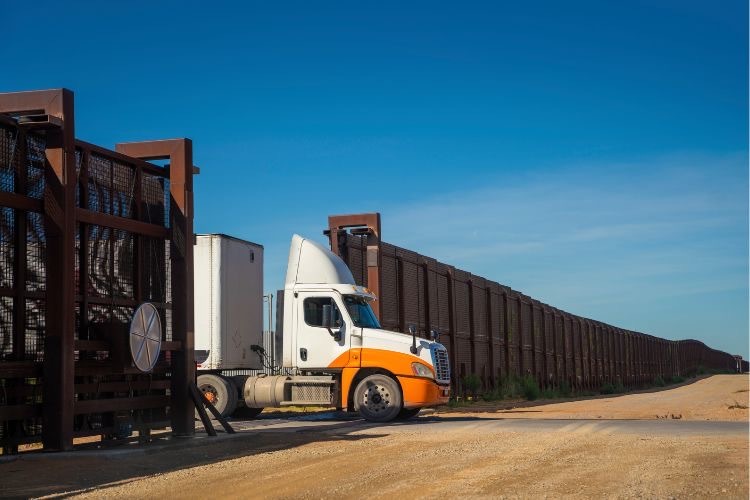


The number of freight truck crossings from Mexico into the United States rose from 5.5 million to 7.4 million annually between 2015 and 2023, an increase of 32.9%. However, despite the growth in cross-border trade, exporting companies faced challenges such as cargo truck theft on Mexican highways.
René Cabral and Eduardo Saucedo, researchers at Tecnológico de Monterrey’s EGADE Business School, along with André Mollick of the University of Texas Rio Grande Valley (UTRGV), analyzed border-crossing data and cargo truck theft records over that period to explore the potential relationship between these crimes and the flow of freight transportation into the United States.
“This affects the supply chain for all this production, as well as other companies involved in these exports,” Saucedo says. “It undermines the competitiveness of the Mexican market and Mexican exports. Essentially, it represents an additional cost that companies have to bear.”
After examining records using publicly available data from both countries, the researchers found a negative association between cargo truck theft and the flow of goods into the United States.
Cargo Truck Theft Far From the Border and Its Effects on Trade
Among the study’s main findings, the researchers observed that higher numbers of cargo truck thefts nationwide were associated with a trend toward fewer truck crossings into the United States.
The researchers estimated that a 1% increase in the national cargo truck theft rate was associated with an approximately 0.76% decrease in border crossings.
They found a similar relationship when examining thefts reported in border states, but no statistically significant evidence of such a relationship in the municipalities where border crossings are located.
“To our surprise, because we expected the risk to be greater closer to the border crossing, we actually found that crime at the municipal level, in the areas closest to the crossing, was not statistically significant,” Cabral explains. “It is in the states just south of the border states where we see a significant impact on truck crossings.”
However, the researcher notes that the findings do not establish how many additional trucks would have crossed into the United States if thefts had been reduced, since trade flows also depend on other factors, such as economic activity in both countries and demand for goods.
“Although crime has a negative impact, that does not necessarily mean trucks stop crossing the border. They may simply take a different route,” he adds.
Researchers Examine the Relationship Between Cargo Truck Theft and Trade
The researchers used data from the Bureau of Transportation Statistics (BTS), an agency of the U.S. Department of Transportation that tracks the number of trucks entering the country through 20 border crossings.
They also examined approximately 30 crime-related variables, including homicides and thefts in general. However, they found that cargo truck theft was the variable showing a statistically significant association with border crossings, meaning that the relationship was unlikely to be explained by chance alone.
“What we were primarily looking for was whether an impact existed, rather than its magnitude, because ultimately all models have limitations in their predictive power,” Cabral explains. “What we can identify is when the negative effects of crime on border crossings begin to emerge and when they do not.”
They compared this information with cargo truck theft records from Mexico’s Executive Secretariat of the National Public Security System between 2015 and 2023. Before 2015, a different methodology was used to record and classify crimes, while 2023 was the most recent year for which complete data were available when the research was conducted.
The team analyzed the data at the national, state, and municipal levels to determine whether the relationship varied depending on where the crimes occurred.
Although the researchers were able to identify which border crossings trucks used to enter the United States, they did not have information about where the goods originated or which routes the trucks followed through Mexico. Another limitation of the study is that, while the records indicate that a theft occurred, they do not specify whether part of the merchandise, the entire shipment, or even the truck itself was stolen.
The Challenge of Protecting Trade Routes to the United States
For Cabral, evidence generated by this type of research can help inform more targeted security strategies, not only in border states but also in other regions of Mexico where cargo truck theft has been found to have a stronger association with trade flows into the United States.
“We need security policies focused on those regions where crime tends to be more widespread and have a greater impact,” the researcher says.
Eduardo Saucedo notes that these crimes can also increase costs, undermine companies’ competitiveness, and even affect the prices of their products. With this in mind, he suggests taking a closer look at periods when security conditions improved to identify strategies that may have helped protect freight transportation.
He adds that insecurity can affect perceptions of Mexico as a destination for foreign investment, particularly among multinational companies that use the country as a manufacturing hub.
“It is important for Mexico to improve its international image when it comes to violence, so that we do not send the message that it is a serious problem in the country that ultimately affects our ability to attract foreign investment,” Saucedo says. “There are domestic factors we can address to make our country more competitive.”
Were you interested in this story? Do you want to publish it? Contact our content editor to learn more marianaleonm@tec.mx.