

Picture two patients. The first arrives at the clinic with a Body Mass Index (BMI) of 33 (clinically obese) but with normal triglycerides, glucose levels, and blood pressure. The second is a lean 38-year-old presenting with diabetes, fatty liver disease, and a history of heart attacks.
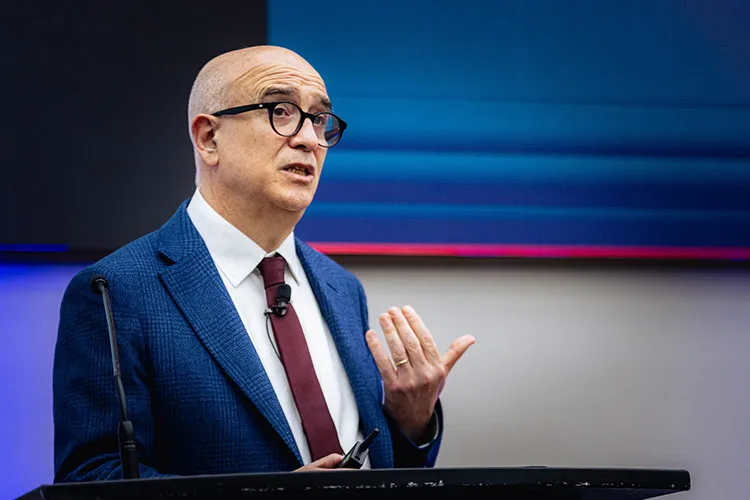
Antonio Vidal-Puig, professor of molecular nutrition and metabolism at the University of Cambridge, used these two cases to illustrate the current problem in how we treat obesity during his conference at the International Congress on Obesity Research in the Institute for Obesity Research (IOR) of Tec de Monterrey.
His research has found that weight or BMI are poor measurements of metabolic health because they fail to capture metabolic flexibility, one of the earliest signs of metabolic dysfunction. “Today’s BMI is not a good indicator of metabolic risk,” said Vidal-Puig. “You need to look at more functional aspects that go beyond waist circumference.”
The doctor has spent years studying how fat is stored in the body. During his conference, he explained that the process begins in adipose tissue, which has the ability to expand to accommodate more fat. When this organ reaches its limit, lipids start migrating to other organs like the liver, heart, or pancreas, often with serious and irreversible consequences.
How much fat the body can store is largely dictated by genetics and varies from person to person. “Not everyone can become obese even if they tried,” he said during his talk. “There’s a limit, and when you reach it, you’re becoming metabolically very unwell.”
But it’s not just about how much fat they store or where, but something much harder to measure: the body’s ability to adapt. This is called metabolic flexibility, and, according to Vidal-Puig, its deterioration is the first sign that something is wrong, appearing well before a conventional diagnosis could catch it.

Why BMI is a poor predictor of metabolic health
Metabolic flexibility is the body’s ability to efficiently alternate between burning fat and burning sugar, depending on what’s available. In evolutionary terms, this fluctuation allowed humans to survive in different environments. A metabolically flexible body can use the resources that are available. An inflexible one gets stuck using the same fuel, regardless of what their needs might be at that moment.
In a healthy person, that flexibility oscillates constantly throughout the day. After a meal, the metabolism starts burning carbohydrates. At night, with no food coming in, it switches to burning fat. In an obese patient, that oscillation slows down.
“At night, they don’t register that it should be burning lipids, so they can’t use them correctly,” said Vidal-Puig in an interview with TecScience. “During the day, when they’re eating, they also can’t process carbohydrates efficiently.”
This doesn’t always lead to visible symptoms, which is why his team is developing tools to detect metabolic risk before any outward signs of disease appear.
Building a genetic map of metabolic dysfunction
To measure this oscillation, Vidal-Puig’s laboratory uses indirect calorimetry, a technique that measures the oxygen consumed and the carbon dioxide produced by the body to determine, in real time, the type of fuel it’s burning.
The difference between the daily maximum and minimum is what his team calls the metabolic flexibility index. This measurement, unlike BMI, reflects how the metabolism is functioning.
Currently, they’re building the first genetic map of metabolic inflexibility, analyzing more than 1,500 mouse lines to identify the genes that determine how each individual processes different nutrients.
“We want to identify the genetic factors that will determine how a person uses carbohydrates or lipids,” explained Vidal-Puig. “People who have issues with those genes will have difficulties using those nutrients in the right way.”
The liver as the first line of defense
Understanding metabolic flexibility also means rethinking how we interpret conditions like fatty liver disease. When the adipose tissue reaches its limit, the liver steps in as a backup, storing excess fat to protect the rest of the body.
Many people carry fat in their liver without any complications. The problem occurs when that mechanism is pushed too far, triggering inflammation, fibrosis, and, in severe cases, cirrhosis or pancreatic cancer.
“Ideally, your liver helps you,” he said, “but you can’t abuse it too much because eventually it will get angry.” The progression of organ damage tends to follow a sequence—first, adipose tissue; then, the liver and muscle; and finally, the beta cells of the pancreas.
“You can reverse fat in the liver and you can reverse fat in the muscle,” he explained. “But pancreatic cells don’t defend themselves well against fat. You could lose them.”
This means that a fatty liver is not just a symptom but a sign that a person’s metabolic function has been deteriorating for some time.

A problem that plays out differently across populations
That redistribution doesn’t happen the same way in every person or population. Part of Vidal-Puig’s research focuses on understanding why different groups respond differently to obesity.
In Asia, people develop severe metabolic complications at BMI levels that are considered normal in other contexts. In Mexico, the prevalence of complications is disproportionately high relative to obesity rates, suggesting that there are genetic and environmental factors at play that doctors have yet to fully understand.
His pitch is to move beyond BMI toward an assessment that includes lipid distribution, the state of metabolic organs, and functional markers like metabolic flexibility. In populations where BMI is a particularly weak predictor, that shift could make a meaningful difference.
“Being obese and metabolically healthy is a real condition,” he warned in his conference, “but it’s an unstable intermediate state. Don’t ignore it. It’s an opportunity for prevention.”
The limits of Ozempic
These limitations also shape how Vidal-Puig views the rise of GLP-1 drugs such as semaglutide. His emphasis on prevention is especially relevant in a moment when GLP-1 medicines, like semaglutide, are redefining obesity treatment. Vidal-Puig worries that their success is overlooking fundamental scientific questions.
The problem isn’t that these drugs work, but that we don’t fully understand why, and that gap limits medicine’s ability to anticipate and prevent complications rather than simply managing them.
“If you don’t have a fundamental understanding of how these mechanisms work,” he warned, “when something goes wrong, you don’t know where to start.”
For the researcher, losing weight without recovering metabolic flexibility may not be enough. The real question isn’t whether patients can lose weight, but whether the body regains its ability to efficiently adapt to different fuel sources.
That’s essentially the bet his laboratory is making: in the future, medicine may treat obesity not as a number on a scale but as a complex system that fails differently in each person—and one whose warning signs can be detected early if we know where to look.
Were you interested in this story? Do you want to publish it? Contact our content editor to learn more marianaleonm@tec.mx.