
By Rosa Leonor González-Díaz and Iván Luzardo-Ocampo
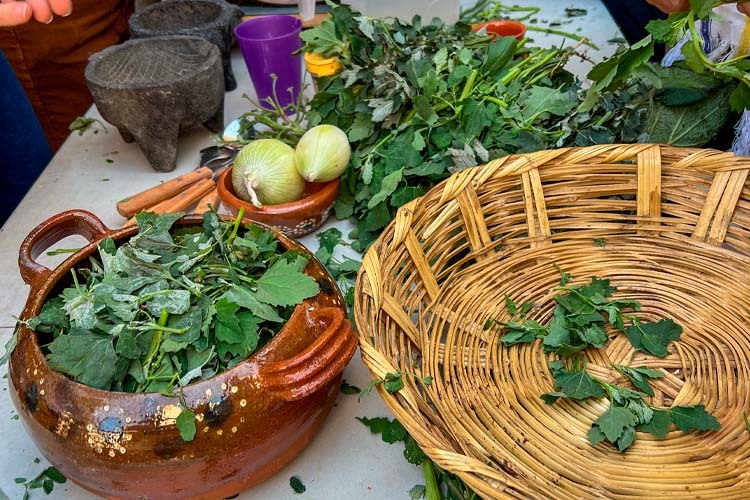
Across Mexico, rural communities make use of more than 500 species of edible plants. Among the most important are quelites — traditional greens with remarkable nutritional value and growing potential to support more climate-resilient agricultural systems.
The word quelite comes from the Nahuatl term quilitl, used to describe the tender leaves, stems, and flowers of edible plants [1]. Revered since pre-Hispanic times, these greens served as a vital food source during periods of winter scarcity.
Their long-standing use has made them central to the identity of many communities. Beyond their role in everyday diets, quelites are deeply tied to cultural traditions, festivities, artistic expressions, and medicinal practices.
Today, they are recognized not only as part of Mexico’s culinary heritage but also as a natural strategy for food security, environmental adaptation, and biodiversity conservation.
Recent research has highlighted the potential health benefits of quelites and their value as a sustainable food source capable of strengthening food security through nutrient-rich crops with a low environmental footprint [2,3].
Quelites encompass a wide range of wild and semi-cultivated species that can thrive in diverse environments, including home gardens and the edges of agricultural fields.
Bioactive Compounds in Quelites
For generations, quelites were a staple of daily diets across Mexico. Yet their consumption has steadily declined as industrial agriculture shifted toward crops considered more commercially strategic.
These plants provide meaningful amounts of protein, carbohydrates — including dietary fiber — healthy fats, minerals, and vitamins.
They also contain smaller but equally important bioactive compounds, particularly polyphenols, natural substances with antioxidant properties. These compounds help neutralize free radicals, unstable molecules linked to inflammation and chronic disease when they accumulate in the body [4].
Researchers have also identified flavonoids and other secondary metabolites — plant-produced compounds associated with anti-inflammatory and antimicrobial effects.
At the Healthy Foods Unit of the Obesity Research Institute at Tecnológico de Monterrey, scientists have identified a broad range of these compounds in the leaves and flower clusters of several quelites, including huauzontle (Chenopodium berlandieri). Some of these flavonols have shown antioxidant activity even greater than that reported in amaranth (Amaranthus spp.) or mullein (Verbascum thapsus) [5].
Studies have also documented chemoprotective effects against human colon cancer cells in vitro linked to compounds found in other widely consumed quelites, such as chaya leaves (Cnidoscolus aconitifolius) and pápalo (Porophyllum ruderale), both common throughout Mexico and Latin America [6].
These findings are particularly significant because quelites are locally available, affordable, and nutritionally dense foods capable of complementing diets increasingly dominated by ultra-processed products.
Sustainable Agriculture
Many quelite species are naturally adapted to challenging environmental conditions. They can grow in nutrient-poor soils, require relatively little water, and depend on minimal agricultural inputs.
That resilience makes them well-suited for sustainable farming practices. Unlike intensive monocultures, quelites promote agrobiodiversity and help improve soil structure.
As native species, they also hold a major advantage: greater adaptability to regional climate conditions and environmental shifts.
This aligns with international recommendations that encourage the diversification of traditional crops as a strategy to confront both food insecurity and climate change [7].
Research increasingly shows that quelites are far more than simple “wild greens.” They represent an important reservoir of nutrients and could become strategic allies in the transition toward healthier diets and more sustainable agricultural systems [9,10].
The erosion of dietary diversity reflects the gradual disappearance of quelites from everyday meals, at a time when most plant-based calories worldwide come primarily from corn, rice, and wheat. Reviving traditional crops, therefore, means investing in more diverse diets while also strengthening local economies.
.
Main references
- Vargas-Madriz, A. F., Luzardo-Ocampo, I., Moreno-Celis, U., Roldán-Pradrón, O., Chávez-Servín, J. L., Vergara-Castañeda, H. A., Martínez-Pacheco, M., Mejía, C., García-Gasca, T., & Kuri-García, A. (2023). Comparison of phytochemical composition and untargeted metabolomic analysis of an extract from Cnidoscolus aconitifolius (Mill.) I. I. Johns and Porophyllum ruderale (Jacq.) Cass and biological cytotoxic and antiproliferative activity in vitro. Plants, 12(10), 1987.
- Vargas-Madriz, A. F., Kuri-García, A. F., Luzardo-Ocampo, I., Vargas-Madriz, H., Pérez-Ramíez, I. F., Anaya-Loyola, M. A., Ferriz-Martínez, R. A., Roldán-Padrón, O., Hernández-Sandoval, L., Guzmán-Maldonado, S. H., & Chávez-Servín, J. L. (2023). Impact of drying process on the phenolic profile and antioxidant capacity of raw and boiled leaves and inflorescences of Chenopodium berlandieri ssp. Berlandieri.Molecules, 28(20), 7235.
Extra sources
- A. Balcázar-Quiñones, L. White-Olascoaga, C. Chávez-Mejía, y C. Zepeda-Gómez, “Los quelites: riqueza de especies y conocimiento tradicional en la comunidad otomí de San Pedro Arriba, Temoaya, Estado de México”, Polibotánica, vol. 0, n.o 49, pp. 219-242, 2020.
- M. González-Elizondo, H. Ávila-González, N. L. Piedra, A. Castro Castro, S. M. Gonzalez-Elizondo, y U. Luna, “Quelites Del Gran Nayar, Un Acercamiento”, Revista Etnobiología, vol. 22, n.o 3, pp. 24-45, 2023.
- P. Severiano-Pérez et al., “Quelites Pasados of the Sierra Tarahumara, Chihuahua, Mexico: An Interdisciplinary Ethnobotanical Study of Leafy Green Vegetables”, Economic Botany, vol. 77, n.o 4, pp. 433-454, 2023.
- L. Mateos-Maces, J. L. Chávez-Servia, A. M. Vera-Guzmán, E. N. Aquino-Bolaños, J. E. Alba-Jiménez, y B. B. Villagómez-González, “Edible leafy plants from Mexico as sources of antioxidant compounds, and their nutritional, nutraceutical and antimicrobial potential: A review”, Antioxidants, vol. 9, n.o 6, pp. 1-24, 2020.
- Á. F. Vargas-Madriz et al., “Impact of Drying Process on the Phenolic Profile and Antioxidant Capacity of Raw and Boiled Leaves and Inflorescences of Chenopodium berlandieri ssp. berlandieri”, Molecules, vol. 28, n.o 20, p. 7235, Oct. 2023.
- Á. F. Vargas-Madriz et al., “Comparison of phytochemical composition and untargeted metabolomic analysis of an extract from Cnidoscolus aconitifolius (Mill.) I. I. Johnst and Porophyllum ruderale (Jacq.) Cass. and biological cytotoxic and antiproliferative activity in vitro”, Plants, vol. 12, n.o 10, p. 1987, may 2023.
- FAO, “Aumentar la diversidad alimentaria en medio de la crisis climática”, 2023.
- P. Das, P. Ch. Nath, R. Singh, y Y. K. Mohanta, “Recent advances in extrusion technology for plant-based meat analogues: composition, development, and challenges”, European Food Research and Technology, vol. 252, n.o 28, pp. 1-21, 2026.
- Y. Rivera-Hernández, I. Salgado-Escobar, S. Valle-Guadarrama, E. Cedillo-Portugal, y D. Guerra-Ramírez, “Evaluation of Nutritional Profile and Effect of Heat Treatment on Nutraceutical Potential of Suyuquelite (Ipomoea dumosa) Leaves”, Plant Foods for Human Nutrition, vol. 80, n.o 4, pp. 1-7, 202.
- [R. Ebel, F. D. Menalled, J. P. Morales Payán, G. Maria Baldinelli, L. Berríos Ortiz, y J. Ariel Castillo Cocom, “Quelites- Agrobiodiversity beyond our crops”, Elementa, vol. 12, n.o 1, pp. 1-26, 2024.
.
Authors
Rosa Leonor González Díaz. Professor at the School of Engineering and Sciences at Tecnológico de Monterrey. Her research focuses on the valorization of agro-industrial waste and the development of biotechnological strategies to obtain value-added compounds for health and environmental applications.
Iván Luzardo-Ocampo. Research professor at the School of Engineering and Sciences and the Obesity Research Institute at Tecnológico de Monterrey, Guadalajara campus. His work explores the impact of cereals, legumes, and Mexican plants on inflammation, obesity, and cancer through the lens of bioengineering and functional nutrition.