

In the world of 3D food printing, achieving complex formulations that are truly nutritious is no easy feat. Most researchers only use two or three ingredients. A team of Mexican researchers has demonstrated that it is possible to print real food.
In their study, titled Evaluation of rheology and printability of 3D printing nutritious food with complex formulations, the experts designed mixtures with up to nine ingredients, intended to meet the nutritional requirements of children.
“There’s no reason to limit ourselves in the number of ingredients we can use for printing,” explains Rubén Maldonado, PhD in biotechnology from the School of Engineering and Sciences (EIC) at Tec de Monterrey and first author of the article.
Their research represents a major advance in this emerging field and has therefore been awarded the 2025 Rómulo Garza Award in the Published Scientific Article category.

In conventional 3D printing, materials—plastics, resins, or metals—are designed to flow and solidify under regulated conditions, but food is a biological system that is more difficult to control.
For this reason, for years, studies have simplified the problem by using minimal mixtures containing two or three ingredients, such as water and a protein concentrate, for example.
“When we talk about what really constitutes food, we should consider its nutritional value, that it contains protein and fiber, not just carbohydrates,” points out Viridana Tejada, a research professor from the Department of Bioengineering at EIC and co-author of the study.
The article is part of a line of research that Tejada began in 2020 after being awarded the L’Oréal Fellowship for Women in Science.
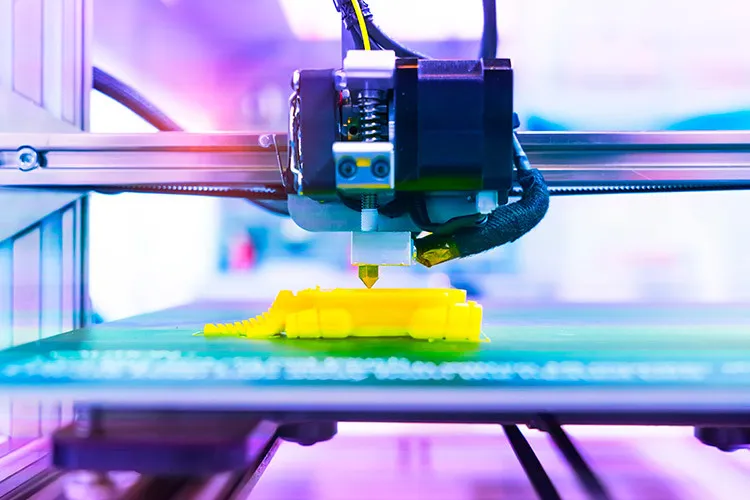
3D Food Printing
To print complex formulations, the researchers varied the concentration of pregelatinized corn starch and the printing temperature, finding the ideal parameters for these two variables.
“The formulations become so complex due to the interaction between all the ingredients that it’s almost impossible to print them,” says Tejada.
Although it sounds simple, it’s not always possible to achieve the right consistency and shape for the printed product, preventing it from collapsing during the process or from it getting stuck in the printer head. With each added ingredient, the complexity increases.
“Foods are generally not natively printable; we realized this because they would spread and water would escape from our formulations,” says Maldonado. “We looked for a key ingredient that would help us avoid these problems.”
At the heart of the study was rheology, a branch of physics that studies the deformation and flow of matter in solid and liquid states. In 3D printing, rheology can determine whether a mixture can flow out of the printer head and maintain its structure once outside.
Until now, many studies have measured the physical properties of food, without being able to directly relate them to the final printed result.
The team managed to establish a mathematical correlation between rheological parameters and the printability of a mixture.
In their study—and in general—rheology allows for the prediction of whether a mixture will work before printing it.
“Although it’s often thought that the higher the starch concentration, the better the print quality, that’s not necessarily the case,” explains Maldonado.
Their finding breaks with one of the most widespread assumptions in the industry: that increasing viscosity is enough to improve printing. In reality, what matters is finding the perfect balance between fluidity and rigidity.
Customizable Foods
According to the researchers, the advantage of 3D printing, instead of mixing ingredients and pouring them into molds, is the possibility of customization.
In their vision, everyone could have a 3D printer at home in the future. “That’s what we should expect: that you buy your nutritious mix at the supermarket, like pancake mix, add water, and let it print,” the expert explains.
Printing food opens up the possibility of designing snacks that taste good but are also nutritious for hospital patients, seniors with swallowing difficulties, or children with specific nutritional needs.
Currently, most snacks that are printed or sold in stores contain ingredients like sugar, glucose syrup, gelatin, artificial flavorings, vegetable waxes, or colorings, so they can’t really be called food.
Furthermore, printing allows for the use of sustainable ingredients, such as fruit peels, which are currently considered waste.
In the study, they used amaranth leaves, fruit pulp, cacao, sugar, and cricket protein, for example. The result was a paste with a pleasant flavor.
The idea is to continue along the same lines so that eventually anyone can print food.
“Fifty years ago, it was unthinkable that everyone would have a microwave, but today we all have one with a popcorn button,” Tejada reflects. “That means someone calculated the power and time needed to pop them.”
To reach this futuristic scenario, it is essential to understand how food behaves when used as a material.
“My vision is something similar to the replicator in Star Trek: a device capable of manufacturing personalized food on demand,” Maldonado concludes.
Did you find this story interesting? Would you like to publish it? Contact our content editor for more information: marianaleonm@tec.mx