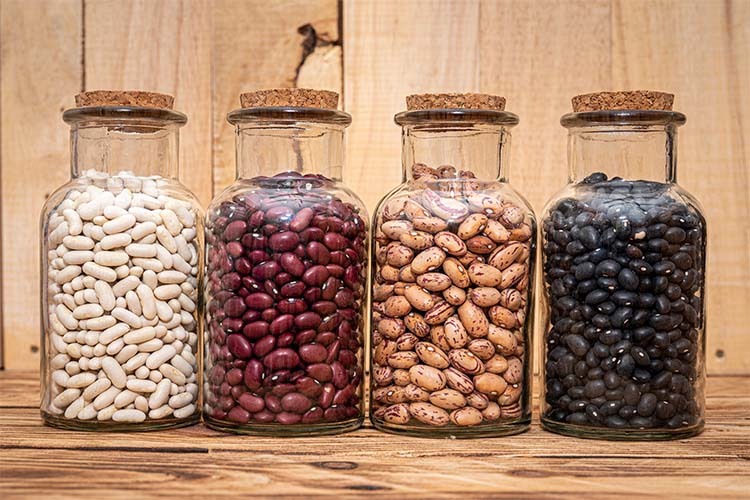


When we see a bag of beans at the market, we rarely remember that they are alive. Dry and seemingly inert, the seeds aren’t exactly what we imagine when we think of an organism. For decades, science echoed this idea, assuming that their metabolism was virtually halted after harvesting.
A new study challenges this by showing that, even when dry, common bean seeds maintain their biological activity, allowing them not only to retain their vitamin B9 reserves, but to increase them.
“We are demonstrating that, at least, this metabolic pathway remains active,” says Rocío Díaz de la Garza, a research professor at the Institute for Obesity Research (IOR) of Tecnológico de Monterrey. “We are breaking a paradigm.”
The research focused on a simple question, but one with major implications: what happens to folates —the different forms of vitamin B9— while beans are stored?
In cereals such as corn, rice, and wheat, previous studies had documented that this vitamin degrades during storage, but in legumes, that story hadn’t been studied as much.
To answer this, a group of researchers analyzed three commercial varieties of common bean under different combinations of temperature and humidity.
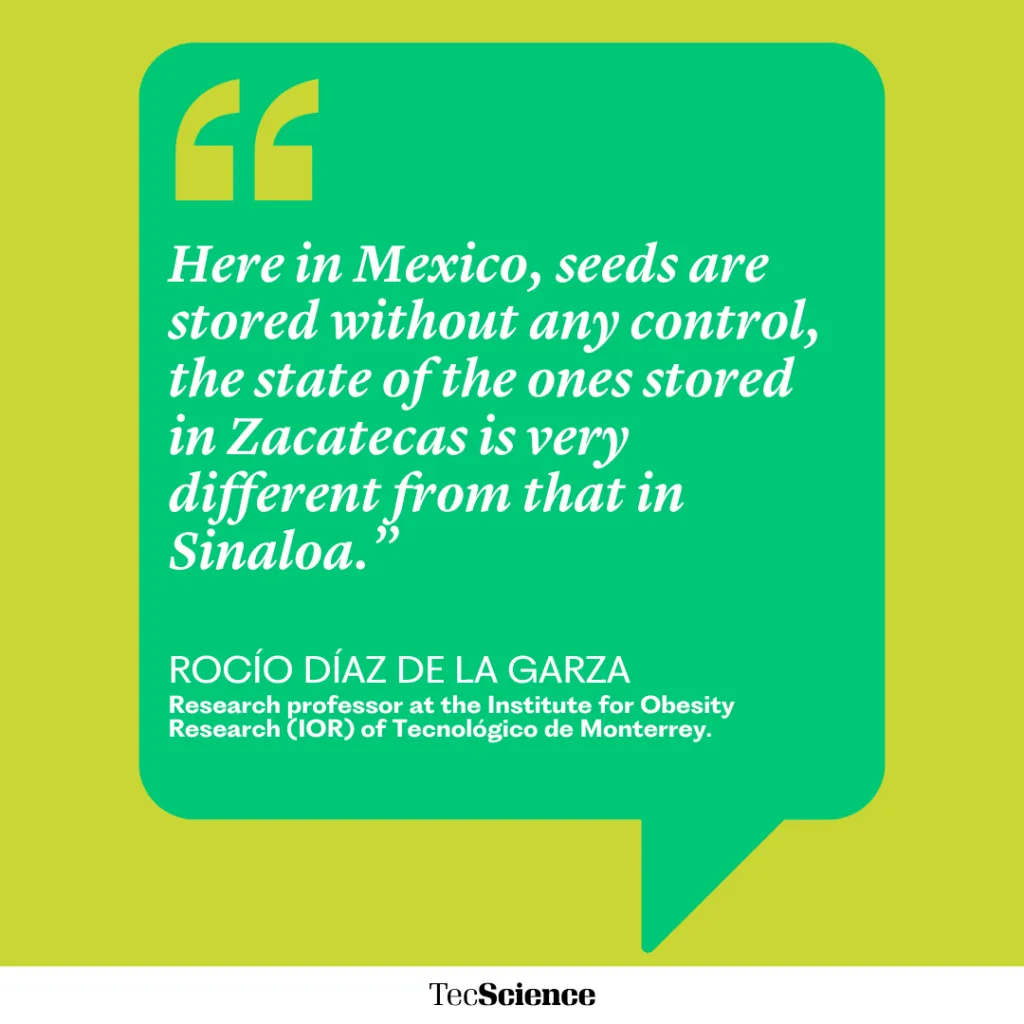
“What happens in real life is that the beans are harvested, dried, and stored until the buyer arrives,” says Díaz de la Garza. “Here in Mexico, seeds are stored without any control, the state of the ones stored in Zacatecas is very different from that in Sinaloa.”
What Happens to a Stored Bean Seed?
During the research —which includes Itzel Aviña’s doctoral thesis and Arturo Tlelo’s master’s thesis— the team stored grains of three varieties of beans for six months, varying the temperature and humidity.
Throughout this process, the team quantified the content of folates and their chemical precursors, measured proteins and amino acids, and performed transcriptomic analyses to identify the genes that remained active during storage.
“We modeled four different situations to see what happens when it is hot and humid, when it is dry, or when it is colder,” Díaz de la Garza recalls.
The results surprised the researchers: although the folate content decreased during the first month, under storage conditions of 15°C and 55% relative humidity it began to recover, exceeding initial levels after 180 days. Depending on the variety, the increase ranged from 36 to 48%.
“After thirty days, folate levels start to drop and then increase, so that was a shock,” the expert explains.
After repeating the experiments and carrying out the necessary controls, the idea that what they were observing was a mistake disappeared.
Gene expression analyses revealed beyond doubt that the activity of several genes responsible for the biosynthesis, transport, and stabilization of folates increased.
At the same time, they observed an increase in more stable forms of this vitamin, suggesting that the seeds not only produce it, but also preserve it during storage.
However, this gene activation did not occur throughout the entire metabolism. While folate levels increased, other pathways, protein levels, and amino acids decreased.

Possible Applications of a Shifting Paradigm
During the experiments and various measurements, a possible explanation emerged: some genes related to the synthesis of purines —molecules that are part of DNA— and to the cell cycle, which are essential for future cell division, were activated.
According to the authors, it appears that the seeds may be accumulating folate reserves in preparation for germination, even before coming into contact with water.
“This vitamin is very important because it is needed for cell division,” explains Díaz de la Garza. “All organisms need it, from bacteria to plants to yeast; vertebrates cannot synthesize it, so our main source is plants.”
Thus, the study challenges one of the most deeply rooted paradigms in plant biology: that dry seeds are metabolically inactive or asleep when we store them.
With their results, the researchers are fostering new opportunities to improve food conservation, preserve its nutritional value, and develop biofortification strategies in food crops.
“These are lines of research that could be initiated,” says Díaz de la Garza. “We are opening a window that can impact both agriculture and human nutrition.”
Did you find this story interesting? Would you like to publish it? Contact our content editor to learn more: marianaleonm@tec.mx