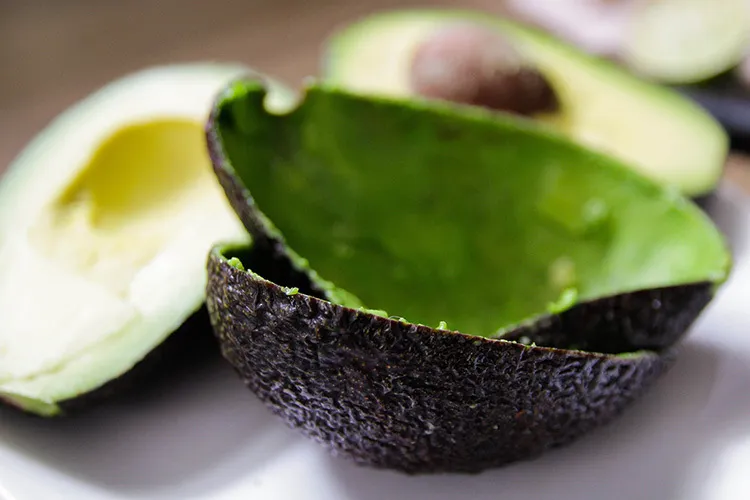


Jalisco is Mexico’s second-largest avocado producer, harvesting around 400,000 metric tons each year. But alongside that production, large quantities of peels and pits are discarded during the processing of avocado products such as pulp and oil.
To make use of this waste, researchers at Tecnológico de Monterrey’s Guadalajara campus are developing a functional ingredient through the comprehensive valorization of avocado peel, with a focus on harnessing its fiber.
The team is also exploring the benefits of other bioactive compounds that could be incorporated into foods such as beverages, breads, and cookies, explains Verónica Rodríguez, a researcher with the flagship Food Security & Nutrition project at the School of Engineering and Sciences (EIC) at Tecnológico de Monterrey.
“What is considered waste by one industry can become a raw material for us. It’s a byproduct that still has untapped potential and can be transformed into something with added value,” says Rodríguez, who also serves as director of the graduate programs in Biotechnology.
The research team is currently validating a prototype that will allow the resulting ingredient to be incorporated into food products using conventional technologies, helping keep production costs from increasing.
Waste Is Not Always Waste
The first step, Rodríguez says, is to stop thinking of avocado peel as waste or garbage. Instead, it should be recognized as a byproduct, since it still contains valuable compounds that can be reintroduced into the food supply through circular economy processes.
Through the project Avocado Byproducts: Transformation for Sustainable Food Innovation, the research team secured seed funding in a Tecnológico de Monterrey innovation challenge and received support from the Jalisco State Council for Science and Technology (COECyTJAL) to advance technologies with strong potential for transfer to industry.
With that goal in mind, the researchers aim to develop a functional ingredient that not only retains the dietary fiber found in avocado peel but also preserves as much as possible of its minerals, including potassium and magnesium, vitamins E and C, and bioactive compounds such as polyphenols and flavonoids, which are known for their antioxidant, antimicrobial, and anti-inflammatory properties.
Preserving these valuable compounds has become one of the project’s main challenges, leading the team to optimize a process that stabilizes the byproduct while retaining as much of its fiber as possible.
Reuse Techniques for a Circular Economy
The process begins by drying the avocado peel through convection drying, a method that uses hot air to remove moisture and stabilize the material.
“Our goal is to optimize that process so the peel retains as many bioactive compounds as possible,” Rodríguez explains. “The fiber remains largely unchanged, but antioxidant compounds are heat-sensitive and can be lost during drying.”
Although other methods, such as freeze-drying, are available, they significantly increase production costs. Instead, the researchers aim to use conventional drying technology that is already widely available in many food processing facilities.
Once the peel has been dried, the researchers grind it into a powder and use ultrasound-assisted extraction to obtain the compounds needed to produce the functional ingredient. This technique relies on high-frequency sound waves to break down the plant tissue, making it easier to release the fiber and other bioactive compounds.
To separate those compounds, the team uses solvents such as water or ethanol, which are more environmentally friendly alternatives that help reduce the use of chemicals commonly employed in conventional extraction methods.
“Many of these extraction processes are not considered green because they rely on organic solvents that are often difficult to recover or reuse, creating environmental pollution,” Rodríguez says. “A circular economy is not just about making use of a resource—it’s also about minimizing our environmental impact throughout the process.”
Using these extracts, the researchers are formulating the functional ingredient and testing different ways to incorporate it into food products to determine where it best preserves its beneficial properties while remaining appealing to consumers.

Nutrition and Consumer Appeal in Ice Cream and Beverages
The team is currently exploring two application pathways. The first focuses on solid foods, such as breads and cookies, while the second targets beverages, where the ingredient could be incorporated without affecting the product’s key characteristics.
To obtain the raw materials used in their research, the scientists have partnered with private-sector organizations in Jalisco, including Agrícola Isgua and the Jalisco Avocado Growers Association. Together, they have explored the possibility of sourcing byproducts not only from avocado processing facilities but also directly from farms.
Rodríguez has collaborated on the project with fellow researchers from the Food and Biotech group, which specializes in waste valorization, including Luis Eduardo García, Tomás García, Viridiana Tejada, and Danay Carrillo, as well as graduate students Mayra Ramírez and Ricardo Montiel.
The project is currently in the validation stage (TRL 2), where the team is working to identify formulations that strike the best balance between nutritional value, stability, and consumer acceptance. One of the key challenges is ensuring that the ingredient can be incorporated into foods without introducing undesirable flavors or other sensory characteristics.
“So far, it appears we haven’t encountered any negative effects, but we still haven’t conducted consumer testing,” Rodríguez says. “I believe it has strong potential—not only in baked goods, but also as an ingredient in ice cream and beverages, where we want to increase fiber content.”
Were you interested in this story? Do you want to publish it? Contact our content editor to learn more marianaleonm@tec.mx