
By Carolina Ramírez Martínez and Alberto Ordaz Cortés
A biotechnological process may work flawlessly in a 250-milliliter flask or a 2-liter bioreactor, but replicating it in a 50,000-liter industrial system presents monumental challenges.
Although scientific breakthroughs are born in Petri dishes and laboratory flasks within university labs, most never reach real-world industrial application.
The reason lies in the challenge of executing science at an industrial scale. Many biotech companies succeed in raising funds to advance their technologies, only to fail because of operational shortcomings and weak business models [1].
To rescue this knowledge from the so-called “valley of death” and prevent industrial failure, techno-economic analysis (TEA) has become an essential navigation tool.
A TEA begins with a mass and energy balance: it calculates how much raw material, water, and energy a process requires, as well as how much product it can generate. From there, researchers can estimate production costs, resource consumption, and commercial feasibility.
At the same time, TEA provides the methodological framework to anticipate three fatal mistakes repeatedly identified in the industry: 1) failing to understand manufacturing costs at scale, 2) targeting low-margin markets —such as biofuels, which account for 56.7% of failures— and 3) overestimating how much consumers are willing to pay a “green premium.”
In short, techno-economic analysis integrates financial indicators that translate experimental data into potentially viable projects with a clear business outlook.
Science vs. Business
An investor does not ask the same questions as a scientist. The question is not whether microorganisms can grow, but how much it costs to make them produce at an industrial scale.
One example is the study Economic and technical insights into carotenoids and lipids large-scale production in Rhodotorula glutinis: A study based on pulse-feeding culture, cell disruption strategies and cytotoxicity, which evaluates the technical and economic feasibility of a biotechnological process for the large-scale production of carotenoids and lipids —compounds used in the food, cosmetics, pharmaceutical, and biofuel industries— through the oleaginous yeast Rhodotorula glutinis [2].
The research suggests that R. glutinis could become a more sustainable alternative to traditional sources because it requires less agricultural land and can make use of industrial waste and byproducts.
The TEA revealed that downstream processing —particularly the cell disruption stage required to release lipids and carotenoids for purification— is one of the most critical bottlenecks in the process. Without this type of evaluation, researchers could spend years optimizing fermentation conditions without realizing that extraction and purification costs ultimately make the final product commercially unfeasible.
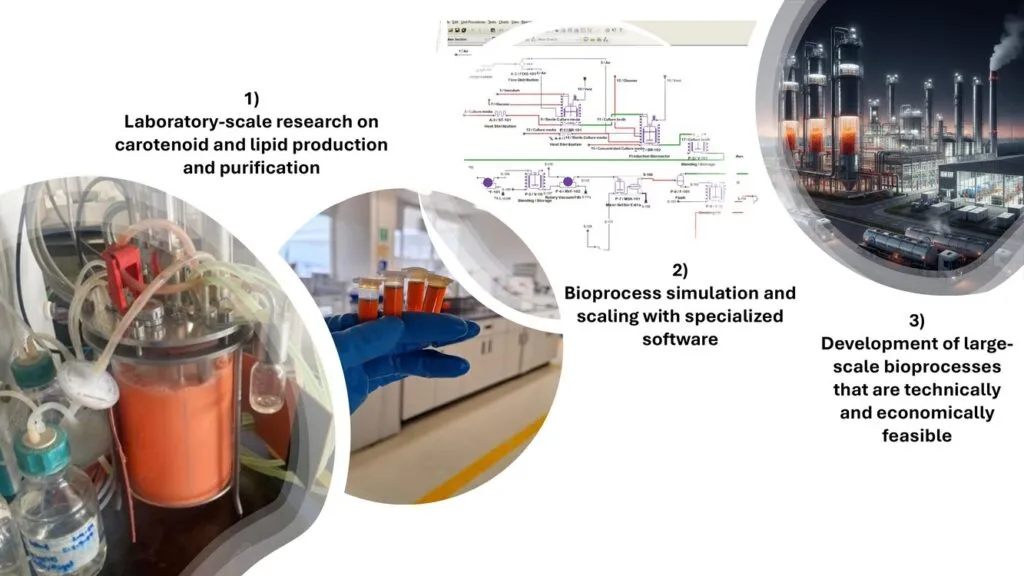
Tools like SuperPro Designer function as virtual laboratories, allowing researchers to model an entire industrial plant before laying a single brick. However, they are not “black boxes” that generate random numbers; their power lies in technical precision [3].
In the case of the yeast Rhodotorula glutinis, the simulation made it possible to achieve:
- Reality-based scale-up and design. Scaling up is not simply about making a laboratory experiment larger. Simulation translates the yeast’s performance into specific tank and equipment sizes, ensuring the plant can physically process every kilogram of raw material.
- A detailed map of costs and process flows. By calculating precise mass and energy balances, researchers can determine how much water, electricity, and steam are consumed for every gram of carotenoid produced, identifying the “hot spots” where the process consumes the most resources.
- Financial rigor. Beyond simple profit estimates, the simulator generates a discounted cash flow analysis. This makes it possible to calculate key investor metrics such as Net Present Value (NPV) and Internal Rate of Return (IRR), which reveal whether the project can truly generate long-term value after accounting for taxes and depreciation.
From the Flask to the Factory
In science, uncertainty is the only constant. By using simulators, researchers can perform sensitivity analysis —a type of stress test that helps safeguard projects against potential risks. In the case of carotenoid production using Rhodotorula glutinis, these tools can provide data-driven answers to questions such as:
- Can the economy withstand market changes? What happens to profitability if substrate prices increase by 20%?
- What if the yeast underperforms? Does the project remain viable if lipid production drops under stress conditions?
- What is the optimal selling price, and how sensitive is it to fluctuations in production output?
- How efficient is the separation process? How do changes in purification efficiency affect the project’s final financial indicators?
These insights —grounded in the integration of process engineering and economics— are key to reducing perceived risk.
By demonstrating that every variable has been considered, from exact batch processing times to the environmental impact of waste streams, researchers can transform a laboratory concept into a genuine business opportunity.
References
- Samaranayake, E. (2025, November 24). Turning the Industrial Biomanufacturing Graveyard Into a Winning Playbook. Better Bioeconomy.
- C. Ramírez-Martínez, S. Rincón, A. Zepeda, A. Ordaz. Economic and technical insights into carotenoids and lipids large-scale production in Rhodotorula glutinis: A study based on pulse-feeding culture, cell disruption strategies and cytotoxicity, Process Biochemistry 161 (2026) 112–125.
- J.S. Aranda-Barradas, C. Guerrero-Barajas, A. Ordaz. Addressing Challenges in Large-Scale Bioprocess Simulations: A Circular Economy Approach Using SuperPro Designer, Processes 2025, Vol. 13, Page 2259 13 (2025) 2259.
.
Authors
Carolina Ramírez Martínez. Professor in the Department of Bioengineering at the School of Engineering and Sciences at Tecnológico de Monterrey. She is a Ph.D. candidate in Biotechnology Sciences and has authored four Scopus-indexed publications.
Alberto Ordaz Cortés. Research professor in the Department of Bioengineering and a member of the Water 360 research group at the School of Engineering and Sciences at Tecnológico de Monterrey. He has 49 scientific publications indexed in Scopus and is a Level 1 member of Mexico’s National System of Researchers.