

In Mexico, cities have doubled their populations in the last thirty years and are expanding at an accelerated pace. At the same time, they are experiencing massive population loss in their city centers. This had been speculated about for years, but it had not been possible to demonstrate it with evidence —until now.
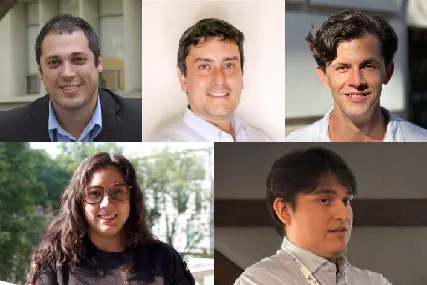
“It’s not just that metropolitan areas have grown in the peripheries, but also that the people who used to live in the centers have been expelled,” says Gonzalo Peraza, a researcher at the Center for the Future of Cities (CFC) and associate professor at the School of Government and Public Transformation (EGobiernoyTP) of Tecnológico de Monterrey.
In a recent study published in Nature Communications, Peraza and a group of researchers found that between 1990 and 2020, the urban centers of 69 metropolitan areas in the country lost around 2.5 million inhabitants and moved to intermediate and peripheral areas.
The collaboration between the CFC and the Complexity Science Hub in Austria showed that this loss can be observed in cities of different sizes and characteristics, even when their overall population increases.
This directly impacts the quality of life of those who inhabit them.
Some of the effects include longer commute times, increased greenhouse gas emissions, and a decline in mental health due to traffic.
“When you look at the demographics, it makes you think what we’re doing is pointless,” says Roberto Ponce, research director at the CFC and leader of the project. “We’ve invested so many resources in city centers and we’re abandoning them to go to the outskirts, where there are no services.”
The Math Behind How Mexican Cities Have Grown
To demonstrate this, the researchers built a spatial database of 69 Mexican metropolitan areas from the population and housing censuses of the National Institute of Statistics and Geography (INEGI) of 1990, 2000, 2010, and 2020.
“We designed a data flow that allowed us to fix the geometric alignment errors,” Peraza explains.
Next, they divided the maps into a grid of cells approximately 470 by 470 meters, like a chessboard superimposed on the territory. This allowed them to stop viewing the cities solely as a collection of municipalities or administrative areas and instead observe how the population was distributed within it.
They established their historical founding point as the center and calculated how far each cell was from that point, organizing the territory into concentric rings to measure the distance to the center.
In order to compare huge cities, such as Mexico City, with small ones, such as Zamora, Michoacán, they used sophisticated mathematics to compress or expand the population of each of the cities and assume a simulated population of one million inhabitants.
“Once they all have this hypothetical population, you can see where the gain is and where the loss is,” explains Rafael Prieto, a researcher at the Complexity Science Hub.
Thus, they were able to distinguish between the effect of a city simply being bigger and a real change in the way its population was distributed.
Finally, they compared these distributions across different years and calculated how much the population had shifted outwards. They called this indicator the urban expansion factor.
The Impacts of the Great Loss
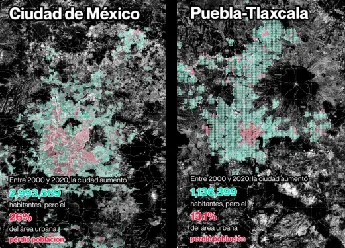
What they found was surprising to the researchers involved: every city analyzed had lost population in the center.
In 1990, more than 40% of the urban population lived in central areas. By 2020, that proportion had fallen to 22%, creating larger and denser cities, but poorly located—89% of the new population lives in distant or peripheral areas.
“In some cases they lose thousands of people, in others hundreds of thousands,” says Rodolfo Figueroa, a data scientist at the CFC.
Although the discovery may not sound so shocking, its important to consider that this is a universal loss throughout the entire country and that it happened despite each city having different governments.
“We had different political parties, different mayors, different governors, and yet it happened,” Prieto reflects. “There was no invisible hand; we simply let the demographics of a country happen.”
Although the study’s objective was solely to diagnose the problem, the authors point out that this large loss has negative repercussions: more and more people are living far from central areas, increasing the distances they must travel daily to go to work, school, or the doctor.
“People travel almost 30% more to get to the centers,” says Eugen Reséndiz, fellow of the CFC and research professor at the School of Architecture, Art and Design (EAAD) of Tec de Monterrey.
This increased need to travel has a direct impact on traffic, the saturation of public transport systems, the mental health of the population due to having to spend so much time in transit, and greenhouse gas emissions from motor vehicles.
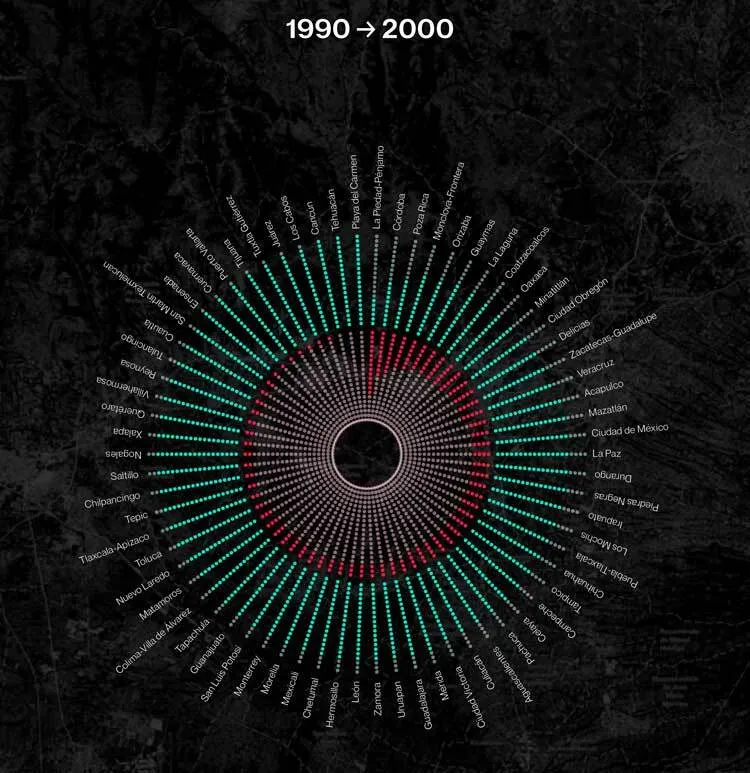
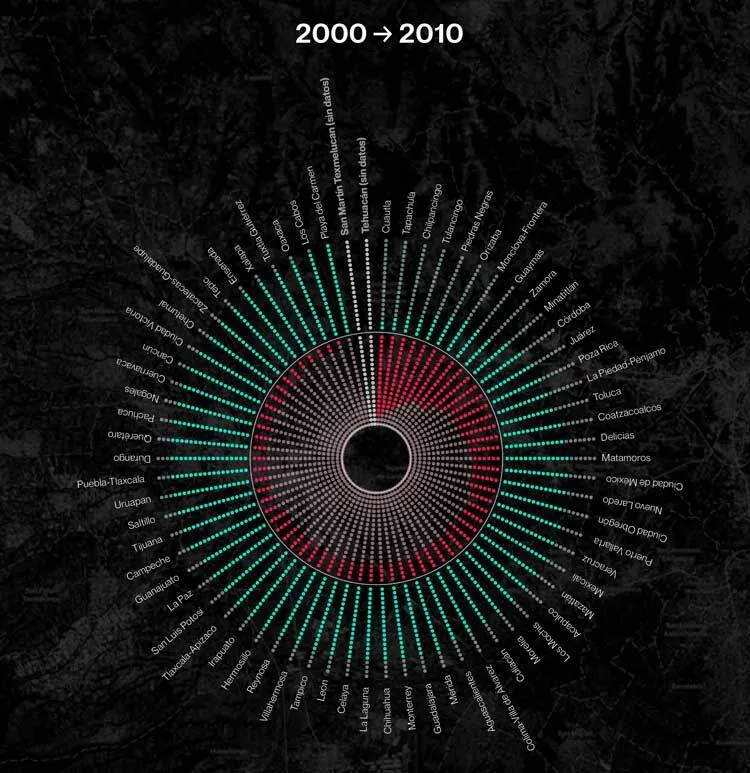
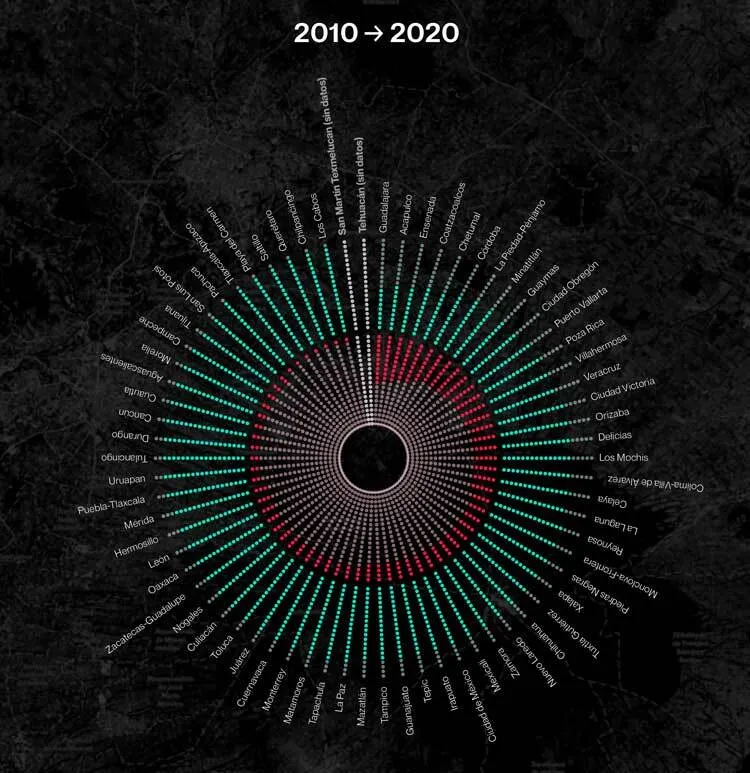
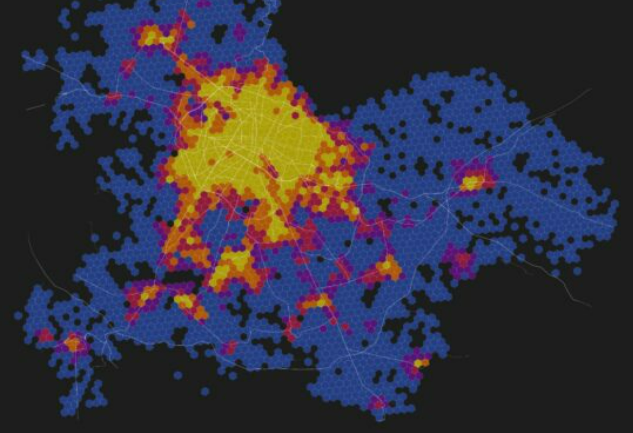
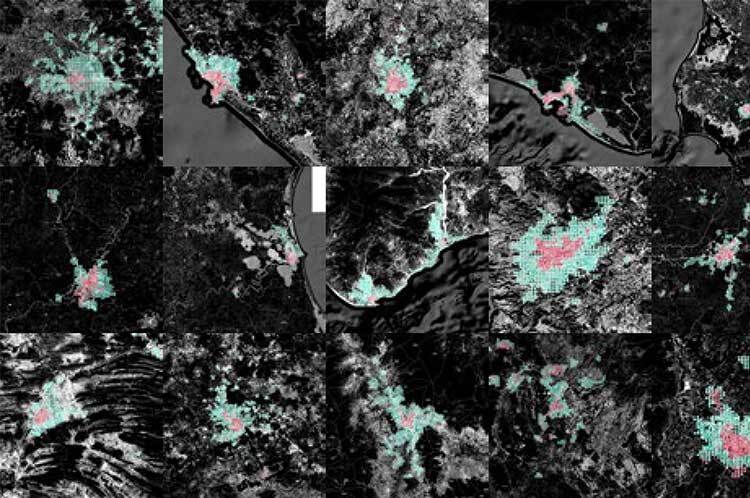
Each graph depicts the evolution of 69 Mexican cities per decade. Red marks population loss in urban centers; green marks growth in the outskirts. Source: Center for the Future of Cities and Complexity Science Hub.
The Rich Periphery and the Poor Periphery
Another consequence is that city centers become less safe, as they are full during the day with people who work there, but empty at night because no one lives there.
Resources are also wasted there. Bringing infrastructure and services to the peripheries is more expensive and complicated, which makes it difficult to guarantee them, greatly affecting the most vulnerable.
“The people who end up being expelled from the centers are the ones who work there,” says Reséndiz.
Experts also point out that the expansion of cities has created two peripheries: the rich one and the poor one.
In wealthy areas, the main impact of this phenomenon is the increase in travel times. In poor areas it is compounded by insecurity and the lack of basic services such as drinking water, drainage, electricity and public transport.
“In Chalco, for example, the possibility of having water is almost zero and there is a terrible absence of government,” Prieto points out.
There is also a loss of contact with cultural activities due to the distance from historical centers. “When we look at where the museums are, almost none of them are in the peripheries,” says Reséndiz.
Thus, the researchers argue that the loss of population in city centers is a problem that must be addressed urgently so that the pattern does not repeat itself in the following decades.
“Al permitir que la población se concentre en las zonas centrales, se consigue que las ciudades sean menos funcionales y eficientes”, añade Peraza.
The Possible Causes of this Loss
The loss of population in the centers may sound like a natural occurrence that simply happened, but researchers argue that some of the causes could have been avoided.
One of the main factors was the change in housing policies in Mexico during the nineties, which allowed the sale of ejido lands where the land was cheaper, but further away.
“There is something intrinsic that is failing in our urban models,” Ponce points out.
Another cause—probably the most important—was the lack of affordable housing in city centers. For decades, living there has been very expensive, regardless of a person’s income level.
Reforms to financing agencies allowed private companies to build large amounts of housing in the outskirts, where it is cheaper to buy a house or apartment, or to rent.
“Housing affordability is the most important issue to address,” says Peraza. “But I also think that no one really understands how the current housing market works.”
In addition, factors such as the exponential increase in car purchases, the changing population pyramid, and the lack of a public policy for urban densification contribute to the problem. Researchers suggest that these processes may reinforce each other and lead to a redistribution of the population to more remote areas.
How to Stop the Population Decline in City Centers
Knowing that Mexico is losing population in city centers and recognizing that this is a bad thing is essential to stopping the trend.
“Without a diagnosis, there are no next steps,” Prieto points out. “We must understand this as something negative, a process that shouldn’t be happening.”
The researchers contribute to this not only by publishing the article, but also by using this same information to develop the Centering the Future (Centrar el Futuro) platform, where decision-makers and citizens can consult the information, presented didactically.
Some of the possible solutions include promoting more compact cities and preventing urban growth from continuing to spread uncontrollably towards the peripheries.
To achieve this, they propose coordinating housing, transportation, and economic development policies so that new housing and opportunities are not concentrated solely in increasingly distant areas. The goal would be to maintain existing population density and make better use of already established urban areas.
“This does not depend on the will of a single actor; it is a game of incentives in which a number of actors participate,” says Ponce.
Three of the political and economic instruments that could help the most are land use regulation, tax incentives, and infrastructure projects to develop other areas in cities with good infrastructure, services, and job opportunities, which relieves pressure on land values in the central areas.
This could allow buildings and homes in the city center to be recnverted and regenerated, inviting people to return.
“Cities don’t have to be condemned to a future of pollution, suburbs, cars, honking horns, and traffic,” Prieto concludes. “Instead, let’s think about what we want Mexico to be like by 2050.”
Did you find this story interesting? Would you like to publish it? Contact our content editor for more information: marianaleonm@tec.mx