

When talking about democracy, elections, or political institutions, the discussion is generally around data at the national level. However, this approach can mask important political differences between smaller territories within the same country.
That is one of the problems that the Subnational Politics Project (SPP), an initiative that gathers and systematizes data on subnational political institutions in Latin America and makes it available to researchers, students, journalists and organizations to facilitate its analysis and comparison over time, seeks to address.
The SPP is led by Agustina Giraudy, a distinguished visiting professor at the School of Social Sciences and Government (ECSG) of Tecnológico de Monterrey, has a group of researchers and students.
The project, its progress and potential were presented and discussed during the Subnational Politics Project panel, held during the 4th Latin American Congress of Social Sciences and Government.
The conversation was moderated by Giraudy and included the participation of Alejandro Poiré, distinguished professor at the School of Government and Public Transformation (EgobiernoyTP) of Tec de Monterrey; Felipe Botero, Director of Political Science and Global Studies at the University of the Andes, Colombia; Gustavo Fajardo, principal economist in the Socioeconomic Research Department at the Development Bank of Latin America and the Caribbean (CAF); and Francisco Urdinez, professor at the Institute of Political Science of the Catholic University of Chile. principal economist
“Anyone who does subnational research knows how difficult it is to access this type of data, especially if you want to look at it comparatively,” Giraudy said.

Understanding the Political Depth of Each State and Province
A subnational institution is a government unit that operates below the national level. In federal countries like Mexico, Brazil, and Argentina, these are primarily states and provinces, which have their own authorities, legislatures, and political rules.
These institutions make decisions that directly affect the populations of their territories and, at the same time, may exhibit political dynamics that are different from those of the national government.
That’s why it’s important to have data on them. National averages can mask territorial differences in aspects such as electoral competition, party alternation, the composition of congresses, or the concentration of power.
The SPP seeks to make this variation visible. It currently gathers information from 87 subnational units in Argentina, Brazil, and Mexico, with historical series dating back to the 1980s.
Their platform allows users to explore around a hundred political and sociodemographic variables through maps, charts, rankings, and fact sheets for each state or province. The data can also be downloaded for independent research.
“It is a public good, that is available to everyone,” the expert said.
During the panel, Poiré highlighted the practical value of SPP for understanding political phenomena that occur at the regional level and suggested that it would be especially useful to delve deeper into even smaller units, such as municipalities, to understand how economic, demographic and social factors in each territory influence politics.
“I think we need to continue breaking it down, going to the municipalities, to the capital cities, because that’s where the regional economic, employment, demographic and demand conditions are concentrated” he said.
From Regional Analysis to New Questions About Subnational Policy
For his part, Botero considered that the SPP allows for a better study of electoral competition, representation, and the State’s capacity to respond to the needs of the population, and proposed expanding the project to more Latin American countries to facilitate regional comparisons.
“People’s problems are located in municipalities, in cities,” he said.
Fajardo emphasized that the project is useful both for academic research and for institutions working directly with subnational governments. He particularly valued the historical dimension of the data and proposed incorporating more countries and regional governments. He also noted the importance of explaining more clearly how the democracy indices are constructed to avoid misinterpretations of the results.
“The database is a reference, especially given the difficulty of obtaining electoral data for Mexico and Argentina,” the researcher said.
Finally, Urdinez explained how SPP data can be used to study phenomena that connect subnational politics with international processes, such as Chinese foreign investment in Latin America.
“There are a number of variables in the SPP that allow us to understand why some investments reach certain states and others do not,” he emphasized.

The discussion also looked to the future. The team is working to incorporate information on judicial systems, press freedom, political participation, and other dimensions of democracy, in addition to expanding the economic data. The possibility of including new countries, such as Colombia, Chile, and Peru, was also raised.
Rather than simply offering a collection of figures, the project seeks to open up new questions and ways to delve deeper into the politics that have a more direct impact on citizens’ daily lives.
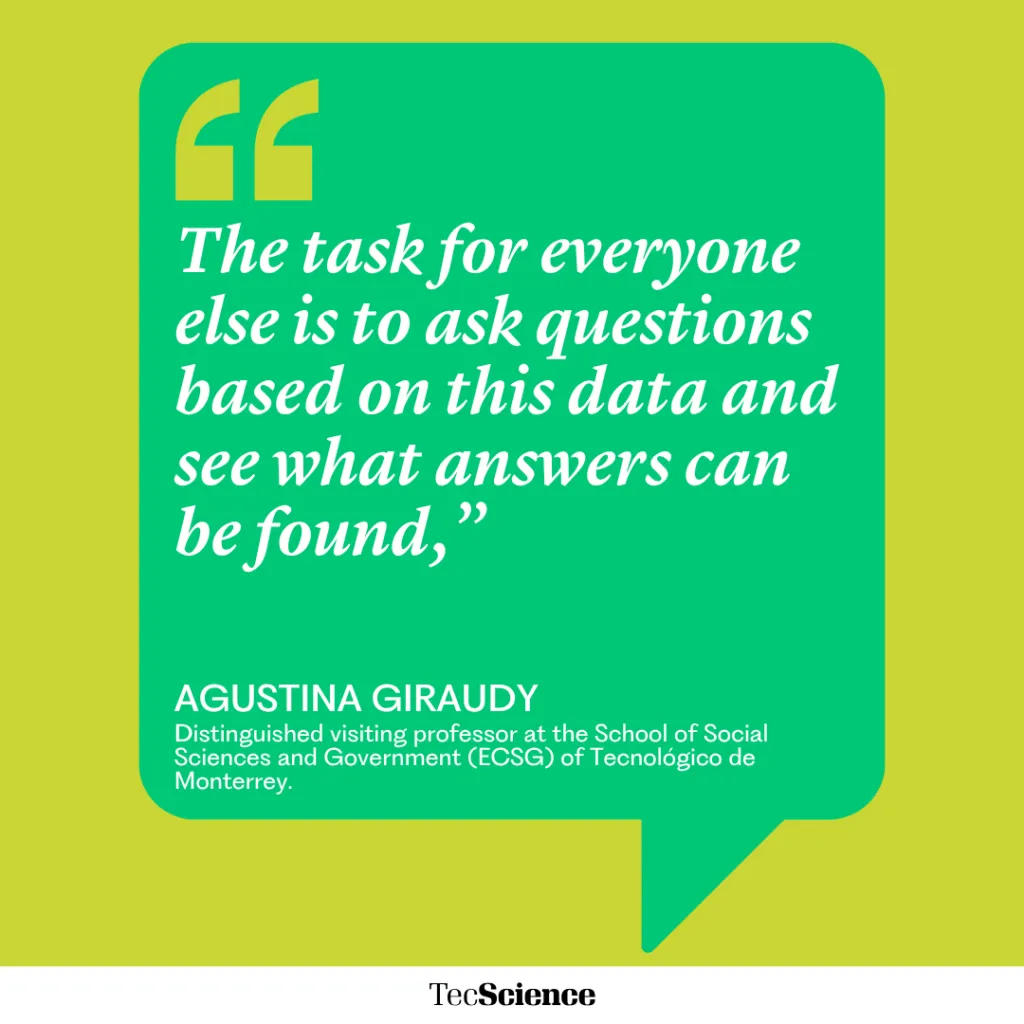
“The task for everyone else is to ask questions based on this data and see what answers can be found,” Giraudy concluded.
Did you find this story interesting? Would you like to publish it? Contact our content editor to learn more: marianaleonm@tec.mx