

For several years now, countries such as Mexico, Argentina, and Brazil have legally recognized same-sex marriage. But that recognition is not consistent across Latin America. As a result, same-sex couples may lose legal recognition of their relationship when moving to another country in the region, affecting the human and civil rights associated with marriage.
Researchers at Tecnológico de Monterrey have published a study examining the regulation of same-sex marriage in 20 Latin American countries. Their work documents a phenomenon they call “multijurisdictionality” and describes the different ways legal systems recognize this institution.
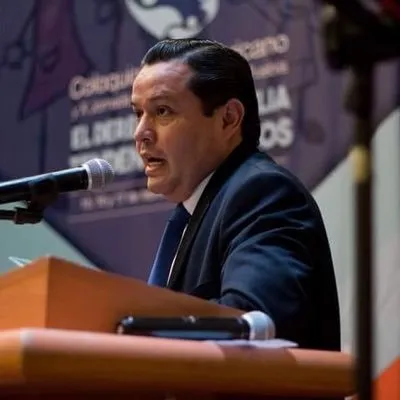
The study, titled The Multijurisdictionality of (Same-Sex) Marriage in Latin America: Heteronormativity, Sexual Orientation as a Protected Category, and Inter-American Court Standards, was conducted by Arán García and Luis Fernando Flores, researchers at the School of Social Sciences and Government on the Puebla and Querétaro campuses, respectively.
The project grew out of earlier research on same-sex marriage in Mexico, at a time when some states legally recognized it while others did not.
“We live in a globalized world,” García explains. “Once the issue was largely settled in the country, we decided to broaden our perspective to Latin America and investigate how civil, family, and human rights operate in a context of multijurisdictionality.”
Uneven Standards for Same-Sex Marriage Create Geographic Fragmentation
The researchers compared how each country defines and applies marriage, as well as the differences among their legal frameworks.
“Multijurisdictionality allows us to see how the same legal institution can be understood and regulated in different ways depending on the country,” says Flores.
As part of the study, the researchers analyzed each country’s constitutions, civil codes, and family laws. They also reviewed national court rulings and decisions issued by the Inter-American Court of Human Rights (IACHR). In 2012, following the Atala Riffo v. Chile case, the Court recognized sexual orientation as a protected category against discrimination. Later, through Advisory Opinion OC-24/17, it reinforced the principles of equality and non-discrimination for same-sex couples.
The Atala Riffo and Daughters v. Chile case became a landmark precedent for the region. In 2012, the IACHR ruled that the Chilean state had discriminated against Karen Atala by stripping her of custody of her three daughters because of her sexual orientation. The Court also found that the children themselves had been discriminated against, as authorities considered factors that would not have been taken into account in a custody dispute involving heterosexual parents.
Although countries in the region are part of the same human rights system, the implementation of these standards remains uneven, creating a form of geographic fragmentation, Flores says.
When Rights Cross Borders
The researchers also developed a statistical snapshot of Latin America to better understand how marriage functions across the region. To do so, they used marriage data from 20 countries and analyzed the number of marriages performed.
Based on this information and their review of legal frameworks, the researchers identified three groups of countries in Latin America: those that recognize same-sex marriage, those that prohibit it, and those that do not provide an explicit definition of the institution.
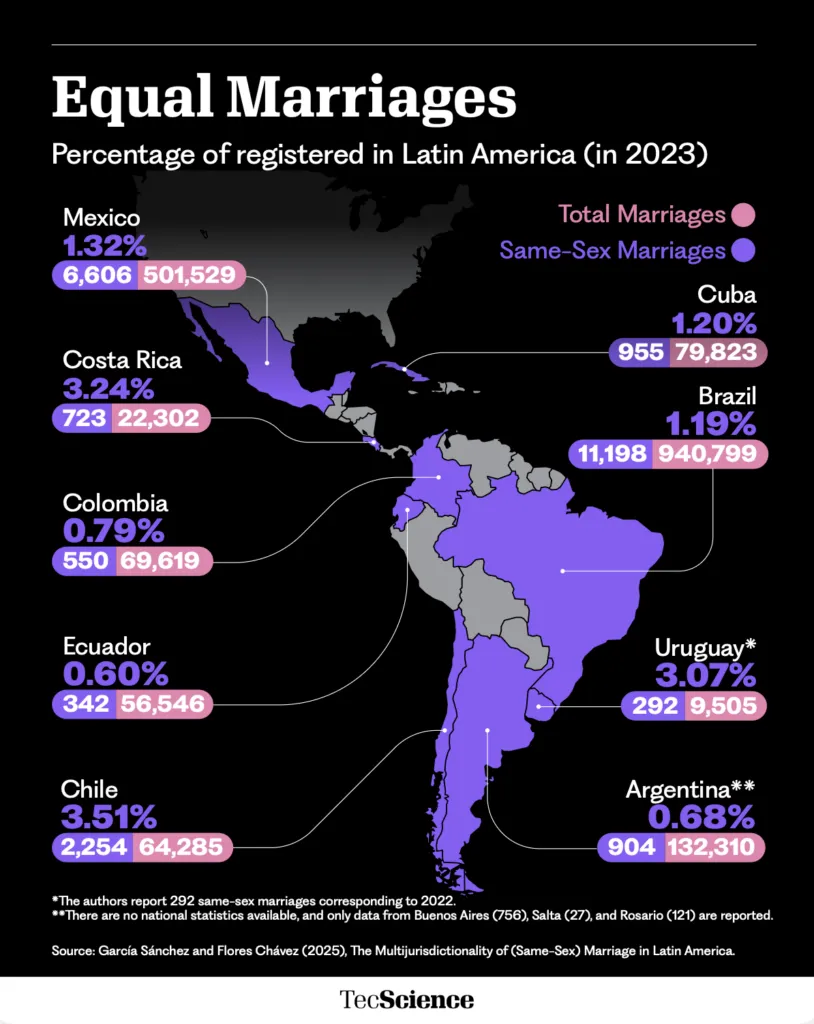
The first group consists of nine countries that fully recognize same-sex marriage and record thousands of such unions each year, including Argentina, Brazil, Chile, Colombia, Costa Rica, Cuba, Ecuador, Mexico, and Uruguay. In 2023, Brazil registered roughly 11,000 same-sex marriages, while Mexico reported more than 6,000.

A second group is made up of 10 countries that continue to impose restrictions on the legal recognition of these marriages, including El Salvador, Guatemala, Haiti, Honduras, Nicaragua, Panama, Paraguay, Peru, the Dominican Republic, and Venezuela.
The third group consists of Bolivia, a country that occupies a middle ground. Although it does not fully recognize same-sex marriage, it does provide other forms of legal partnership for same-sex couples, such as civil unions.
For the researchers, these regulatory differences are particularly significant in a region characterized by high levels of human mobility.

Ten Countries Still Present Obstacles
For example, a couple married in a country that recognizes same-sex marriage may encounter obstacles if they move to another nation where that institution does not exist or lacks the same level of legal protection. These challenges can affect the recognition of marital status, access to spousal benefits, social security coverage, inheritance rights, and even decision-making in medical emergencies.
“There are no uniform outcomes, and this legal fragmentation exists—first, in some cases within countries themselves, and in others across Latin America as a whole,” Flores explains. “It is difficult to understand why countries maintain such different regulatory approaches.”
According to the researchers, one of the main drivers of this fragmentation is the persistence of heteronormativity in Latin American legislation. In other words, marriage is still widely conceived as a union between a man and a woman and, in many cases, is closely tied to procreation.
García notes that the legal frameworks of some countries that have not recognized same-sex marriage reflect historical and traditional views of the family, shaped by cultural, religious, and moral factors.
Despite these regulatory differences, García believes the coming years could bring change through legislative reforms, political commitment, and the efforts of social actors advocating for the recognition of these rights.
Sexual orientation is already recognized as a protected category against discrimination, and rulings by the Inter-American Court of Human Rights have promoted a broader and more inclusive understanding of family. This has helped build a legal framework that supports the recognition of same-sex couples’ rights across Latin America.
“The same circumstances and conditions that unfolded in Mexico will eventually occur throughout the Latin American system,” the researcher says. “I don’t know when, and I don’t know whether I’ll live to see it, but it will happen sooner or later.”
Did you find this story interesting? Would you like to publish it? Contact our content editor for more information: marianaleonm@tec.mx