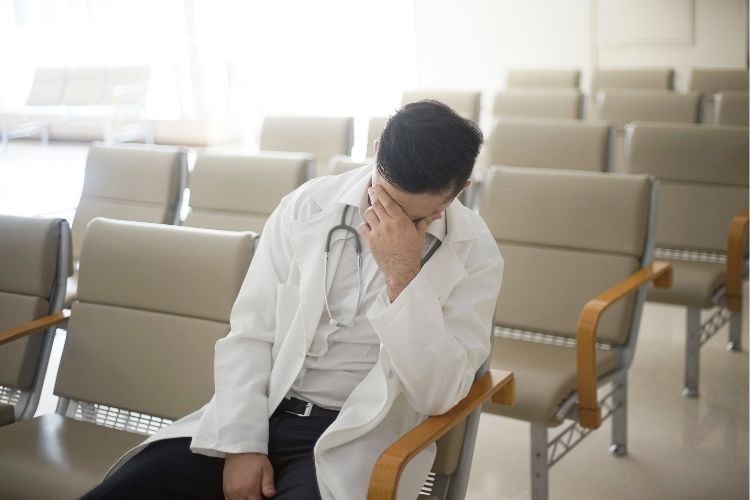


Approximately 60% of family medicine residents who participated in a study conducted in Mexico experienced some degree of depression; 16.7% reported having thoughts about death, and 7.9% said they had attempted suicide at least once. Similar research in the United States has found that suicide is one of the leading causes of death among medical residents and fellows.
During the first Bioethics Congress, organized by the Research Ethics Committee of the School of Medicine and Health Sciences (EMCS) at Tecnológico de Monterrey, medical education experts agreed that long working hours, insufficient rest, and experiences of mistreatment can take a toll on physicians’ mental health during their training and contribute to the development of burnout.
Ana Carolina Sepúlveda, dean of the Faculty of Medicine at the National Autonomous University of Mexico (UNAM), and Ramón Esperón, president of the Mexican Association of Faculties and Schools of Medicine (AMFEM), shared research findings and strategies aimed at preventing burnout and creating safer training environments. The session was moderated by Mary Ana Cordero, a research professor at EMCS and coordinator of the Wellness and Professionalism Program for Clinical Postgraduate Students.
“The goal is not to frame professional burnout as an individual failure, but rather to reflect on what we can and must change within universities, hospitals, and healthcare systems,” Sepúlveda said. “When the environment places excessive demands on people, the institutional response cannot simply be to ask them to become more resilient.”
The congress, held at Zambrano Hellion Hospital, also explored other bioethical challenges in healthcare, clinical research, and medical education, including data security and the use of artificial intelligence in therapy.

What Is Burnout and How Does It Affect Medical Residents?
The World Health Organization (WHO) recognizes burnout as an occupational phenomenon resulting from chronic workplace stress that has not been successfully managed. Although burnout is sometimes referred to as a syndrome, it is not classified as a medical condition.
Sepúlveda explained that burnout is characterized by three dimensions: exhaustion or energy depletion, increased mental distance from one’s job or negative attitudes toward work, and reduced professional effectiveness. She emphasized that burnout should not be confused with other mental health conditions, such as depression or anxiety, although they can be related and may even coexist.
The researcher also presented findings from studies she participated in examining the training conditions of medical specialists. These studies identified problems related to excessive workloads, insufficient rest, and experiences of mistreatment.
One of these studies, published in 2017 and involving 137 residents at a pediatric hospital, found that 32% reported having experienced harassment. However, when asked about specific situations, 82.4% identified experiences of mistreatment.
“The difference is highly significant; it suggests that certain practices may have become so ingrained in everyday life that they are no longer recognized as forms of violence,” she explained. “Mistreatment is not a teaching method.”
Sepúlveda clarified that her research on depression, anxiety, and mistreatment did not directly measure burnout and cannot establish causal relationships. Nevertheless, she noted that the findings help identify training and working conditions that educational institutions and hospitals should address.
Burnout Can Also Affect Patient Safety
A report by Mexico’s National Human Rights Commission (CNDH) surveyed 642 medical residents, 54% of whom reported experiencing violence from colleagues or supervisors. These experiences of mistreatment, combined with excessive workloads and long working hours, can contribute to the development of burnout.
Esperón noted that burnout not only affects residents’ health and well-being but can also pose a risk to the patients they care for during their training. He also presented findings from studies that have identified a link between burnout and a higher frequency of medical errors.
One such study found that physicians experiencing burnout may be up to 2.72 times more likely to report medical errors than those who do not experience it. “We are no longer talking solely about the impact of this problem on physicians, but also about its impact on patients.”
The researcher emphasized that these studies, along with the evidence they have generated about patient safety risks, have helped drive institutional changes aimed at promoting medical residents’ well-being and improving the safety of patient care. A study conducted in the United States found that limiting working hours to a maximum of 80 hours per week and shifts to fewer than 28 consecutive hours was associated with an 11% reduction in patient mortality.
“This clearly demonstrates how the quality of medical training in a hospital directly affects the quality of patient care,” Esperón said. “Taking care of those who care for others is also a patient safety measure.”
Preventing Burnout Among Medical Residents
To prevent burnout among medical residents, the experts agreed that it is essential to combine individual support with improvements in training and working conditions within hospitals.
To this end, Sepúlveda proposed six areas for action, including reviewing workloads and rest periods, establishing mechanisms to prevent mistreatment, strengthening educational supervision, and ensuring access to confidential psychological care. She also recommended improving coordination between universities and hospitals, as well as regularly assessing residents’ well-being and working conditions.
“A safe environment is not simply declared; it is built through sustained practices and accountability,” the researcher said.
For his part, Esperón emphasized the importance of involving institutional leaders, fostering a culture of support among healthcare professionals, and providing more flexible working conditions. He also stressed the need to facilitate access to mental health services and create environments where residents feel comfortable seeking help without fear of retaliation.
“Burnout, as an ethical issue, must shift from being an individual responsibility to an institutional one,” he said.
Did you find this story interesting? Would you like to publish it? Contact our content editor to learn more: marianaleonm@tec.mx
Related news