

In 2024, a water crisis in Mexico City affected small businesses, including restaurants, laundromats, car washes, and other establishments. Many had to invest additional resources to purchase water deliveries by tanker truck to keep operating, while others reduced or suspended their services altogether.
The situation highlighted that many micro, small, and medium-sized enterprises (MSMEs) are not prepared to respond to the impacts that climate change-related events can have on their operations.

In response to these challenges, researchers at Tecnológico de Monterrey and the National Polytechnic Institute (IPN) developed EcoEmprende, a project designed to strengthen the sustainability and resilience of MSMEs through a digital platform.
They also offer a course to help entrepreneurs identify risks, develop solutions, and prepare for the impacts of the climate crisis.

Building Capacity to Manage Climate Risks
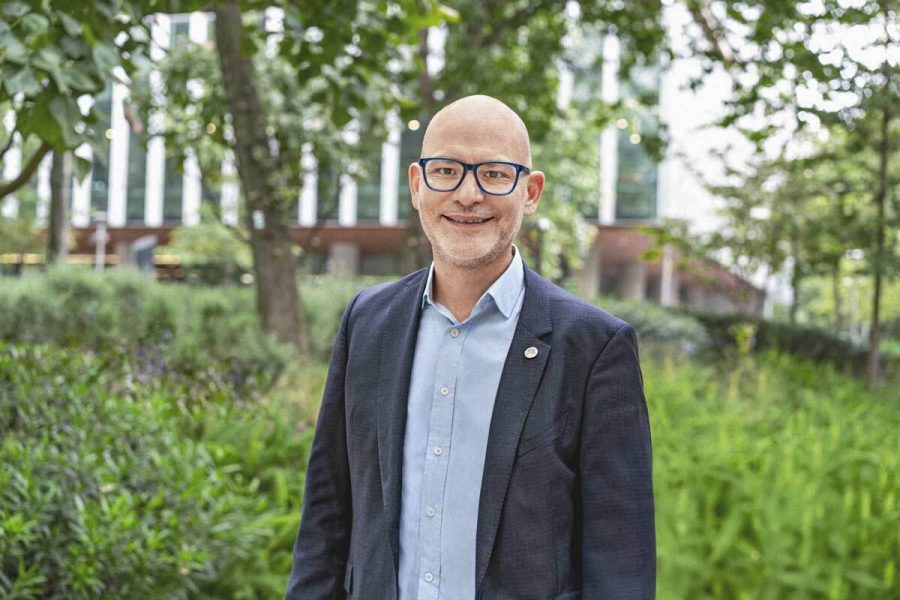
“The goal is not to tell a business exactly what to do in the face of climate change, but rather to build its capacity to identify its own risks, develop solutions, and adapt to those scenarios,” explains Leonardo Glasserman, a researcher at the Institute for the Future of Education (IFE) and the project lead at Tecnológico de Monterrey.
The project emerged from a call for proposals launched by Mexico City’s Secretariat of Education, Science, Technology, and Innovation (SECTEI), through which researchers from Tecnológico de Monterrey and the National Polytechnic Institute (IPN) designed an initiative that uses educational innovation and training to address these challenges.
EcoEmprende was one of 11 initiatives selected through the call to receive funding and be implemented in Mexico’s capital.

A Five-Stage Course for Tackling Real-World Challenges
The team brought its proposal to life by developing a self-guided digital platform where owners, entrepreneurs, and employees of micro, small, and medium-sized enterprises (MSMEs) can register, complete a course at their own pace, submit assignments, and earn a digital badge upon finishing the program.
The platform also enables instructors to track users’ progress, store supporting evidence of their work, and issue certificates. As a result, it serves not just as a content repository but as a comprehensive learning environment.
The course takes approximately 10 hours to complete and was designed to fit the schedules of people who already own or work for a business. Its methodology incorporates microlearning principles, organizing content into short learning modules while integrating personalization and self-regulated learning strategies that allow participants to progress at their own pace.
The course is organized into five stages designed to address a real-world challenge.
- The first stage is identification, in which participants learn to recognize a climate change-related challenge while building an understanding of adaptation in complex environments and the United Nations Sustainable Development Goals.
- Next comes problem investigation, where participants examine successful case studies to identify causes and consequences while engaging in reflective exercises.
- The third stage focuses on developing solutions by generating and evaluating alternatives to address the challenge.
- Participants then move on to the collaboration stage, where they share their proposals with other learners and receive feedback.
- The final stage is communicating a proposal, during which participants develop a pitch to present their ideas and solutions.
“Each participant progresses at their own pace. The course is designed to be completed gradually, and learners can always pick up where they left off,” Glasserman says. “Based on the SEL4C methodology, the course is built around core competencies such as self-regulation, leadership, self-awareness and values, as well as social innovation and sustainability.”
The researcher explains that the course was not designed to provide a single technical solution for sectors with different needs and characteristics. Instead, it enables each participant to analyze their own context and develop responses tailored to their specific circumstances.
The initiative is part of the Institute for the Future of Education’s commitment to developing educational solutions that address societal challenges. It was recognized as one of the Research Lab’s featured projects in the IFE Impact Report 2025–2026. In addition, it aligns with the institute’s Big Bold Initiative #2, which focuses on building ecosystems that foster the skills needed in today’s workforce.
Validating the Educational Model
In addition to developing the platform, the team sought to determine whether the program actually helped participants build new skills. To do so, the researchers used assessment tools before and after the course to measure the project’s impact and evaluate changes in participants’ competencies.
“We observed statistically significant improvements in participants’ self-perceived competencies related to leadership, innovation, sustainability, social awareness, and self-regulation,” the researcher notes.
These findings validated the educational model in a real-world implementation setting and enabled the project to achieve Technology Readiness Level (TRL) 7.
The project also exceeded its participation goals. The researchers initially aimed to train 1,000 entrepreneurs, but by the end of the program, 1,257 certificates had been issued. About 68% of participants came from the Mexico City Metropolitan Area, although users also enrolled from other Mexican states and even from countries such as Honduras.
The platform remains available for new users to enroll in the course. Meanwhile, interactions among participants led to the creation of the EcoEmprende Network, a community that brings together MSMEs, organizations affiliated with SECTEI, and other members of the innovation ecosystem to share challenges, experiences, best practices, and potential solutions related to sustainability and climate change.
The team is currently preparing two scientific papers: one on validating instruments for measuring social entrepreneurship and another evaluating the course and its educational outcomes. The researchers are also working on a book that documents the project’s methodology, the development of the platform, the course content, and the key lessons learned throughout the initiative.
Looking ahead, the team aims to strengthen the EcoEmprende Network and pursue new funding opportunities that will allow the project to expand into other regions of Mexico and extend the platform’s reach.
For Glasserman, initiatives such as EcoEmprende demonstrate that education can also serve as a powerful tool for strengthening businesses’ ability to respond to the increasingly frequent challenges associated with climate change. “Educational innovation should not remain confined to the classroom; it must extend beyond it and address the real problems facing society.”
Were you interested in this story? Do you want to publish it? Contact our content editor to learn more marianaleonm@tec.mx